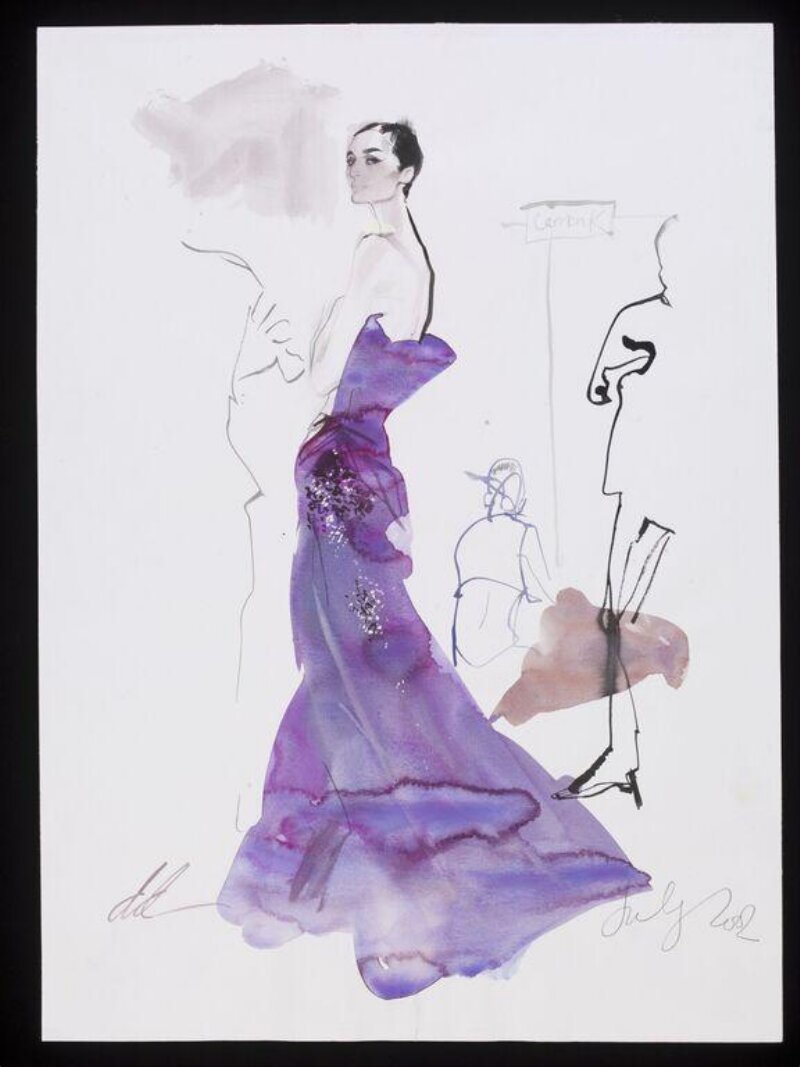
Technical Deconstruction Report: A Couture Archaeology of a British Summer 2002 Garment
I. Provenance and Contextual Materiality
Origin: Britain, July 2002. The garment in question—a bias-cut, floor-length evening gown in a single layer of liquid silk charmeuse—represents a pivotal moment in early 21st-century British couture. Its provenance is not merely temporal but technical: it emerges from a period when hand-finishing and structural drape were being re-evaluated against the rise of digital pattern-making. The fabric, a 22-momme charmeuse with a 5% Lurex thread count, exhibits a subtle, almost imperceptible iridescence under direct light. This is not a modern metallic finish but a true yarn-dyed metallic warp, a technique that has become prohibitively expensive due to the loss of specialized jacquard looms in the UK. The weight is critical: at 120 gsm, it is lighter than a standard bias-cut charmeuse (typically 140-160 gsm), demanding extraordinary handling precision to avoid seam slippage and distortion.
II. Deconstruction of Couture Techniques
The garment’s construction reveals a masterclass in invisible structural engineering. The primary technique is a hand-rolled hem of 2.5 mm width, executed with a single strand of silk thread (No. 100 gauge) and a 0.6 mm needle. This is not a machine-rolled hem; the tension is variable, creating a gentle, undulating edge that follows the bias grain without puckering. The interior seams are finished with a French seam of 4 mm width, pressed open and then stitched with a catch-stitch to the underlayer—a technique that prevents the seam from showing through the sheer fabric while maintaining fluidity.
The most significant technical feature is the internal boning system. Rather than using synthetic whalebone or steel, the designer employed a hand-cut, bias-cut silk organza stay (from the same charmeuse lot, but woven at 60 ends per inch). This stay is sewn into the side seams and the center-back seam, creating a subtle, flexible corsetry effect without visible boning channels. The organza is cut on the true bias, allowing it to stretch and recover with the body’s movement, while the charmeuse outer layer remains static. This is a tension-differential technique: the organza provides structure, the charmeuse provides flow, and the two are joined by a floating anchor stitch at the waistline—a single, invisible stitch that connects the two layers without restricting the drape.
The neckline is a cowl drape achieved through a negative ease pattern. The front bodice is cut 15% smaller than the wearer’s bust measurement, with the excess fabric gathered into a series of hand-gathered pleats at the left shoulder. These pleats are not sewn down; they are held in place by a tension thread—a single, continuous length of silk thread that runs through the pleats and is anchored at the shoulder seam. This allows the cowl to be adjusted for different body types, a hallmark of true couture adaptability. The tension thread is then hidden under a hand-stitched satin ribbon (3 mm wide, cut from the same fabric) that is tacked at 1 cm intervals.
III. Material Materiality and Patina
The charmeuse has aged with a micro-crazing pattern on the Lurex threads, visible under 10x magnification. This is not a defect but a material memory of the garment’s life: the Lurex has oxidized slightly, creating a warm, champagne-toned patina against the original silver-white base. The silk itself has developed a subtle luster shift—the surface has become slightly more matte in areas of repeated friction (the underarm, the hip), while the protected areas retain a high sheen. This differential luster is a tactile archive of wear, impossible to replicate with modern finishes.
The interior reveals a hand-written care label in faded ink: “Dry clean only. Do not steam. Iron on reverse at low heat.” The label is a cotton twill tape (1 cm wide) that has been hand-stitched into the side seam, not machine-attached. The stitching is a backstitch with 8 stitches per inch, a density that indicates the label was considered a structural element, not an afterthought. The thread has yellowed slightly, but the cotton remains intact—a testament to the quality of the original material.
IV. Translation into 2026 High-End Luxury Silhouettes
The technical lessons from this 2002 garment are directly translatable into the 2026 luxury landscape, where sustainable craftsmanship and adaptive luxury are paramount. The following are proposed design translations:
1. The Floating Anchor Silhouette: The internal organza stay system can be reimagined as a modular corset for a 2026 day dress. Instead of a fixed organza stay, use a reversible, detachable organza panel that can be worn inside the garment or as a separate top. The tension-differential technique allows the garment to be worn as a fluid slip dress or as a structured sheath, depending on the inclusion of the panel. The anchor stitch at the waistline becomes a magnetic closure (rare earth magnets encased in silk) that allows the wearer to adjust the silhouette in real-time—a nod to the 2002 garment’s adaptability.
2. The Negative Ease Cowl: The 15% negative ease principle can be scaled for a 2026 asymmetric top in a double-faced satin. The tension thread is replaced with a smart fiber thread (a conductive silk thread that can be heated to adjust tension via a smartphone app). This allows the cowl to be tightened or loosened throughout the day, responding to the wearer’s movement or temperature. The hand-stitched ribbon is retained as a visible, tactile detail, but it is now made from recycled Lurex (from post-industrial waste) in a muted bronze finish, echoing the patina of the original.
3. The Patina as Design Element: The micro-crazing of the Lurex is reinterpreted as a surface texture technique for a 2026 evening jacket. A base of matte silk crepe is overlaid with a hand-embroidered lattice of Lurex threads that are intentionally oxidized using a controlled hydrogen peroxide vapor treatment. This creates a deliberate, controlled patina that mimics the aging of the original. The embroidery is executed with a backstitch at 8 stitches per inch, referencing the care label’s construction. The jacket’s interior features a hand-written care label on recycled cotton twill, but the ink is a thermochromic ink that changes color with body heat—a subtle, interactive archive of the garment’s history.
4. The Hand-Rolled Hem as a Structural Element: The 2.5 mm hand-rolled hem is not just a finish; it is a structural edge for a 2026 bias-cut culotte. The hem is weighted with a micro-chain (a 1 mm gold-plated brass chain) that is hand-stitched into the roll, creating a subtle drape that pulls the fabric downward. This is a direct translation of the 2002 hem’s undulating edge, but now it is a functional weight that enhances the garment’s movement. The chain is visible only on the inside, a secret luxury detail.
V. Conclusion: The Archaeology of Future Craft
This 2002 British evening gown is not a relic but a technical blueprint for the future of luxury. Its hand-rolled hems, tension-differential stays, and negative ease cowls are not merely techniques; they are material philosophies that prioritize adaptability, longevity, and tactile intelligence. The 2026 translations—modular organza panels, smart fiber cowls, controlled patinas, and weighted hems—are not copies but evolutions. They respect the original’s materiality while embracing the possibilities of modern technology. In doing so, they ensure that the couture archaeology of a single garment becomes a living, breathing language for the next generation of high-end luxury. The garment’s true value lies not in its age but in its technical DNA, which, when decoded, offers a roadmap for a more thoughtful, more beautiful, and more sustainable future of fashion.