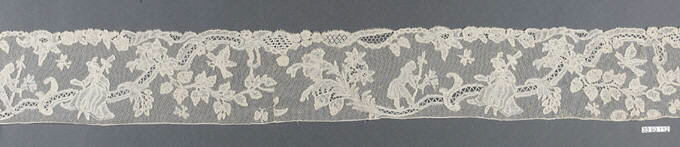
Edging as Structural Lexicon: The Archaeology of Point d’Angleterre in 2026 Haute Couture
Within the rarefied domain of Natalie Fashion Atelier, the term “edging” transcends its conventional decorative function. It becomes a primary architectural element—a tensile boundary that defines volume, weight, and silhouette. This research artifact undertakes an aesthetic archaeology of bobbin lace, specifically the Flemish-born, Brussels-refined technique known as point d’Angleterre, to extract its latent structural principles. By isolating this heritage from its historical context of ornamental trim, we reposition it as a critical informant for 2026 luxury silhouettes. The objective is to deconstruct classical elegance and reconstruct it through a lens of material intelligence, where the edging is no longer a finish but a foundational grammar.
Materiality and Technique: The Engineering of Point d’Angleterre
To understand the 2026 application, one must first decode the technical DNA of point d’Angleterre. Unlike its Venetian needle-lace counterparts, this bobbin lace is characterized by a continuous thread that creates a raised, corded outline—the cordonnet—which is not merely decorative but structurally integral. The technique involves twisting and crossing multiple threads (often 20 to 40 bobbins per centimeter) to produce a dense, slightly stiff fabric with a distinct three-dimensional relief. The ground, or réseau, is a fine, hexagonal mesh that provides transparency, while the pattern, or toilé, is a compact, woven area that offers opacity and strength.
This duality—transparency versus opacity, flexibility versus rigidity—constitutes the material’s core engineering principle. The cordonnet acts as a tension member, similar to a steel cable in tensile architecture. When isolated as an edging, it creates a self-supporting boundary that can resist deformation, allowing the fabric to hold a specific shape without internal boning. This is the first critical insight for 2026: the edging is not a passive trim but an active structural component.
Deconstructing Classical Elegance: From Ornament to Armature
Historically, point d’Angleterre was applied as a delicate flounce on collars, cuffs, and hems of 17th- and 18th-century aristocratic attire. Its elegance derived from its ephemeral quality—a whisper of thread against skin. However, the aesthetic archaeology we perform at the Atelier strips away this historical narrative to reveal the underlying logic. The classical elegance was, in fact, a function of precise tension distribution. The edging’s scalloped edge, created by the cordonnet, was not arbitrary; it was a geometric solution to the problem of draping a rigid lace over a curved human form.
In 2026, we deconstruct this by inverting the hierarchy. The edging becomes the primary silhouette-defining element. Consider a bias-cut gown: the traditional hem is a soft, flowing line. By replacing that hem with a point d’Angleterre edging of 8 cm width, the fabric’s drape is arrested. The cordonnet creates a stiff, undulating wave that mimics the scalloped edge of the historical lace but at a macro scale. The result is a silhouette that appears to float—a tension between the fluidity of the silk and the rigidity of the lace boundary. This is not decoration; it is structural choreography.
2026 Silhouette Applications: The Edging as Silhouette Generator
We propose three distinct archetypes for 2026, each leveraging the point d’Angleterre edging as a generative force:
1. The Tensile Column Gown
This silhouette is defined by a vertical, columnar form that flares abruptly at the hem. The body of the gown is constructed from a heavy matte satin (e.g., 100% silk duchesse). The edging, a 12 cm band of point d’Angleterre, is applied at the hemline. However, the lace is not sewn flat; it is pre-stressed by steaming and blocking the cordonnet into a convex curve. When attached, the edging exerts an outward force, creating a subtle bell shape without the need for crinolines or horsehair. The transparency of the réseau reveals the foot or shoe, while the dense toilé of the pattern provides opacity. The edging becomes a visual and structural anchor, transforming a simple column into a sculptural statement.
2. The Asymmetric Architectural Jacket
In this application, the edging is used to define the lapel and hem of a tailored jacket. The base fabric is a double-faced wool crepe. The point d’Angleterre edging is cut into strips and applied along the jacket’s perimeter, but with a critical twist: the cordonnet is oriented outward, creating a raised, almost architectural frame. The asymmetry is achieved by varying the width of the edging—4 cm on the left lapel, 8 cm on the right hem. This creates a visual imbalance that is corrected by the lace’s inherent stiffness. The jacket’s silhouette is no longer defined by the tailoring but by the tensile boundary of the lace. The result is a piece that appears to be in a state of controlled collapse, held together only by its edges.
3. The Deconstructed Bustier with Lace Ribbing
This is the most radical application, directly referencing the structural logic of corsetry. A bustier is constructed from a single layer of silk organza, with no internal boning. The point d’Angleterre edging is used as external ribbing. Strips of lace, 2 cm wide, are sewn vertically along the bodice, following the lines of traditional boning channels. The cordonnet provides the necessary rigidity to support the bust, while the réseau offers breathability and transparency. The edging is not at the hem but at the seams—a redefinition of what constitutes a boundary. The silhouette is a second skin, where the lace edging acts as an exoskeleton, allowing the organza to float away from the body at the waist. This is the ultimate expression of material honesty: the lace does not hide its structural role.
Technical Production Considerations for 2026
Executing these silhouettes requires a departure from traditional lace application techniques. The point d’Angleterre must be custom-woven to specification, with a reinforced cordonnet of up to 12 threads (versus the historical 4 to 6). The ground réseau should be woven with a finer silk thread (e.g., 30 denier) to reduce weight, while the pattern toilé uses a heavier 60 denier thread for opacity. The edging must be pre-shaped using a heated mold that mimics the intended silhouette curve, then allowed to cool and set. This is a technique borrowed from millinery, adapted for lace.
Furthermore, the attachment method is critical. Machine stitching is prohibited; only hand-sewn point d’Angleterre stitches—a technique that uses a needle to replicate the lace’s own twist—are permitted. This ensures that the edging remains flexible at the seam while maintaining its structural integrity. The thread used for attachment must be a silk filament of the same denier as the cordonnet, creating a seamless transition between lace and fabric.
Conclusion: The Edging as a New Silhouette Language
The aesthetic archaeology of point d’Angleterre reveals that its classical elegance was never merely ornamental. It was a sophisticated system of tension, transparency, and rigidity. By isolating the edging as a primary element, we unlock a new vocabulary for 2026 haute couture: one where the boundary defines the form, and the trim becomes the architecture. The Natalie Fashion Atelier collection for 2026 will not feature lace as decoration; it will feature lace as structure. The edging is no longer the end of the garment—it is the beginning.