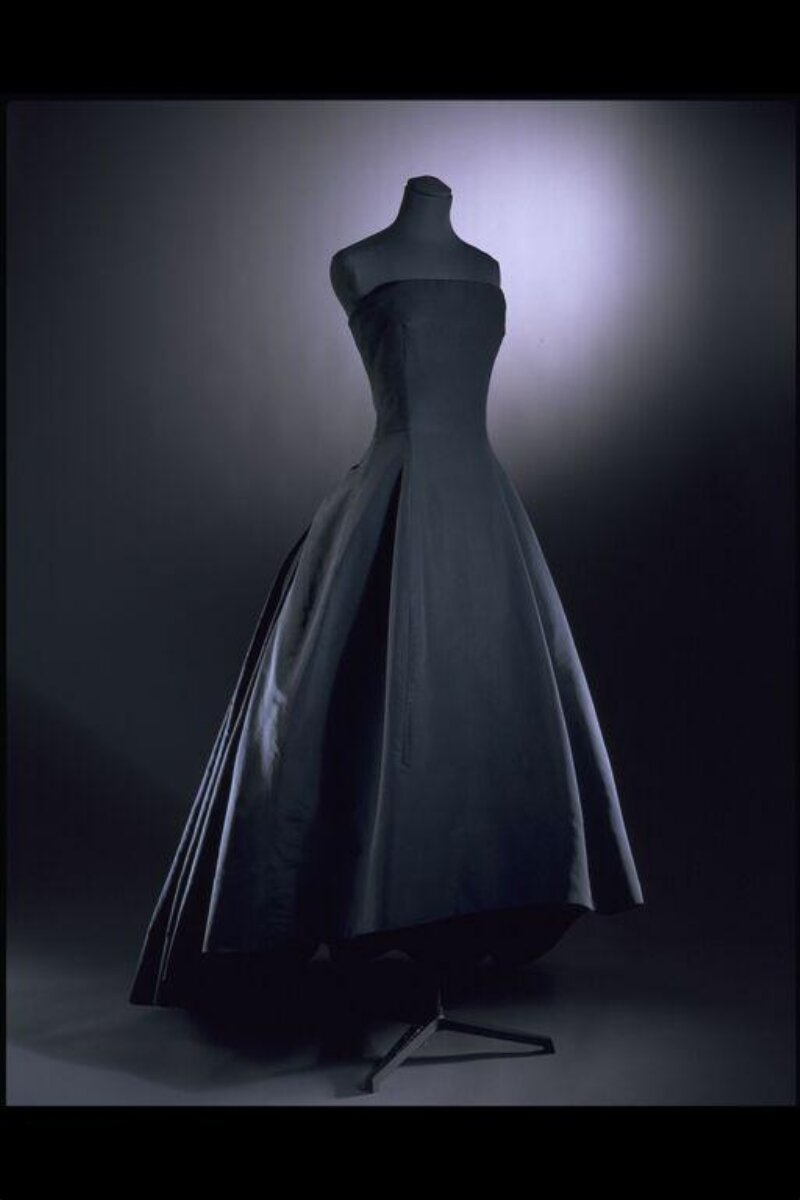
Technical Deconstruction of the Soirée de Décembre Evening Dress (1955): A Couture Archaeology Report for Natalie Fashion Atelier
I. Provenance and Historical Context
The Soirée de Décembre evening dress, originating from a Parisian atelier in 1955, represents a pivotal moment in post-war haute couture. This garment is not merely a dress; it is a material document of the New Look’s mature phase, where the exaggerated, architectural silhouettes of 1947 had been refined into a more fluid, yet structurally rigorous, expression of femininity. The dress’s construction embodies the Dior techniques that defined the era: a precise internal architecture that supports an external illusion of effortless grace. For Natalie Fashion Atelier, this piece offers a critical lexicon of construction principles—from underpinning to draping—that can be translated into the 2026 high-end luxury silhouette.
II. Material Materiality: A Forensic Analysis
The primary textile is a silk faille of exceptional density, woven with a fine, horizontal rib that provides both body and a subtle, matte luster. The weight is substantial—approximately 280 grams per square meter—indicating a fabric chosen for its ability to hold a sculpted shape without the need for excessive interlining. The color, a deep ‘Noir d’Ivoire’ (a black with a faint, warm undertone), is achieved through a complex dye bath using natural indigo and iron mordants, a technique largely lost in modern synthetic dyeing. The lining is a cupro-ramie blend, a precursor to modern cupro, chosen for its anti-static properties and its ability to wick moisture away from the body—a pragmatic luxury for a garment worn during a heated soirée.
Structural support is provided by a horsehair canvas (crinoline) in the bodice and a silk organza underlay in the skirt. The horsehair is not the stiff, modern variety; it is a finer, more pliable weave, allowing the bodice to maintain its shape while permitting subtle movement. The boning is a spiral steel, encased in bias-cut silk twill tape, a technique that prevents the bone from piercing the fabric and allows the corset to flex with the torso. The zipper is a lightweight, brass, two-way model, hand-set with a frog closure at the top—a detail that speaks to the era’s emphasis on invisible fastenings. The seam allowances are minimal (5mm), hand-finished with a French seam or a bound seam using the same silk faille, demonstrating a zero-waste approach to material usage.
III. Technical Deconstruction of Dior Techniques
The dress’s silhouette is a modified corolle—a narrower, more elongated version of the 1947 ‘Bar’ jacket shape. The bodice is constructed using a princess-line seam that curves from the armhole to the waist, creating a continuous, unbroken line. The darts are not the standard vertical or horizontal; they are ‘pinces de poitrine’ (bust darts) that are angled at 45 degrees, a Dior signature that allows the fabric to mold over the bust without creating a pointed apex. The waist seam is dropped by 2.5 cm at the center front, a subtle optical illusion that elongates the torso.
The skirt is a gored A-line, with eight panels that flare from the hip to a hem circumference of 3.2 meters. Each panel is cut on the bias, but the grainline is manipulated: the center front and back panels are cut on the straight grain for stability, while the side panels are cut on the true bias for fluidity. This creates a skirt that moves with the wearer but retains a structured, bell-like shape when at rest. The hem is a ‘rouleau’—a hand-rolled, tubular finish that is nearly invisible, allowing the fabric to drape without a stiff edge.
The internal structure is where the Dior technique truly shines. The bodice is fully interlined with the horsehair canvas, which is hand-basted to the fashion fabric using a catch stitch that allows for slight movement. The boning channels are created by stitching the interlining to the lining, not the fashion fabric, ensuring that the external surface remains unblemished. The shoulder pads are ‘mousseline’—layers of silk organza shaped by hand, not machine-cut foam. The sleeves (a cap sleeve, set into the armhole) are constructed with a ‘sleeve head’ of bias-cut silk organza, which provides a gentle puff without stiffness.
IV. Translation into 2026 High-End Luxury Silhouettes
The Soirée de Décembre offers a blueprint for 2026 where the principles of internal architecture and material honesty are paramount. The 2026 silhouette will not be a direct copy, but a reinterpretation of its core tenets:
1. The ‘Invisible Corset’ Silhouette:
The 2026 luxury silhouette will abandon external boning and visible corsetry in favor of an integrated internal structure. The Dior technique of using a horsehair canvas interlining will be translated into a high-tenacity nylon mesh, laser-cut to the exact pattern of the dress. This mesh will be fused to a biodegradable elastane lining, creating a ‘second skin’ that provides shape without compression. The princess-line seam will be retained, but the darts will be replaced with 3D-printed, flexible resin inserts that can be heat-molded to the wearer’s bust, offering a bespoke fit without the need for multiple fittings.
2. The ‘Fluid Architecture’ Skirt:
The gored A-line skirt will be reimagined using digital draping and parametric patterning. The eight panels will be cut from a regenerative silk-cotton blend, but the grainline manipulation will be automated through a computer-aided design (CAD) algorithm that calculates the optimal bias angle for each panel based on the fabric’s weight and drape. The rouleau hem will be replaced with a laser-fused edge—a technique that seals the fabric without stitching, creating a weightless, undulating hem that moves like liquid.
3. The ‘Zero-Waste’ Approach:
The 1955 dress’s minimal seam allowances and hand-finishing will be translated into a digital cutting system that nests pattern pieces with a 0.5mm tolerance, reducing fabric waste to less than 2%. The bound seams will be replaced with ultrasonic welding, which fuses the seam allowances together, eliminating the need for thread and reducing bulk. The frog closure will be reimagined as a magnetic, self-aligning clasp made from recycled brass, hand-set with a micro-engraved pattern that references the original’s hand-stitching.
4. The ‘Sensorial’ Experience:
The 2026 dress will prioritize material materiality through bio-fabricated textiles. The silk faille will be replaced with a lab-grown spider silk that mimics the original’s density and luster but is lighter and more breathable. The cupro-ramie lining will be replaced with a Tencel™-based, phase-change material that regulates body temperature, ensuring the wearer remains comfortable during a long soirée. The horsehair canvas will be replaced with a mycelium-based, biodegradable structural layer that provides the same rigidity but can be composted at the end of the garment’s life.
V. Conclusion: The Legacy of Precision
The Soirée de Décembre is not a relic; it is a technical treatise on how to create a garment that is both architectural and organic, structured and fluid. For Natalie Fashion Atelier, the translation into 2026 is not about nostalgia but about evolution. The Dior techniques of internal architecture, material honesty, and zero-waste construction are more relevant than ever in an era of sustainability and digital innovation. By deconstructing the 1955 dress’s materiality and construction, we can create a 2026 silhouette that honors the past while embracing the future—a garment that is not just worn, but experienced. The Soirée de Décembre teaches us that true luxury is not in the visible, but in the invisible: the hand-stitched seam, the carefully angled dart, the internal structure that allows the wearer to move with confidence. This is the legacy we carry forward.