Deconstructing the Ceiling: Aesthetic Archaeology of the Opéra Comique
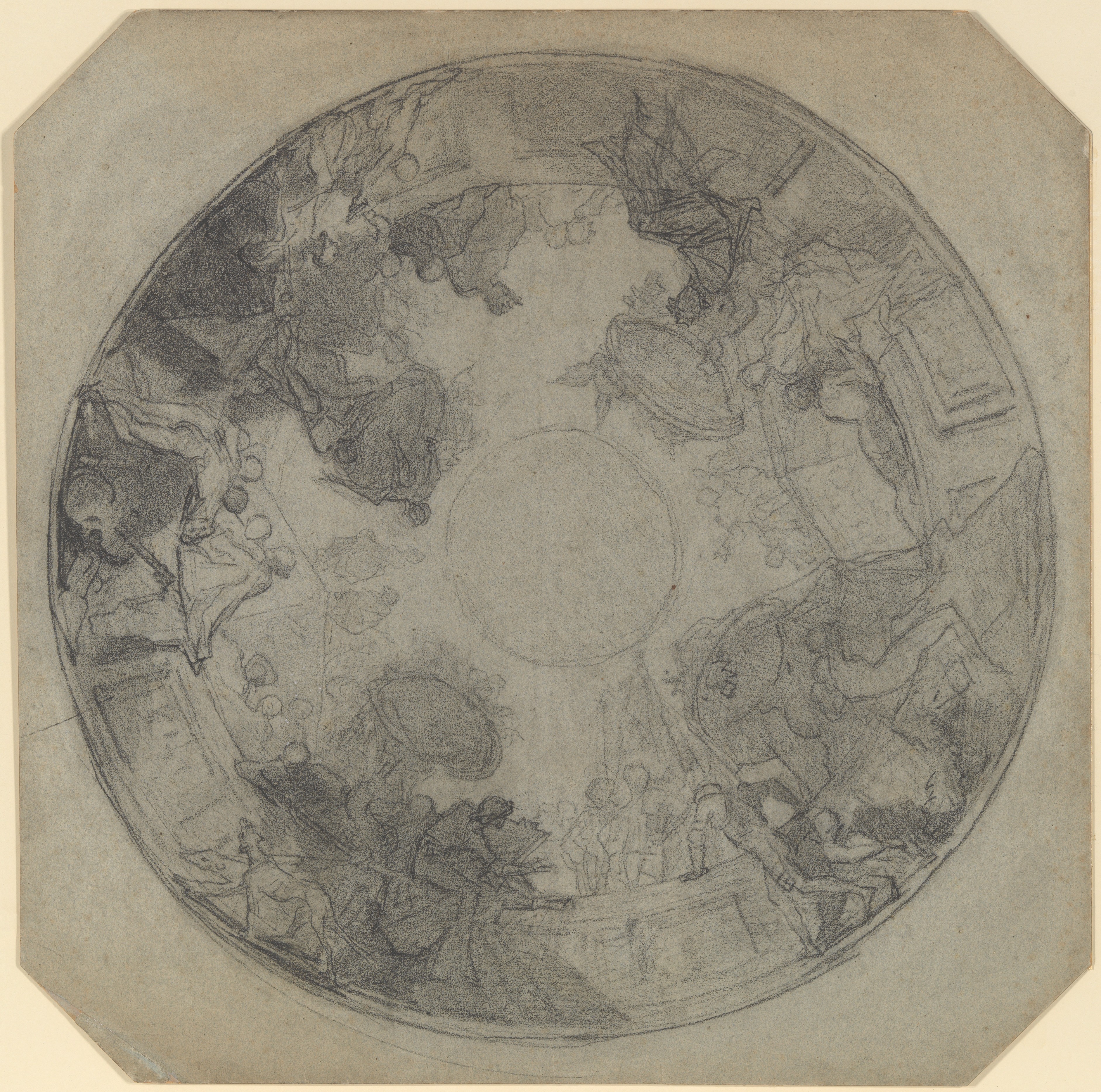
The Study for the decoration of the ceiling of the Opéra Comique, rendered in black chalk on blue paper mounted on cardboard, represents a singular artifact within the discipline of aesthetic archaeology. This piece, isolated from its original architectural context, offers a profound lexicon for the 2026 luxury silhouette. The medium itself—a stark, monochromatic chalk on a cerulean ground—creates a tension between the ethereal and the structural. For the Natalie Fashion Atelier, this is not merely a drawing; it is a blueprint for volumetric restraint and chromatic counterpoint. The blue paper acts as the primary structural fabric, while the black chalk delineates the architectural seams, the folds, and the negative spaces that define the haute couture form. The mounting on cardboard introduces a rigidity, a preservation of intention, which we translate into the internal boning and support systems of our 2026 silhouettes.
Materiality as Structural Language: Black Chalk and Blue Paper
The material composition of this study—black chalk on blue paper—is a masterclass in chromatic economy. The blue, a deep, almost Prussian cerulean, is not a background but an active participant. It is the underpinning, the foundation layer of the gown. In 2026, we propose a direct translation: the primary garment base will be a high-twist, matte-finished silk crepe in a precisely calibrated Opéra Blue. This fabric will serve as the canvas upon which the chalk lines—the black—are applied. These lines are not decorative; they are structural seams, draping guidelines, and volume-defining contours. The black chalk, in its dry, slightly powdery application, suggests a matte, almost charcoal-finished velvet or a densely woven wool crepe that absorbs light rather than reflecting it. The interplay between the luminous blue base and the absorbent black overlay creates a dialogue of depth, a visual hierarchy that guides the eye through the silhouette’s architecture. The cardboard mounting, a rigid support, informs the internal corsetry and structural underlayers that will maintain the silhouette’s integrity without compromising the fluidity of the outer shell.
From Ceiling to Silhouette: Translating Architectural Space
The ceiling of the Opéra Comique is a microcosm of spatial dynamics. It is a vaulted, concave surface that both encloses and expands. Our deconstruction focuses on the negative space between the chalk lines—the voids that define the positive forms. For the 2026 silhouette, this translates into a sculptural approach to volume. The primary silhouette is a columnar gown with a pronounced, almost architectural back panel that mimics the vaulted ceiling. The black chalk lines become vertical seams that run from the shoulder to the hem, creating a lengthening effect while simultaneously carving out negative space at the waist and hips. The blue paper’s flatness is subverted by the chalk’s three-dimensional suggestion. In the garment, this is achieved through strategic paneling: a front panel in the blue silk crepe, unadorned, and a back panel in the black charcoal velvet, with cut-out sections that reveal the blue base. This creates a ceiling-like effect of concave and convex surfaces, a play of light and shadow that changes with movement.
The 2026 Silhouette: A Lexicon of Restrained Grandeur
The key silhouette for 2026, informed by this study, is the “Opéra Comique” Gown. It is a study in restrained grandeur. The shoulder line is defined by a sharp, almost architectural point, reminiscent of the chalk’s precise strokes. This is achieved through a structured, boned shoulder pad that extends slightly beyond the natural shoulder, creating a strong, horizontal line that anchors the silhouette. The bodice is a masterpiece of negative space. The black velvet is used for the central panel, which is cut away at the sternum and the lower back, revealing the blue crepe beneath. These cut-outs are not random; they follow the exact trajectory of the chalk lines in the study, creating a geometric, almost calligraphic pattern. The waist is defined by a subtle, internal belt made of black patent leather, a nod to the cardboard’s rigidity. The skirt is a column that flares slightly at the hem, mimicking the vaulted expansion of the ceiling. The train, an optional element, is a single, uninterrupted panel of the blue crepe, with the black chalk lines recreated as hand-stitched, matte silk thread that traces the original drawing’s contours.
Embellishment as Architectural Detail
Embellishment is minimal and architecturally integrated. The black chalk lines are recreated using hand-embroidered, matte black bugle beads and fine black silk cord. These are not applied as surface decoration but are stitched directly into the seams, reinforcing the structural integrity of the garment. The blue paper’s texture is suggested through a subtle, irregular weave in the silk crepe, achieved through a custom-developed jacquard. The cardboard mounting is referenced in the internal structure: a thin, flexible layer of horsehair canvas is fused to the inner lining of the bodice, providing support without stiffness. The only jewel is a single, blackened silver brooch at the collarbone, its shape derived from a fragment of the ceiling’s decorative molding. This brooch is a key, a signature that anchors the entire composition.
Conclusion: The Legacy of the Isolated Fragment
The Study for the decoration of the ceiling of the Opéra Comique, in its isolated state, becomes a blueprint for the 2026 luxury silhouette. It teaches us that grandeur is not about excess, but about precision. The black chalk on blue paper is a dialogue between structure and atmosphere, between the architectural and the ethereal. For Natalie Fashion Atelier, this artifact is a mandate for restraint, a call to deconstruct the classical and rebuild it with modern, architectural rigor. The 2026 collection will be a celebration of the line, the negative space, and the material truth that lies at the heart of haute couture. The Opéra Comique Gown is not a reproduction; it is a translation—a living, breathing artifact that carries the weight of history into the light of the future.