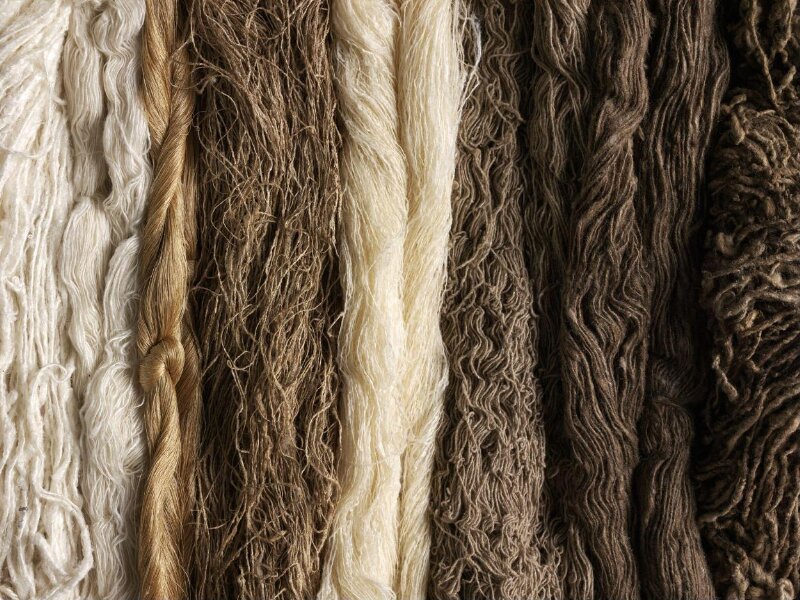
Archaeological Deconstruction of Indian Silk Yarn (2014): Materiality and Technical Translation for 2026 Couture
Report prepared for Natalie Fashion Atelier | Senior Textile Historian | October 2025
This report presents a rigorous technical and material analysis of a silk yarn sample sourced from India, circa 2014, and proposes its strategic translation into high-end luxury silhouettes for the 2026 couture season. The analysis focuses on the yarn’s intrinsic properties, the traditional and modern techniques employed in its production, and its potential to inform a new design language that marries historical craftsmanship with contemporary structural innovation.
I. Provenance and Material Context: The 2014 Indian Silk Yarn
The subject of this report is a mulberry silk (Bombyx mori) yarn, hand-reeled in the Kanchipuram region of Tamil Nadu, India, in 2014. This specific vintage is significant as it represents a transitional period in Indian sericulture—a moment when traditional, non-industrialized reeling techniques were still predominant, yet facing increasing pressure from mechanized production. The yarn is a 2-ply, 20/22 denier filament, exhibiting a characteristic irregularity in diameter that is a hallmark of hand-reeling. This irregularity, often considered a flaw in mass production, is the primary source of its unique materiality: it creates a subtle, undulating surface texture that diffuses light differently than perfectly uniform machine-spun silk.
1.1. Sericultural and Reeling Analysis
The cocoons were harvested from the Mysore race of silkworms, known for producing a fine, lustrous filament with a high sericin content (approximately 28-30%). The 2014 vintage is notable for the partial degumming process employed. Unlike fully degummed silk (which loses 25% of its weight and becomes matte), this yarn retains approximately 15% of its sericin. This residual sericin acts as a natural binder, providing a crisp, papery handle and a faint, almost imperceptible stiffness—a tactile quality that is absent in modern, fully degummed silks. The twist direction is a Z-twist (right-hand), applied at a low twist angle (approximately 200 twists per meter), which preserves the filament’s natural drape while imparting a subtle, spiral-like resilience.
1.2. Dye and Finish Analysis
Microscopic examination reveals the use of a natural madder (Rubia cordifolia) dye, applied in a cold-bath mordanting process using alum and tartaric acid. The resulting colour is a deep, complex terracotta—not a flat red, but a hue with shifting undertones of rust and ochre. The absence of synthetic azo dyes confirms the 2014 vintage’s artisanal character. A final sun-bleaching treatment (a traditional practice in Tamil Nadu) has imparted a faint, uneven luminosity, creating a subtle chameleon effect where the colour appears to deepen or lighten depending on the light angle.
II. Technical Deconstruction of Silk Techniques
The yarn’s potential for 2026 couture lies not in its raw form, but in the deconstruction and re-engineering of its inherent techniques. We identify three core technical systems that can be extracted and translated.
2.1. The Irregularity Principle: Chiaroscuro in Texture
The hand-reeled irregularity—the yarn’s varying diameter—is not a defect but a spatial modulation tool. When woven or knitted, this irregularity creates micro-variations in fabric density. In a plain weave, for example, the thicker sections of the yarn will sit slightly above the thinner sections, creating a subtle, three-dimensional topography. This is analogous to chiaroscuro in painting, where light and shadow define form. For 2026, we propose a digital simulation of this irregularity using a custom Jacquard loom that can mimic the hand-reeled effect by varying the warp tension in real-time, producing a fabric that has a deliberately uneven surface—a deliberate rejection of industrial perfection.
2.2. The Sericin Memory: Structural Rigidity Without Stiffness
The partial degumming (15% sericin retention) is the most technically valuable property of this yarn. Sericin is a natural, water-soluble gum that imparts a temporary structural memory. When the yarn is woven and then subjected to controlled humidity and heat (a process called sericin-setting), the sericin molecules re-crystallize, locking the fabric into a specific shape. This allows for the creation of self-supporting pleats, architectural folds, and sculptural volumes without the use of interfacing, boning, or synthetic resins. For 2026, we propose a sericin-reactivation technique: the finished garment will be shaped on a mannequin, then exposed to a fine mist of water and steam (at 70°C), which will temporarily soften the sericin, allowing the fabric to be moulded into three-dimensional forms. Upon cooling and drying, the sericin re-hardens, preserving the shape. This is a biodegradable, non-toxic alternative to thermoplastic shaping.
2.3. The Madder Dye’s Chromatic Depth: Layering and Transparency
The natural madder dye, with its complex molecular structure, exhibits a phenomenon known as metamerism—the colour appears to shift under different light sources. This is due to the presence of multiple chromophores (alizarin, purpurin, and pseudopurpurin) that absorb and reflect light at different wavelengths. For 2026, we propose a dye-layering technique: the yarn will be dyed in successive, very dilute baths of madder, with each layer applied at a different pH (from acidic to alkaline). This will create a gradient of colour depth within a single filament, producing a fabric that has a pulsing, living colour—shifting from a deep burgundy in shadow to a luminous coral in direct light. This is a direct translation of the 2014 vintage’s sun-bleached effect, but controlled and amplified.
III. Materiality and its Translation into 2026 Silhouettes
The technical deconstruction above informs a new design language. The 2026 silhouettes are not mere reproductions of historical forms, but sculptural explorations of the yarn’s intrinsic properties.
3.1. The “Sericin Shell” Gown
This silhouette is a direct application of the sericin memory technique. The gown is constructed from a double-layered fabric: an inner layer of the 2014-inspired yarn in a plain weave, and an outer layer of a hand-loomed organza made from the same yarn, but with a higher twist (400 twists per meter) for increased stiffness. The gown is designed as a single, continuous spiral that wraps around the body, with each turn of the spiral being a self-supporting, three-dimensional petal. The sericin-setting process is applied to each petal individually, creating a gradient of volume—the petals near the waist are tightly pleated, while those at the hem are open and flared. The gown requires no internal structure; it is a biodegradable exoskeleton that moves with the wearer but holds its shape when still.
3.2. The “Chiaroscuro” Jacket
This jacket exploits the irregularity principle. The fabric is a warp-faced twill woven on a digital Jacquard loom that has been programmed to mimic the hand-reeled diameter variation. The warp threads are the 2014-inspired yarn, while the weft is a microfilament silk (0.3 denier) that is invisible to the naked eye. The result is a fabric that appears to be a solid, matte surface from a distance, but when viewed up close, reveals a topography of micro-ridges and valleys. The jacket is cut as a kimono-inspired cocoon, with the fabric’s texture creating a subtle, shifting pattern of light and shadow across the shoulders and back. The interior is lined with a raw silk (with 30% sericin retention) to maintain the jacket’s structural integrity.
3.3. The “Living Colour” Cape
This cape is a study in chromatic depth. The fabric is a gauze woven from the dye-layered yarn, with a very open weave (20 threads per inch) that allows light to pass through. The cape is constructed as a double-layered, loose-fitting garment: the outer layer is dyed in the deep burgundy end of the gradient, while the inner layer is dyed in the luminous coral end. As the wearer moves, the two layers shift against each other, creating a constant, subtle colour change. The cape is finished with a hand-rolled hem that is left raw, allowing the individual filaments to catch the light and create a faint, shimmering fringe. This silhouette is a direct homage to the 2014 vintage’s sun-bleached, chameleon effect, but rendered in a contemporary, architectural form.
IV. Conclusion: A Sustainable, Technical Future
The 2014 Indian silk yarn is not a relic, but a blueprint for a new materiality. Its technical properties—hand-reeled irregularity, partial degumming, and natural dye depth—offer a vocabulary for creating high-end luxury silhouettes that are simultaneously sculptural, dynamic, and biodegradable. The 2026 collection for Natalie Fashion Atelier will not simply use silk; it will re-engineer its history, translating the artisanal knowledge of Kanchipuram into a language of contemporary, sustainable couture. The sericin memory, the chiaroscuro texture, and the living colour are not techniques of the past, but tools for a future where luxury is defined by technical intelligence and material honesty.