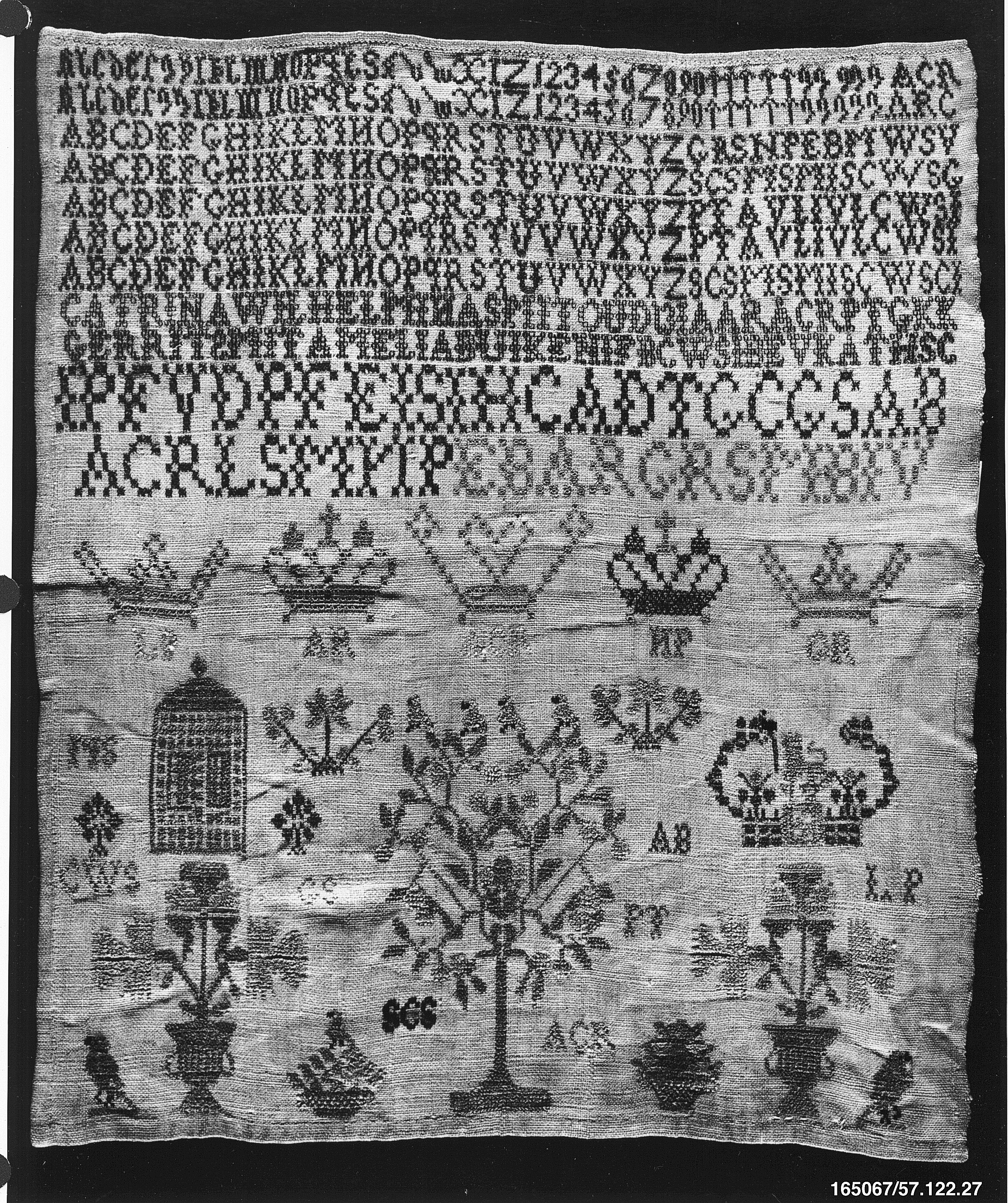
Deconstructing the Sampler: Aesthetic Archaeology and the 2026 Silhouette
The sampler, a seemingly modest artifact of domestic pedagogy, represents a profound intersection of material discipline, aesthetic transmission, and structural logic. At Natalie Fashion Atelier, we approach the sampler not as a mere decorative exercise but as a primary source in aesthetic archaeology. Its isolated survival—a fragment of silk on linen, preserved from a broader, lost context—offers a unique lens through which to deconstruct classical elegance and project its principles onto the 2026 luxury silhouette. This research artifact posits that the sampler’s inherent tension between rigid structure and expressive freedom, its dialogue between thread and ground, directly informs the architectural drapery and tactile luxury of our forthcoming collection.
Material Dialectics: Silk on Linen as a Structural Paradigm
The material choice of silk on linen is not arbitrary; it is a deliberate study in contrast and cohesion. Linen, with its robust, irregularly spun fibers, provides a ground of tensile strength and organic texture. It is the anchor, the structural foundation that resists and supports. Silk, conversely, is the agent of fluidity, luminosity, and precision. Its smooth, continuous filament allows for the execution of minute stitches—cross-stitch, satin stitch, stem stitch—that create both pictorial and geometric order.
For the 2026 silhouette, this dialectic translates into a new architectural approach to garment construction. The linen becomes the internal armature, a structural underlayment that dictates the garment’s hold and posture. We are developing a technique of “invisible scaffolding,” where a fine, high-twist linen canvas is integrated into the interior of a silk crepe or organza shell. This is not a traditional lining; it is a morphological skeleton that allows the silk to drape with controlled volume, mimicking the sampler’s interplay of rigid ground and expressive thread. The result is a silhouette that appears weightless yet possesses a precise, almost architectural contour—a standing collar that does not wilt, a sleeve that maintains its bell shape without internal wiring.
The Grammar of Ornament: From Stitch to Silhouette
The sampler’s decorative program—its alphabets, numerals, and motifs—is a grammar of spatial organization. The stitches are not applied randomly; they follow a grid, a predetermined rhythm that creates both repetition and variation. This is the classical elegance of ordered asymmetry. For 2026, we translate this grammar into the silhouette through a concept we term “embroidered architecture.”
Consider the mise-en-place of a sampler’s border: a repeating geometric pattern that frames a central field. In our haute couture application, this border becomes a structural seam. A gown’s waistline, for instance, is not a simple cut but a band of dense, hand-embroidered silk thread on a linen base, creating a rigid yet flexible corset effect. The central field of the sampler—the area of freer expression—becomes the garment’s body, where the silk flows and falls in response to the embroidered constraints. The silhouette is thus generated from the ornament, not the other way around. The embroidery dictates the volume, the drape, and the line.
Furthermore, the sampler’s use of negative space—the unstitched linen—is critical. This void is not emptiness; it is a reserve of potential. In 2026, we exploit this through “negative tailoring.” A jacket’s shoulder, for example, may feature a dense, embroidered panel on the front, while the back is left as a single, unadorned expanse of silk. This asymmetry creates a dynamic silhouette, one that shifts in perception as the wearer moves. The unstitched area becomes a field of light and shadow, a counterpoint to the embroidered density.
Isolated Aesthetic Archaeology: Recovering Lost Proportions
The sampler’s isolation—its removal from its original pedagogical and domestic context—forces a pure aesthetic reading. We are not bound by its function as a learning tool; we are free to extract its formal principles. One such principle is the proportional system of the grid. Samplers often follow a strict, albeit hand-drawn, grid. The ratio of stitch to ground, the spacing of motifs, and the relationship between border and field all adhere to a hidden mathematical order.
For 2026, we recover this proportional system and apply it to the silhouette’s vertical and horizontal axes. The classic haute couture silhouette—the A-line, the hourglass, the column—is re-evaluated through the sampler’s grid. A skirt’s length, for instance, is determined not by hemline fashion but by a golden ratio derived from the sampler’s border-to-field proportion. The waistline is placed at a point that echoes the sampler’s central motif. The result is a silhouette that feels inherently balanced, timeless, and classically elegant, yet entirely new in its execution.
This archaeological recovery also extends to tactile memory. The sampler’s silk thread, when passed through linen, creates a subtle, three-dimensional topography. We replicate this through “tactile layering.” A 2026 evening gown might feature a base of matte, raw silk (the linen analog) overlaid with panels of high-lustre, tightly woven silk (the thread analog). The transition between these layers is not a seam but a gradated embroidery, where the thread density shifts from sparse to dense, creating a visual and tactile landscape. The silhouette thus becomes a narrative of touch, a silent dialogue between the wearer and the garment’s surface.
Projection into 2026: The Silhouette as Sampler
Looking toward 2026, the sampler informs three distinct silhouette archetypes for Natalie Fashion Atelier:
1. The Architectural Cocoon: Inspired by the sampler’s border, this silhouette features a rigid, embroidered shell that encases the body in a controlled volume. The linen armature is visible through strategic cutouts, while the silk surface is densely stitched with geometric patterns. The silhouette is monolithic yet fluid, a paradox achieved through the tension between the internal structure and the external drape.
2. The Deconstructed Grid: This silhouette fractures the sampler’s grid. A dress’s bodice may be composed of separate, embroidered panels that are joined by silk ribbons or exposed seams, creating a visual lattice that reveals the body in fragments. The negative space of the sampler becomes the positive space of the garment, with the skin acting as the “unstitched ground.”
3. The Embroidered Column: The most direct translation, this silhouette is a single, continuous column of silk on linen, where the embroidery itself creates the silhouette’s shape. A vertical band of dense, satin-stitch embroidery runs from the shoulder to the hem, acting as a structural spine that pulls the fabric taut, while the unembroidered sides fall in soft, liquid folds. The silhouette is both severe and romantic, a study in controlled release.
In conclusion, the sampler is not a relic but a blueprint for innovation. Its silk on linen materiality, its grammar of ornament, and its isolated aesthetic archaeology provide the technical and conceptual foundation for the 2026 luxury silhouette. At Natalie Fashion Atelier, we do not imitate the past; we excavate its principles and re-project them into a future of architectural drape, tactile luxury, and classical elegance redefined.