Deconstructing the Garden of Love: Aesthetic Archaeology for 2026 Haute Couture
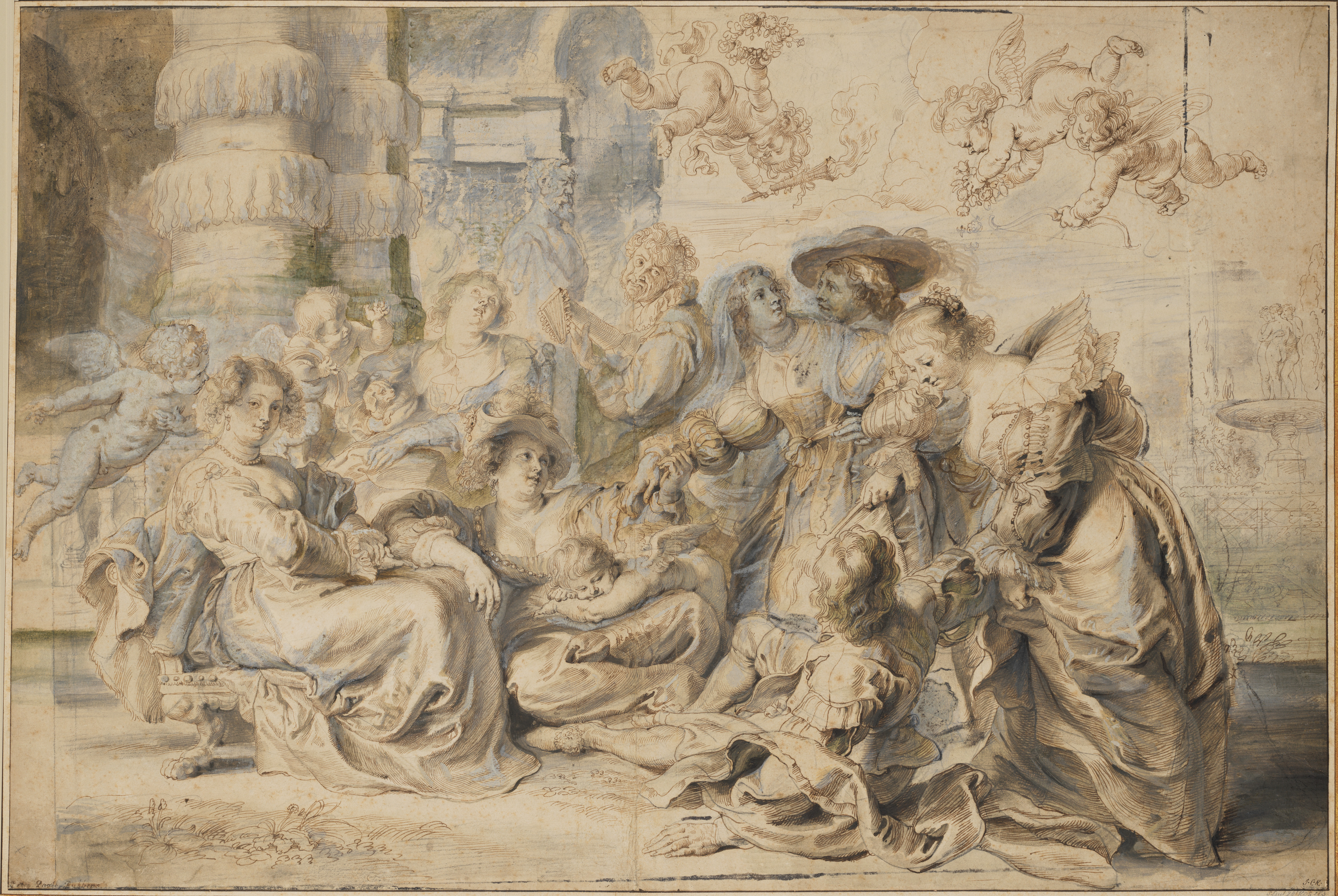
The right portion of The Garden of Love, executed in pen and brown ink, brush and brown and green wash, heightened with light blue gouache, over black chalk, presents a masterclass in restrained opulence. For Natalie Fashion Atelier, this fragment is not merely a pastoral scene; it is a technical blueprint for the 2026 luxury silhouette. The work’s inherent tension—between the fluidity of the wash and the precision of the ink, between the earthy browns and the ethereal blue—offers a lexicon of structural and textural possibilities. This research artifact isolates the aesthetic archaeology of the piece, translating its classical elegance into a contemporary haute couture language that prioritizes architectural volume, chromatic austerity, and the illusion of weightlessness.
I. The Structural Lexicon of Ink and Wash: Silhouette as Drawing
The foundational technique of The Garden of Love—the black chalk underdrawing overlaid with precise pen and ink—directly informs the skeletal architecture of a 2026 silhouette. The black chalk represents the invisible internal structure: the boning, the corsetry, the engineered seams that give a garment its fundamental shape. The pen and brown ink, in turn, become the visible external seams and the deliberate, graphic lines that define the garment’s topography. For the coming season, we propose a silhouette that mimics this layering. A dress is conceived as a three-dimensional drawing.
Consider a column gown where the primary volume is established by a black chalk-like base—a heavy, matte silk crepe. Over this, seams traced in a contrasting brown thread, or even a subtle brown piping, replicate the pen lines. These lines do not follow the body’s natural curve; instead, they create a new geometry, echoing the artist’s deliberate strokes that define a figure’s drapery. The brush and brown wash translates into gradated draping. A single panel of fabric, perhaps a double-faced wool crepe, is cut to create a wash-like transition from dense opacity at the hip to a fluid, almost translucent fall at the hem. This is not a simple A-line; it is a controlled spill of fabric, mirroring how the brown wash bleeds into the paper. The 2026 silhouette, therefore, is not draped but drawn onto the body, with every seam and panel serving as a deliberate mark in a larger compositional sketch.
II. Chromatic Austerity and the Luminous Accent: The Green Wash and Blue Gouache
The palette of this fragment is deceptively simple: brown, green, and light blue. For high-end 2026 silhouettes, this dictates a strategy of chromatic austerity with strategic luminosity. The dominant brown and green washes are not mere background colors; they are the primary tonal field. In a couture context, this translates to a monochromatic base of deep, vegetal hues—think forest floor brown, oxidized bronze, and mossy green. These are achieved through complex dyeing processes, perhaps a double-dip in indigo and madder, or a hand-painted ombré on a heavy silk faille. The color is never flat; it possesses the depth and irregularity of a wash.
The critical intervention is the light blue gouache. In the artwork, this heightening is applied sparingly, as a highlight on a flower or a fold of fabric, creating a startling point of focus. For 2026, this translates into a single, concentrated accent of electrified cerulean or pale, glacial blue. This is not a print or a pattern. It is a material intervention. Imagine a gown in deep, matte green velvet. At the shoulder, a single, sculptural petal of stiffened silk organza, hand-painted with light blue gouache, is appliquéd. Or consider a brown wool crepe coat, entirely unadorned, save for a single sleeve lining of that same light blue, visible only in a moment of movement. The effect is one of discovery, a secret treasure within a field of austerity. This technique elevates the silhouette from mere clothing to a portable artwork, where the viewer’s eye is guided by a single, deliberate, luminous stroke.
III. The Archaeology of the Fold: From Chalk to Couture Construction
The black chalk underdrawing is the ghost of the final form. It suggests volume without defining it. This is the most sophisticated lesson for the 2026 silhouette. We must construct garments that possess a memory of a different, more fluid form. This is achieved through archaeological draping. A dress is not cut and sewn; it is excavated from the fabric. The designer works with a heavy, pliable material like a wool-silk blend, pinning and tucking to create folds that appear to be the result of time and gravity, not a pattern piece.
The green wash, applied over the chalk, creates a sense of atmospheric perspective—the folds recede and advance. In a 2026 gown, this is replicated through gradated pleating. A skirt is constructed with hundreds of micro-pleats that are deeper at the waist and shallower at the hem, creating a visual gradient from dense shadow to lighter, more open texture. The pleats themselves are not pressed to a sharp edge; they are left soft, like the edge of a brushstroke. The brown ink lines then serve as the topstitching that defines the key structural folds, preventing the garment from becoming a mere puddle of fabric. This technique produces a silhouette that is both archaeological and futuristic, a relic of a lost garden reconstructed with the precision of a master draftsman.
IV. Silhouette Typology for 2026: The Ink-Wash Form
From this analysis, three distinct silhouette typologies emerge for the Natalie Fashion Atelier 2026 collection:
The Chalk Line Column: A narrow, columnar silhouette that relies on internal structure (the chalk). The external seams (the ink) are graphic and architectural, creating a sharp, linear profile. The fabric is a dense, matte crepe in a deep brown. The only accent is a single, liquid panel of light blue silk that falls from the shoulder, mimicking the gouache highlight. The silhouette is severe, intellectual, and powerfully minimal.
The Washed Bell: A silhouette that expands gently from a fitted bodice into a full, bell-shaped skirt. The volume is created by the brush and brown wash technique—the fabric is cut in wide, overlapping panels that create a sense of fluid, organic expansion. The color is a deep, layered green, achieved through a complex dye process. The hem is left raw and unfinished, like the edge of a wash. The silhouette is romantic but not sentimental, grounded in the weight of the material.
The Gouache Petal: A silhouette defined by asymmetry and sculptural volume. One side of the garment is fitted and closed, like the dark chalk underdrawing. The other side explodes into a single, large, sculptural element—a petal, a wing, a fold—executed in stiffened silk organza and hand-painted with the light blue gouache. This silhouette is the most dramatic, directly translating the artwork’s central tension between the dark, grounded base and the luminous, fleeting highlight. It is a statement of pure, artistic intent.
In conclusion, the right portion of The Garden of Love is not a source of motifs but a manual for construction. Its materiality—the interplay of chalk, ink, wash, and gouache—provides a rigorous framework for creating silhouettes that are at once historically resonant and radically contemporary. The 2026 haute couture silhouette, as defined by this artifact, is a study in controlled contrasts: the heavy and the light, the matte and the luminous, the drawn and the draped. It is an exercise in aesthetic archaeology, where the highest luxury lies not in ornament, but in the eloquent, deliberate mark of the artist’s hand upon the body.