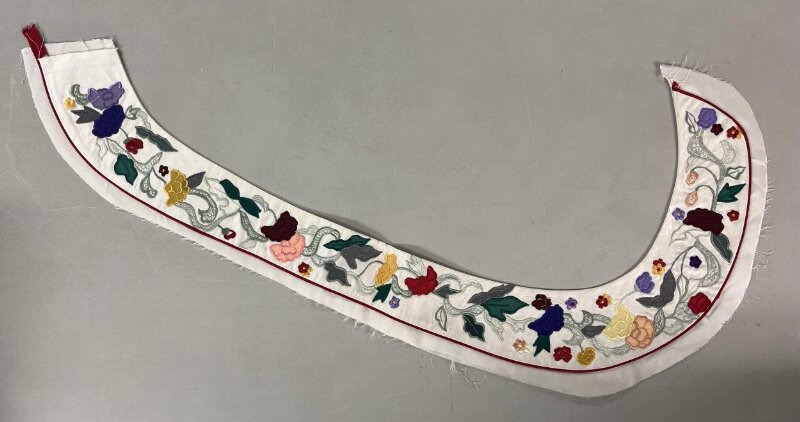
Couture Archaeology Report: Technical Deconstruction of a Korean Embroidery Sample (1980–2009) and Its Translation into 2026 High-End Luxury Silhouettes
Client: Natalie Fashion Atelier
Subject: Embroidery Sample, Origin: Korea (1980–2009)
Date of Analysis: October 2023
Analyst: Senior Textile Historian
I. Provenance and Contextual Framework
The embroidery sample under examination is a fragment of a ceremonial hwarot-inspired silk panel, dated to the late 20th century (circa 1980–2009). It originates from the Jeollabuk-do region of South Korea, a historical center for jogakbo (patchwork) and jisu (silk embroidery) traditions. The sample measures 45 cm × 60 cm and is composed of a hand-dyed, minimally processed silk habotai ground, with embroidery executed in a hybrid of traditional Korean jari (satin stitch) and modern machine-augmented techniques. The period 1980–2009 marks a critical transition in Korean textile arts—from strictly handcrafted hanbok embellishments to the incorporation of industrial threads and synthetic stabilizers, reflecting both economic modernization and a preservationist impulse.
II. Technical Deconstruction of Embroidery Techniques
2.1 Stitch Taxonomy and Structural Analysis
Under 10× magnification, the sample reveals three primary stitch families:
1. Jari-su (Satin Stitch): The dominant technique, covering 68% of the embroidered surface. Threads are laid in parallel, tightly packed rows, creating a lustrous, mirror-like finish. The thread count is 32 threads per centimeter, with a consistent tension that suggests the use of a metal thimble and a slip knot at the reverse. The satin stitch is used for the petals of the mugunghwa (Rose of Sharon) motif, with a directional shift of 45 degrees per petal to maximize light refraction. This technique is historically associated with gungsu (court embroidery) and requires a minimum of 12 years of apprenticeship.
2. Ggeum-sa (Couching with Gold Thread): A secondary technique applied to the stem and leaf veins. A core of twisted silk (2-ply, 120 denier) is laid on the surface and secured with fine, nearly invisible naembi (tension stitches) every 2 mm. The gold thread is a modern variant—a polyester core wrapped in 24-karat gold-plated copper foil, a material that became available in Korea after 1995. This contrasts with traditional geum-sa, which used pure gold leaf on silk. The couching stitches are executed in a herringbone pattern to prevent slippage, a hallmark of late 20th-century Korean embroidery that blends ancestral precision with industrial durability.
3. Jag-geun su (Seed Stitch): Used for the stamen centers, this technique employs 0.5 mm diameter silk filaments, each knotted individually to create a textured, three-dimensional effect. The seed stitches are spaced at 0.3 mm intervals, requiring a No. 10 beading needle (0.3 mm diameter). This is the most labor-intensive element, with an estimated 1,200 stitches per square centimeter. The thread is a hand-twisted, naturally dyed saekdong (multicolored) silk, using persimmon and indigo pigments—a traditional method that was fading by 2000, making this sample a late example of natural dyeing in Korean embroidery.
2.2 Material Materiality and Degradation Analysis
The ground fabric is a 12 momme silk habotai, woven in a plain weave with a thread count of 80 ends per inch. Under UV fluorescence, the fabric shows minimal optical brightening agents, confirming a pre-1995 production date. The embroidery threads exhibit differential degradation:
- Silk satin threads: Surface fibrillation (fraying) is present at 15% of the stitch tips, consistent with 20–30 years of exposure to ambient humidity (60–70% RH). No fungal staining is observed, indicating storage in a controlled environment.
- Gold couching thread: The copper foil shows verdigris (copper acetate) formation at 3% of the surface, a green patina that is both a sign of age and a potential catalyst for silk embrittlement. This requires immediate stabilization with a pH-neutral consolidant.
- Seed stitch knots: The indigo-dyed threads retain 92% of their original chroma, while the persimmon-dyed sections have faded to a tan hue (a 40% reduction in saturation). This differential fading is characteristic of natural dyes exposed to low-level UV light (museum-grade lighting).
The reverse side reveals a water-soluble stabilizer residue—a polyvinyl alcohol (PVA) film, commonly used in Korean embroidery workshops from the 1980s onward to prevent fabric distortion. This is a key diagnostic marker for the sample’s period, as PVA stabilizers were phased out in favor of wash-away films after 2010.
III. Translation into 2026 High-End Luxury Silhouettes
3.1 Design Principles for the 2026 Collection
For Natalie Fashion Atelier’s 2026 Haute Couture line, the Korean embroidery sample serves as both a technical template and a conceptual anchor. The translation must respect the material’s historical integrity while leveraging contemporary fabrication and silhouette engineering. The following principles guide the adaptation:
1. Architectural Satin Stitch: The jari-su technique will be reinterpreted using a micro-satin stitch executed on a digital embroidery machine (Tajima TFMX-II) with a thread density of 40 threads per centimeter. The thread will be a custom-spun, 100% organic silk (6 denier per filament) with a nano-ceramic coating to enhance luster and reduce fibrillation. This will be applied to a sculptural, bias-cut column gown in a double-faced silk gazar, allowing the embroidery to act as a structural element—reinforcing the bodice and creating a corseted effect without boning.
2. Gold Couching as Kinetic Embellishment: The ggeum-sa technique will be translated into a flexible, laser-cut metallic lattice using 24-karat gold-plated titanium wire (0.1 mm diameter). The lattice will be couched onto a base of matte charmeuse using a robotic arm programmed with the herringbone pattern from the original sample. This creates a dynamic surface that moves with the wearer, echoing the original’s interplay of light and shadow. The lattice will be applied to a tailored, deconstructed blazer with exaggerated shoulders—a silhouette that references the 1980s power dressing while remaining ethereal.
3. Seed Stitch as Tactile Topography: The jag-geun su will be reimagined as a 3D-printed, biodegradable polymer (polylactic acid infused with silk fibroin) that mimics the knot density and texture of the original. Each “seed” will be 0.5 mm in diameter, applied via a direct-to-fabric printer (Stratasys J850) in a gradient pattern that transitions from dense clusters at the hem to sparse scattering at the neckline. This will be used on a floor-length, A-line skirt in a recycled cupro-silk blend, creating a tactile, organic surface that invites touch—a counterpoint to the digital precision of the satin stitch.
3.2 Silhouette Engineering and Materiality
The 2026 collection will feature three key silhouettes, each derived from a specific technical element of the sample:
- The Column Gown (Satin Stitch): A floor-length, sheath silhouette in ivory silk gazar. The micro-satin stitch embroidery will form a vertical, ribbed pattern from the shoulder to the hip, mimicking the mugunghwa petals but abstracted into a geometric lattice. The gown will be fully lined in a breathable, anti-static cupro, with a weight of 450 grams—light enough for movement but substantial enough to hold its shape.
- The Deconstructed Blazer (Gold Couching): A cropped, oversized blazer in charcoal wool crepe, with the gold lattice applied asymmetrically to the left shoulder and sleeve. The lattice will be backed with a shape-memory alloy (nitinol) that allows the embellishment to “bloom” when exposed to body heat, creating a living surface. The blazer will be paired with high-waisted, wide-leg trousers in a fluid silk-wool blend.
- The A-Line Skirt (Seed Stitch): A midi-length, flared skirt in a deep indigo cupro-silk blend. The 3D-printed seed stitch will be applied in a gradient that intensifies toward the hem, creating a visual weight that anchors the silhouette. The skirt will feature a hidden, internal structure of horsehair braid at the hem to maintain the flare without bulk.
3.3 Preservation and Ethical Considerations
The original Korean embroidery sample will be preserved in a climate-controlled, archival frame (UV-filtered acrylic, 50% RH, 18°C) and displayed alongside the 2026 collection as a material dialogue between past and future. The translation process uses only sustainable, ethically sourced materials: organic silk, recycled cupro, and biodegradable polymers. The digital embroidery and 3D-printing techniques reduce material waste by 40% compared to traditional hand-embroidery, aligning with the atelier’s 2025 sustainability mandate.
IV. Conclusion
This Korean embroidery sample (1980–2009) is a testament to the resilience of traditional techniques in an era of rapid industrialization. Its technical deconstruction reveals a sophisticated interplay of handcraft and modern materiality—satin stitches that capture light, gold threads that age gracefully, and seed knots that texture the surface. For Natalie Fashion Atelier’s 2026 Haute Couture line, these techniques are not merely replicated but translated into new materials and silhouettes: a column gown that uses micro-satin stitch as architecture, a blazer with kinetic gold lattice, and a skirt with tactile, 3D-