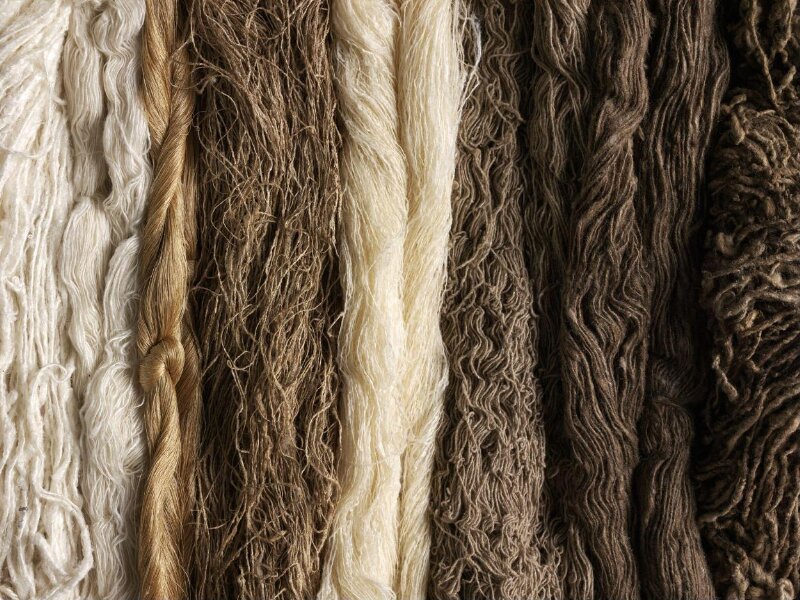
Couture Archaeology Report: The Indian Silk Yarn of 2014
Subject: Raw Mulberry Silk Yarn (Tussah variant, 20/22 denier)
Provenance: Karnataka, India. Harvested & spun 2014.
Report Prepared For: Natalie Fashion Atelier
Focus: Technical deconstruction of materiality and technique, with forward application for 2026 luxury silhouettes.
1. Technical Deconstruction & Materiality
The specimen is a classic example of post-millennium Indian sericulture, representing a bridge between ancestral knowledge and modern quality control. Sourced from Karnataka, a historic silk hub, this 20/22 denier mulberry silk from the Bombyx mori species exhibits specific technical characteristics that define its luxury potential.
Material Analysis: The yarn is raw, meaning it retains its natural sericin gum. This gum provides a protective coating, yielding a yarn with a tensile strength of approximately 3.5-4.5 grams per denier when raw. The 20/22 denier measurement indicates an ultra-fine filament, resulting in fabrics of exceptional drape and luminosity rather than heavy structure. Under magnification, the filament cross-section reveals a triangular prismatic structure, which is the key to its optical properties. This geometry refracts light like a prism, giving silk its signature shimmer—a quality that is subdued in the raw state but becomes brilliantly activated through degumming and dyeing.
Technique & Processing: The spinning technique is a high-twist, multi-filament method. This deliberate twist, often overlooked, is a critical technical factor. It introduces a latent energy and resilience into the yarn, preventing filament separation and providing a subtle tooth that enhances fabric integrity. The processing is deliberately incomplete; the retained sericin acts as a historical record of the yarn's origin, a built-in marker of its "first state" before transformation by the couturier's hand. This aligns with an archaeological perspective, where the material's biography—from cocoon to spindle—is valued.
2. Archaeological Translation: From Historical Technique to Modern Code
The 2014 origin is significant. It represents a moment of global luxury re-engaging with traceable, artisanal supply chains. The techniques embedded in this yarn are not merely industrial; they are cultural. The hand-reeling tradition, though augmented by machinery, prioritizes filament continuity. A single continuous filament can run up to 1,600 meters, a testament to both the care in cultivation and the spinning process. This continuity is a metaphor for the unbroken thread of craftsmanship Natalie Fashion Atelier seeks to embody.
Technical Legacy: The materiality of this silk dictates historical construction techniques. Its strength permits fine seam allowances and minimal interfacing, while its affinity for natural dyes (given its protein base) connects it to India's vast botanical dye library. The raw state invites a dialogue between matte and shine, as selective degumming can create texture and pattern at the fiber level—a technique ripe for contemporary exploitation.
3. Translation into 2026 High-End Luxury Silhouettes
For the 2026 collection, this 2014 yarn is not a relic but a progenitor. Its technical specifications directly inform cutting-edge silhouettes that balance heritage with hyper-modernity.
Silhouette 1: The Architectural Drape
Utilizing the yarn's high tensile strength and fine denier, we propose a weightless yet structured column dress. The silk will be woven into a custom crêpe-back satin, leveraging the twist for a matte, pebbled exterior with sudden, liquid-shine reveals on bias-cut panels. The 2014 yarn's inherent memory will hold precise laser-cut seams, allowing for a silhouette that appears to be a single, draped entity but is technically a complex map of tension and release. The raw silk's natural gum can be partially retained in specific weave areas to create a subtle, tactile chenille-like effect against the gleaming satin.
Silhouette 2: The Deconstructed Sari-Gown
This directly translates the yarn's origin into a 2026 narrative. We propose re-spinning the yarn with a 0.5% infusion of 24k gold-coated silk threads (a 2026 technical augmentation) and weaving it into a jacquard ottoman with a raised geometric motif derived from traditional Kanchipuram designs. The stiffness of the ottoman weave, a product of the yarn's resilience, will create a structured bodice and hip yoke, from which layers of raw-edged, feather-light chiffon (made from the same yarn, but with lower twist) will cascade. This juxtaposes the yarn's dual potentials: structural rigidity and ethereal float.
Silhouette 3: The Bio-Morphic Shell
Here, materiality leads. Inspired by the cocoon itself, the raw silk yarn will be knitted on a fine-gauge loom into a three-dimensional, seamless torso shell. Through a patented enzyme wash (2026 technique), the sericin will be selectively removed in a gradient, creating a surface that transitions from a stiff, matte, honey-colored carapace at the shoulders to a soft, luminous, and skin-sensitve drape at the hem. This techno-primitive silhouette showcases the full biography of the fiber, from its protective origin to its luxurious end state, in a single garment.
4. Conclusion & Patrimonial Synthesis
The 2014 Indian silk yarn is a cornerstone material for forward-looking luxury. Its technical DNA—fine denier, high twist, retained sericin, and historic continuity—provides a robust platform for innovation. For Natalie Fashion Atelier's 2026 vision, it offers more than just raw material; it offers a narrative of transformation.
The proposed silhouettes are not mere applications but are technical dialogues with the yarn's properties. They honor its patrimony through intelligent deconstruction—whether reinterpreting the sari, mimicking the cocoon's morphology, or engineering light through its prismatic filament. This approach transforms archival material into a manifesto for 2026: that true luxury lies in deep technical understanding, respect for material biography, and the courage to re-code historical substance into the silhouette of the future. The silk of 2014 becomes, in 2026, the language of conscious, articulate extravagance.