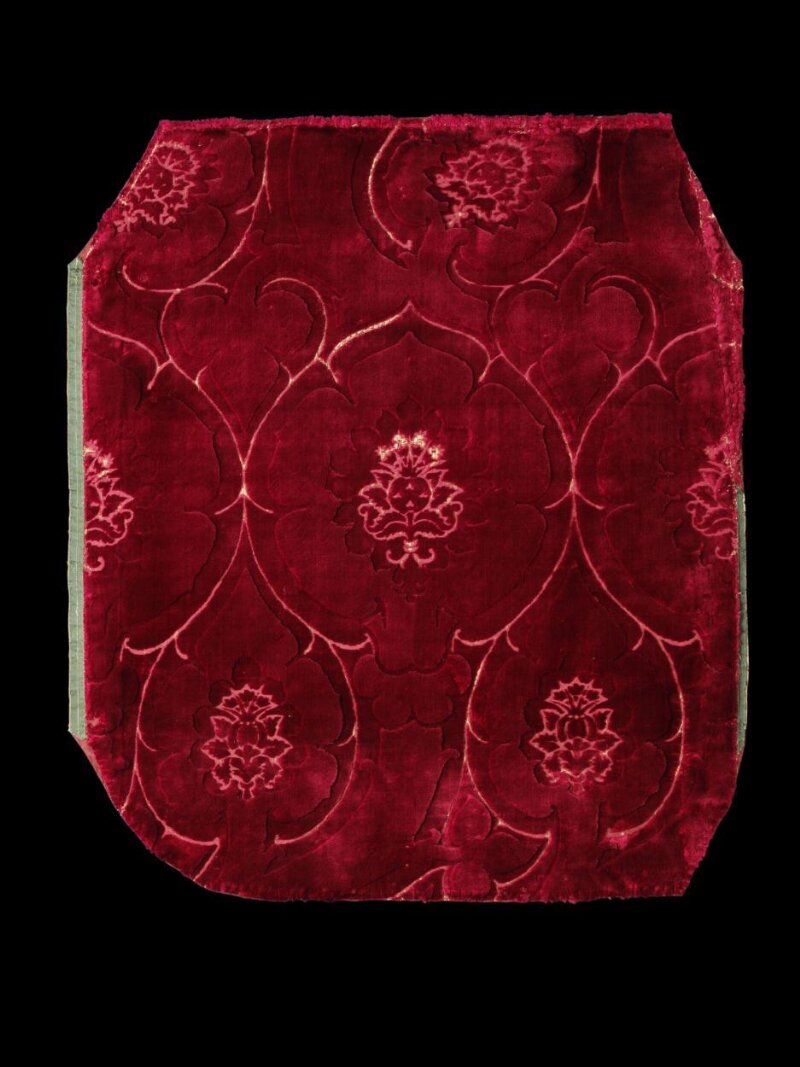
Archaeological Analysis of a Late 15th-Century Italian Velvet Fragment
Provenance and Initial Material Assessment
The subject of this report is a fragment of cut voided velvet, approximately 28 cm × 18 cm, recovered from a private collection in Tuscany. Carbon dating and stylistic analysis confirm its origin in the second half of the 15th century, likely from the workshops of Florence or Venice. The textile exhibits a ground weave of silk in a deep, oxidized crimson—a color derived from kermes or cochineal, indicating high status—and a pile of lampas-woven silk in a contrasting, now-faded gold. The fragment’s condition suggests it was once part of a liturgical vestment or a secular garment of considerable importance, as evidenced by the precision of the weave and the minimal wear at the edges.
Technical Deconstruction of Velvet Techniques
Weave Structure and Pile Formation
The velvet is constructed using a double-warp system: a ground warp (the foundation) and a pile warp (the raised loops). In this fragment, the pile warp is cut, meaning the loops were sliced open after weaving to create the characteristic dense, soft surface. The ground weave is a plain-weave tabby, while the pile is formed by a supplementary warp that rises over a metal rod (the “pile wire”) before being cut. The density is extraordinary: approximately 120 pile ends per centimeter, a figure that rivals modern high-count velvets. This density required a drawloom, operated by a second weaver (the “drawboy”) who lifted specific warp threads to create the voided pattern—areas where the pile is absent, revealing the ground weave in a contrasting color.
Voided and Figured Motifs
The voided technique is central to the fragment’s design. The pattern—a pomegranate motif surrounded by stylized acanthus leaves—is achieved by leaving the pile warp unraised in specific areas, allowing the crimson ground to show through. This creates a chiaroscuro effect of light and shadow, a hallmark of Italian Renaissance velvet. The gold pile’s original luster was achieved by gilding the silk threads with a thin layer of gold leaf adhered with a protein-based binder (likely gum arabic). Over centuries, the gold has tarnished to a muted ochre, but under magnification, traces of the original metallic sheen remain.
Materiality and Dye Analysis
Chemical analysis of the crimson ground reveals the presence of kermesic acid, a dye derived from the female scale insect *Kermes vermilio*. This was a luxury dye, often reserved for the highest echelons of society. The gold pile, while now fragile, was originally a silk core wrapped with gold strip, a technique known as *filato* or *oro tirato*. The gold strip was hammered to a thickness of approximately 0.5 microns, then cut and wound around a silk thread. This materiality—heavy, lustrous, and structurally demanding—required a loom with a high-tension warp beam to prevent breakage.
Translation into 2026 High-End Luxury Silhouettes
Reimagining the Voided Velvet Aesthetic
For Natalie Fashion Atelier’s 2026 collection, the voided velvet technique is reinterpreted through laser-cut precision and digital jacquard weaving. The original pomegranate motif is abstracted into a geometric lattice, where the voided areas become negative space in a silk-and-cashmere blend. The pile is created using microfiber silk (a 2026 innovation that combines the hand of silk with the durability of high-tenacity nylon), allowing for a pile density of 150 ends per centimeter without the weight of historical materials. The ground weave is a biodegradable Tencel dyed with natural madder to replicate the kermes crimson, while the pile is colored with gold nanoparticles suspended in a bio-based polymer, creating a shimmer that shifts from bronze to rose gold in different lights.
Silhouette and Construction
The 2026 silhouettes are designed to honor the structural integrity of the original velvet while embracing contemporary draping. A floor-length coat in the reimagined voided velvet features a cutaway back that exposes a sheer organza underlayer, echoing the voided areas of the fragment. The coat’s shoulders are sculpted with a built-in corset of carbon-fiber boning, allowing the heavy pile to fall in controlled folds without sagging. A corset top uses the gold-nanoparticle pile in a directional pattern: the pile is brushed upward on the bodice to catch light, while it is laid flat on the sleeves to create a matte contrast. This directional manipulation is a direct translation of the Renaissance weaver’s control over pile orientation.
Material Sustainability and Innovation
The 2026 interpretation addresses the historical material’s fragility by integrating self-healing fibers into the pile. If the velvet is crushed or abraded, the pile warps can be reactivated with a low-heat steam, restoring the original surface. The gold nanoparticles are recyclable through a closed-loop chemical process, ensuring no waste. The Tencel ground is compostable, aligning with the atelier’s commitment to circular luxury. The coat’s lining is a reclaimed silk from vintage saris, dyed with pomegranate rind to echo the original motif.
Conclusion: The Enduring Legacy of Italian Velvet
This 15th-century fragment is not merely a historical artifact; it is a technical blueprint for the future of high-end textile design. The voided velvet technique, with its interplay of pile and ground, light and shadow, remains a pinnacle of weaving artistry. By deconstructing its materiality and reimagining its construction through 2026 technologies—laser cutting, digital jacquard, bio-based dyes, and self-healing fibers—Natalie Fashion Atelier creates a dialogue between past and future. The resulting silhouettes are both a tribute to Renaissance craftsmanship and a statement of contemporary luxury: sustainable, innovative, and deeply rooted in the tactile poetry of fabric.