Deconstructing the Celestial Ascent: Kai Kavus and the 2026 Haute Silhouette
I. Aesthetic Archaeology: The Paradox of the Fallen Sovereign
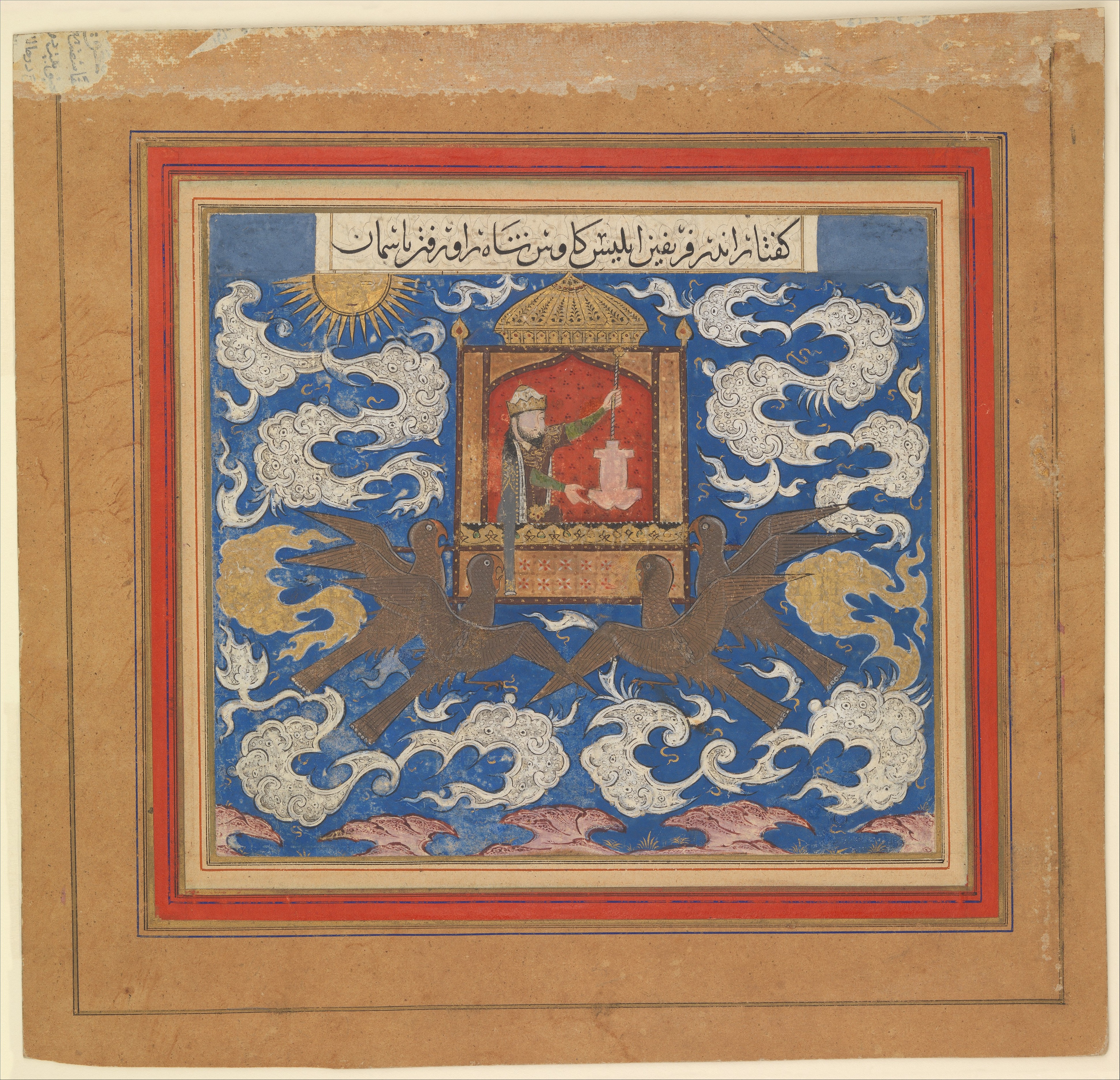
The folio depicting Kai Kavus Attempts to Fly to Heaven from a 16th-century Persian Shahnama presents a profound paradox for the contemporary couturier. The narrative—a monarch’s hubristic attempt to ascend to the heavens via a throne borne by eagles, ending in a catastrophic fall—is one of ambition and gravity. Yet, its aesthetic execution, rendered in ink, opaque watercolor, and gold on paper with margins of ink and gold on dyed paper, offers a lexicon of pure, ungrounded elegance. As an artifact of isolated aesthetic archaeology, we extract not the moral, but the material and compositional logic. For the 2026 Natalie Fashion Atelier silhouette, this folio informs a new architectural language: one that balances the illusion of flight with the inescapable gravity of the body, translating the tension between ascension and descent into tangible fabric and form.
II. Materiality as Structural Grammar: From Folio to Fabric
2.1 The Gilded Substrate: Luminosity as a Structural Element
The manuscript’s foundation is dyed paper, a substrate that is not neutral but actively chromatic. The margins, treated with ink and gold, create a luminous frame that contains and elevates the central narrative. For 2026, this translates into a revolutionary approach to base fabrics. We propose a new category of “substrate silks”—double-faced duchesse satin where the underside is dyed a deep, resonant indigo or pomegranate, while the top surface is treated with a micro-application of gold pigment. This is not a print; it is a material gradient. The silhouette becomes a vessel of light, where the gold catches ambient illumination during movement, while the dyed base provides a grounding weight. The architectural logic is clear: the garment’s structure is defined by its own luminosity, with the gold acting as a structural gilding that highlights seams, darts, and the very lines of construction.
2.2 Opaque Watercolor and Ink: The Palette of Tension
The opaque watercolor in the folio creates areas of dense, matte color—the deep blues of the sky, the rich reds of the royal robes—while the ink provides the calligraphic, precise lines of the throne, the eagles’ wings, and the architecture of the heavens. This duality of opacity and line is the core of our 2026 silhouette strategy. We interpret this as a “negative space” construction. The silhouette will feature large, matte panels of heavy silk gazar (the watercolor) that are bisected and defined by thin, structural seams of black silk organza piping (the ink). These seams do not merely join; they draw the contour of the body, mimicking the ink lines that define the angels and the throne. The result is a dress that is at once a solid, volumetric form and a delicate, linear drawing. The opacity grounds the garment; the ink lines give it the illusion of flight.
III. Silhouette Architecture: The Ascent and the Fall
3.1 The “Throne” Shoulder: A Cantilevered Structure
The central image of the folio is the throne itself—a precarious, elevated platform. For 2026, this inspires a new shoulder architecture: the “Cantilevered Throne” silhouette. The shoulder line is not a natural drop but a deliberate, forward-projecting structure. Using a hidden armature of molded horsehair canvas and micro-steel boning, the shoulder extends outward and upward, creating a horizontal plane that visually “lifts” the torso. This is a direct translation of the throne’s levitation. The fabric—our gilded duchesse satin—is draped over this structure, creating a tension between the rigid, architectural shoulder and the fluid fall of the fabric below. The silhouette is a paradox: it appears to defy gravity at the top, while the skirt, heavy with the weight of the gold pigment, cascades downward, embodying the imminent fall.
3.2 The “Eagle’s Wing” Sleeve: A Study in Asymmetrical Lift
The eagles in the folio are not depicted in symmetrical flight; their wings are angled, creating a dynamic, unbalanced lift. This asymmetry is crucial. The 2026 silhouette will feature a single, dramatic sleeve—the “Eagle’s Wing”—constructed from multiple panels of pleated silk organza. The pleats are not uniform; they are graduated, wider at the shoulder and narrowing to the wrist, mimicking the feather structure of a wing. This sleeve is attached at a single, off-center point on the shoulder, creating a sweeping, diagonal line across the torso. The opposite arm remains bare or is encased in a simple, form-fitting sleeve of matte crepe. This asymmetry creates a visual torque, a sense of rotational movement that echoes the chaotic, spiraling ascent of Kai Kavus’s throne. The sleeve is not merely decorative; it is a kinetic counterweight to the static, grounded body.
3.3 The “Heavenly Descent” Skirt: A Cascade of Gold and Ink
The lower half of the silhouette must resolve the tension between the upward thrust of the shoulders and the inevitable pull of gravity. The “Heavenly Descent” skirt is a floor-length, columnar form that is deceptively simple. Its complexity lies in its construction. The skirt is composed of overlapping, vertical panels of gazar and organza, each panel edged with a thin line of black silk cord (the ink). The panels are cut on the bias, allowing them to twist and fall in a controlled, spiraling cascade. The gold pigment is applied in a gradient: dense at the waist, fading to a mere dusting at the hem. This creates a visual effect of the gold “falling” from the body, like the gold leaf of the manuscript margins bleeding into the paper. The skirt is heavy, grounded, and linear, providing the necessary counterpoint to the soaring, asymmetrical upper body. It is the fall after the flight.
IV. The 2026 Collection: A Lexicon of Controlled Ambition
The final silhouette is not a costume but a technical thesis. It is a dress that wears its construction as openly as the folio wears its gold. The “Kai Kavus” silhouette for Natalie Fashion Atelier’s 2026 haute couture collection is a study in controlled ambition. It acknowledges the impossibility of flight, yet uses the memory of that ambition—the gold, the ink, the cantilevered shoulder, the asymmetrical wing—to create a garment of sublime, paradoxical elegance. The wearer is not Kai Kavus, falling from grace. The wearer is the architect of that fall, the one who understands that true luxury lies in the tension between the desire to ascend and the grace to descend. The silhouette is a monument to that tension, rendered in gold, ink, and the most rigorous of couture techniques.