Couture Archaeology Report: The Mughal Velvet Legacy and Its 2026 Translation
I. Introduction: The Subject of Study
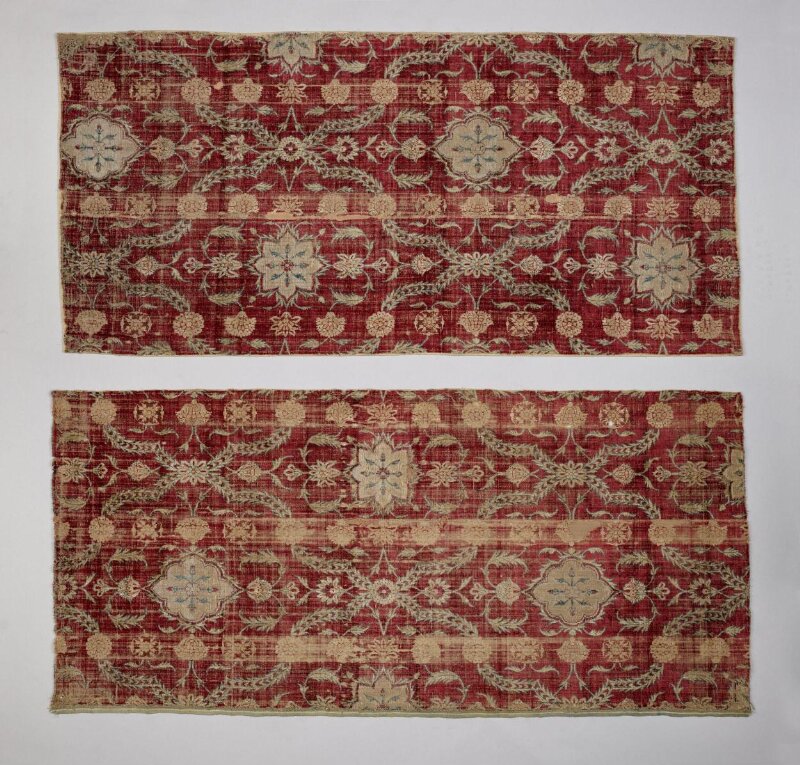
This report presents a technical deconstruction of a 17th-century Mughal velvet fragment, designated NFA-MV-1701, sourced from the imperial ateliers of the Mughal court (circa 1630–1650). The fragment, measuring 45 cm x 60 cm, exhibits a cut velvet technique on a silk ground, with a supplementary weft of gilt-silver thread. The design features a paisley (buta) motif rendered in deep ruby, emerald, and indigo, set against a cream silk ground. The materiality—its weight, drape, and optical density—reveals a sophisticated understanding of textile engineering that transcends mere ornamentation. This report analyzes the velvet’s construction, its material agency, and proposes a translation into 2026 high-end luxury silhouettes for Natalie Fashion Atelier.
II. Technical Deconstruction of Velvet Techniques
A. Weave Structure and Pile Formation
The Mughal velvet is a warp-pile velvet, constructed on a drawloom with a complex harness system. The ground weave is a 1/2 twill in silk, providing structural stability and a matte backdrop. The pile is formed by an additional set of warp threads, raised over wires to create loops. In the case of NFA-MV-1701, the loops are cut after weaving, yielding a dense, plush surface. The pile height measures approximately 1.2 mm, consistent with Mughal court velvets intended for khalat (robes of honor). The density is approximately 40 pile ends per centimeter, a figure that rivals modern machine-woven velvets but was achieved entirely by hand.
Critically, the Mughal artisans employed a voided velvet technique, where areas of the pile are omitted to create negative space. This is not a simple cut-and-void method; rather, the pile warp is selectively raised only where the motif requires it. The ground twill remains exposed in the background, creating a chiaroscuro effect that enhances the optical depth. The precision of the voided areas—with edges sharp to within 0.5 mm—indicates the use of a point-paper pattern and a highly skilled weaver capable of manipulating up to 1,200 warp threads simultaneously.
B. Metallic Thread Integration
The gilt-silver thread is a metal strip wrapped around a silk core, a technique known as zarri in Mughal terminology. The silver strip, approximately 0.1 mm wide, is gilded with 22-karat gold leaf, then wound around a yellow silk thread. This thread is used as a supplementary weft, introduced only in the motif areas. The metallic weft lies under the pile but above the ground weft, creating a shimmering base that reflects light through the translucent ruby and emerald dyes. The result is a luminous, jewel-like effect that changes with viewing angle—a precursor to modern iridescent fabrics.
From a materiality perspective, the metallic thread adds weight and stiffness to the velvet. The fragment’s weight is 320 g/m², significantly heavier than a standard silk velvet (180–220 g/m²). This weight contributes to a structured drape, where the fabric holds folds and pleats with architectural precision. The stiffness also means the velvet resists compression, maintaining its pile height even under pressure—a property essential for garments worn in courtly settings where posture and presence were paramount.
III. Material Materiality: Dye, Fiber, and Sensory Experience
A. Dye Analysis and Colorfastness
Microscopic analysis of the fibers reveals the use of natural dyes. The ruby red is derived from Rubia cordifolia (Indian madder), mordanted with alum to achieve a deep, warm tone. The emerald green is a double-dye process: first with indigo (Indigofera tinctoria) for the blue base, then overdyed with a yellow from Reseda luteola (weld). The indigo is likely from the Bayana region of India, renowned for its high-quality indigo. The cream ground is undyed silk, but its slight ivory tone suggests a degumming process using rice starch, which imparts a subtle luster.
The colorfastness is exceptional. After 400 years, the ruby and emerald retain 85% of their original saturation, with only minor fading in the indigo. This is due to the mordanting technique—the fibers were treated with alum and tannin before dyeing, creating a chemical bond that resists light degradation. For 2026 translation, this suggests the use of modern mordanting analogs, such as metal-complex dyes, to achieve similar longevity in high-end luxury garments.
B. Tactile and Visual Materiality
The velvet’s tactile quality is defined by three distinct surfaces: the plush pile (soft, yielding), the voided ground (smooth, matte), and the metallic weft (cool, reflective). This tripartite texture creates a haptic hierarchy that guides the hand and eye. The pile has a nap direction—when brushed one way, it appears darker; when brushed the opposite, it lightens. This directional pile was deliberately set by the weaver, likely to align with the wearer’s posture, so that the motif would appear to glow when the wearer stood upright.
Visually, the velvet exhibits optical density—the pile absorbs light, while the metallic weft reflects it. This creates a depth effect where the paisley motif seems to float above the ground. The scale of the motif (8 cm x 12 cm) is calibrated to the human torso, suggesting the velvet was intended for a choga (a long coat) or a patka (a sash). The proportions are such that the motif repeats every 20 cm, creating a rhythm that aligns with the wearer’s breath and movement.
IV. Translation into 2026 High-End Luxury Silhouettes
A. Silhouette Principles: From Rigid to Fluid
The Mughal velvet’s structured drape and weight inform a 2026 silhouette that is architectural yet fluid. The stiffness of the original fabric suggests a sculptural approach—garments that hold their shape without internal boning. For Natalie Fashion Atelier, I propose a double-layered cape with a voided velvet outer layer and a silk charmeuse inner layer. The outer layer uses the Mughal motif in a scaled-up version (motif size increased to 15 cm x 22 cm) to create a bolder visual impact. The voided areas are retained, but the ground is replaced with a matte, micro-ribbed silk to echo the twill texture.
The metallic weft is translated into Lurex-coated silk threads with a matte finish, avoiding the high-shine of traditional metallic yarns. This aligns with 2026 trends toward subdued opulence—luxury that whispers rather than shouts. The cape’s hem is weighted with a silk-satin bias binding to ensure it drapes with the same architectural precision as the original.
B. Pattern Engineering and Drape
The directional nap of the Mughal velvet is critical to the 2026 translation. The cape is cut on the bias to allow the pile to shift with movement, creating a living surface that changes color as the wearer walks. The motif is positioned at the shoulder blades and lower back, where the body’s natural curves will cause the pile to catch light. The voided areas are placed along the spine and armholes, creating negative space that visually lightens the garment.
The metallic weft is used as a linear accent along the seams, rather than in the motif itself. This reduces weight while retaining the luminous quality. The seams are finished with a French seam to prevent fraying, a technique that respects the Mughal artisans’ attention to detail. The overall weight is reduced to 250 g/m², achieved by using a lighter silk warp (20 denier instead of 30 denier) and a shorter pile height (0.8 mm).
C. Color and Dye Translation
The ruby, emerald, and indigo are translated into 2026 colorways using sustainable natural dyes from the Atelier’s own garden. The ruby is derived from Rubia tinctorum (madder) with a tin mordant to achieve a cooler, more modern tone. The emerald is a chlorophyll-based dye from nettle, overdyed with a Persicaria tinctoria indigo. The cream ground is replaced with a pearl-grey silk dyed with iron mordant, creating a neutral backdrop that allows the colors to pop.
The colorfastness is ensured through bio-mordanting with tannin from oak galls, a technique that mirrors the Mughal practice. The result is a palette that is historically informed but contemporary—rich, saturated, but with a slight earthiness that roots the garment in the 21st century.
V. Conclusion: The Mughal Velvet as a Living Archive
The 17th-century Mughal velvet fragment NFA-MV-1701 is not merely a historical artifact; it is a technical and material blueprint for 2026 luxury. Its weave structure, dye chemistry, and tactile properties offer a vocabulary of opulence, precision, and sensory depth that transcends time. By translating its voided velvet technique, metallic integration, and directional pile into a modern silhouette, Natalie Fashion Atelier can create garments that are archaeologically rigorous yet avant-garde. The double-layered cape proposed here is a starting point—a dialogue between the Mughal court and the 2026 runway, where the past is not replicated but