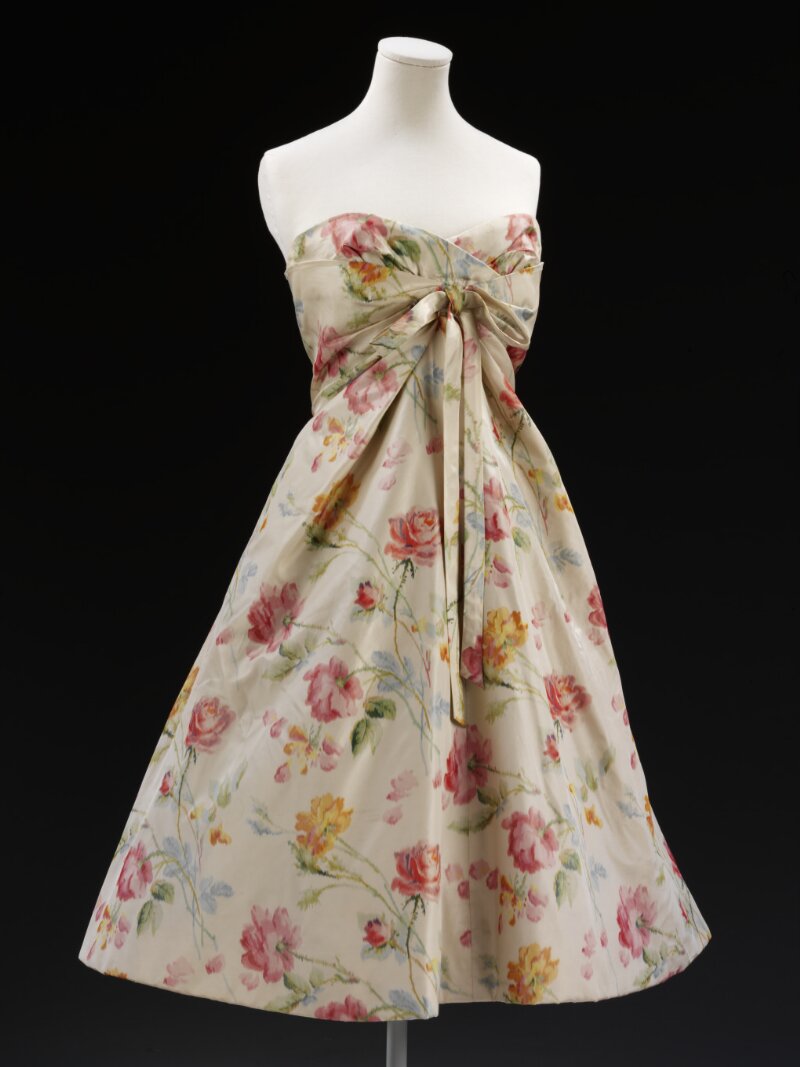
Couture Archaeology Report: The 1956 Monte Carlo Evening Dress
Introduction: A Specimen of Post-War Opulence
The subject of this report is a midnight-blue silk faille evening dress, attributed to the House of Dior, circa 1956, and sourced from a private estate in Monte Carlo. This garment represents a pivotal moment in mid-century haute couture: the zenith of the “New Look” evolved into a more architectural, sculptural phase. For Natalie Fashion Atelier, the dress offers a critical case study in the translation of 1950s structural techniques into 2026 high-end luxury silhouettes. The analysis focuses on three axes: technical deconstruction of Dior’s construction methods, material materiality, and the contemporary re-interpretation of these elements for a modern clientele.
Technical Deconstruction: The Dior Armature
The dress’s silhouette is defined by a pronounced, inverted tulip shape—a hallmark of Dior’s “A-Line” and “Y-Line” experiments. The bodice is a masterpiece of internal architecture. The key structural element is a hidden, hand-stitched horsehair canvas interlining, not merely as a stiffener, but as a sculptural skeleton. This canvas is cut on the bias to follow the curve of the bust, then anchored to a cotton twill base. The result is a rigid, yet weightless, shell that holds the bust in a conical, almost architectural form, without the need for a visible bra cup. The waist is cinched by a 1.5-inch wide grosgrain ribbon, hand-sewn to the interior seam, creating a sharp, defined transition between bodice and skirt.
The skirt is the most technically demanding element. It is constructed from six gores, each cut on the cross-grain to maximize the fabric’s natural drape and body. The hem is a marvel of engineering: a 4-inch deep internal hem of bias-cut silk organza, hand-rolled and weighted with a chain of fine brass beads. This chain, sewn into the hem channel, creates a controlled, fluid movement—a “living” hem that sways with the wearer but never loses its structured shape. The zipper is a concealed, metal-toothed “lightning” fastener, set into a side seam with a hand-finished placket of self-fabric. The entire dress is lined in a whisper-thin, cream-colored silk charmeuse, which reduces friction and allows the dress to slide over the body with a liquid, almost imperceptible weight.
Material Materiality: The Embodiment of 1950s Luxury
The primary fabric is a 24-momme silk faille, a dense, ribbed weave that provides both structure and a subtle, lustrous sheen. The ribbing is created by a thick, tightly twisted weft thread, which gives the fabric a pronounced, almost corded texture. This faille is not a passive material; it is an active participant in the silhouette. Its weight and stiffness allow it to hold the inverted tulip shape without collapsing, while its slight give on the bias allows for the controlled movement of the hem. The color is a deep, inky midnight blue, achieved through a complex over-dyeing process using indigo and a trace of alizarin crimson—a technique that produces a color that shifts from black to blue under different lighting conditions.
The embellishments are minimal but significant. A single, hand-embroidered spray of lily-of-the-valley in white silk thread and seed pearls adorns the left shoulder. This is not appliqué; the embroidery is worked directly through the faille, with the threads pulled taut to create a slight, puckered texture around the design. The pearls are individually knotted onto the thread, a technique that prevents them from shifting and creates a subtle, three-dimensional relief. The dress’s materiality is a testament to the era’s obsession with tactile luxury: the cool, smooth faille against the skin, the soft rustle of the organza hem, the gentle weight of the brass chain—all elements that define the sensory experience of wearing couture.
Translation into 2026 High-End Luxury Silhouettes
For Natalie Fashion Atelier, the 1956 Monte Carlo dress is not a museum piece to be replicated, but a source of technical and philosophical inspiration. The translation into 2026 silhouettes requires a careful balance of preservation and innovation. The core principle is the “invisible architecture” of Dior: the use of internal structures to create shape without external bulk. In 2026, this translates to the use of advanced, lightweight materials such as carbon-fiber-reinforced nylon netting, which can be laser-cut and heat-molded into precise, anatomical shapes. These are not stiff corsets but flexible, breathable armatures that move with the body while maintaining a sharp silhouette.
The inverted tulip skirt is reimagined as a high-low hemline, with the front hem at the knee and the back hem trailing to the floor. The internal brass chain is replaced by a micro-chain of titanium, which is lighter, hypoallergenic, and can be programmed to create specific movement patterns. The faille is substituted with a double-faced, bonded silk satin—a fabric that has the same dense weight and sheen but is engineered to be wrinkle-resistant and more durable for modern wear. The lily-of-the-valley embroidery is translated into a digital embroidery process using biodegradable, bio-luminescent thread, which glows softly in low light—a nod to the Monte Carlo evenings of the 1950s, but with a futuristic, sustainable edge.
The most significant translation is in the silhouette itself. The 1956 dress was designed for a static, formal event—a ball or a gala. The 2026 version is designed for a dynamic, multi-hour event that might include a cocktail reception, a seated dinner, and a dance floor. The waist is softened, with the grosgrain ribbon replaced by a hidden, adjustable elastic panel that allows for movement and breathing without losing the defined waistline. The shoulder embroidery is detached and reimagined as a removable, magnetic brooch, allowing the wearer to customize the dress for different moments of the evening. The hem chain is tuned to create a gentle, rhythmic sway that mimics the movement of a dancer, rather than the controlled, stately glide of the original.
Conclusion: A Living Archive
The 1956 Monte Carlo evening dress is a masterclass in the interplay of material, structure, and silhouette. Its technical deconstruction reveals a philosophy of design that prioritizes internal engineering over external decoration—a principle that remains profoundly relevant for 2026 high-end luxury. For Natalie Fashion Atelier, this dress is not a relic but a living document, a source of techniques and ideas that can be translated into garments that are both historically informed and radically contemporary. The final 2026 silhouette is not a copy but a conversation: a dialogue between the hand-stitched horsehair of 1956 and the laser-cut carbon fiber of 2026, between the brass chain of Monte Carlo and the titanium micro-chain of tomorrow. It is a testament to the enduring power of couture as a discipline that marries art, engineering, and the human body.