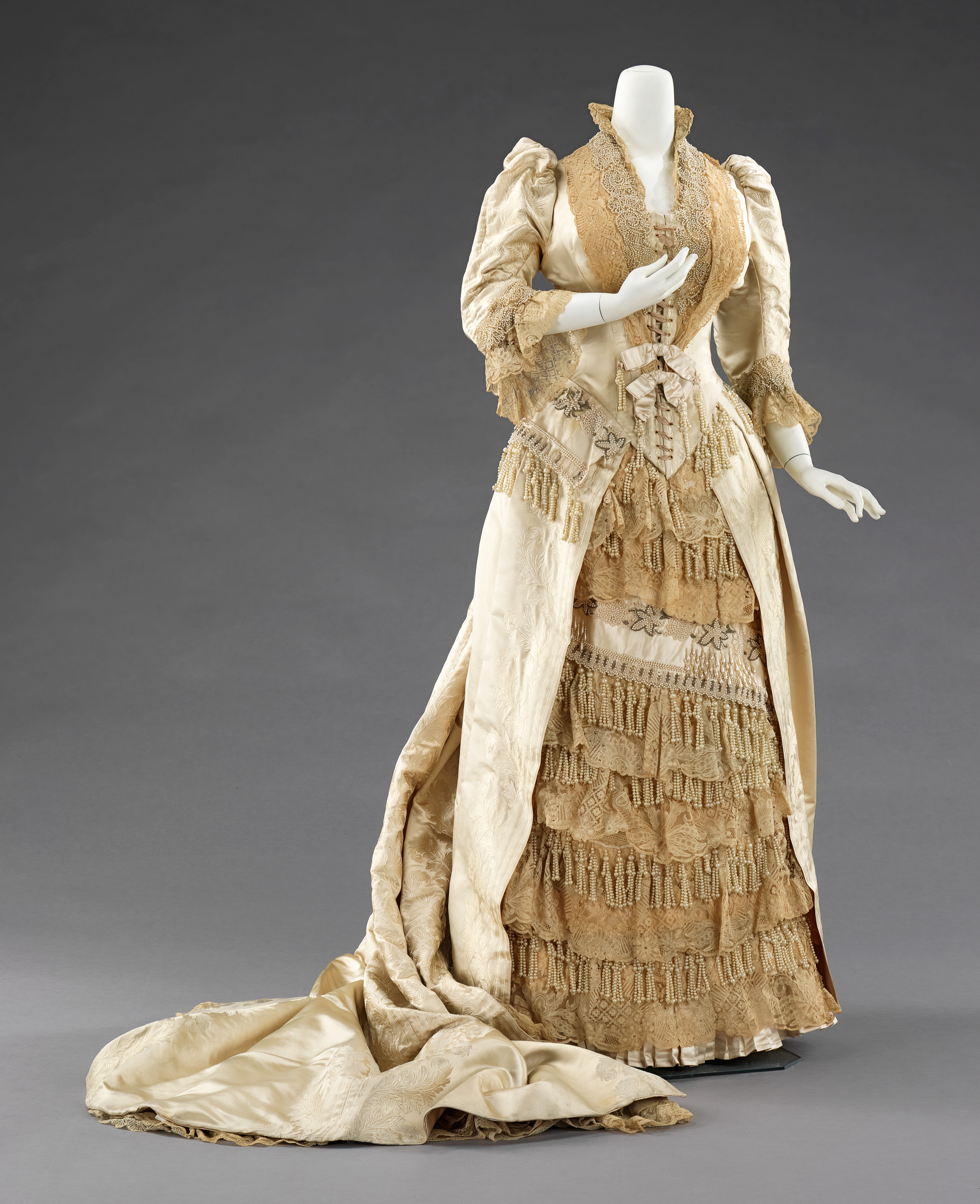
The Artifact Unbound: Deconstructing the Court Presentation Dress for 2026
Within the hallowed archives of Natalie Fashion Atelier, we engage in a practice we term aesthetic archaeology: the exhumation of a garment’s structural soul, divorced from its original social context, to extract pure, form-giving DNA. Our subject is the French Court Presentation Dress—specifically, a late 18th-century grand habit de cour. This is not a study in nostalgia. It is a technical dissection of how a silhouette defined by rigid ceremony and immense material volume can be re-engineered for the fluid, hyper-personalized luxury of 2026. The key to this transformation lies in the dialectic of its materiality: the structural tension between the silk (the skin) and the linen (the architecture).
I. The Archive: A Silhouette of Power and Restriction
The grand habit was a masterpiece of enforced geometry. Its defining feature was the panier—a structure of whalebone or cane—that extended the hips laterally to an extreme width, creating a rigid, inverted cone. The bodice was a corseted cage of linen, boned to an unyielding verticality. Over this, the silk—often a gros de Tours or a lampas—was stretched taut, a canvas for elaborate embroidery. The aesthetic archaeology of this piece reveals a fundamental paradox: the garment’s visual splendor was a direct function of its physical tyranny. The body was a pedestal for the textile.
For 2026, we reject the tyranny but retain the pedestal. Our deconstruction focuses on the linen understructure as a source of architectural integrity and the silk overlay as a source of kinetic luxury. We are not recreating the panier; we are abstracting its logic into a new system of volume and support.
II. Materiality as Language: The Silk-Linen Dialectic
The genius of the French court dress was its material hierarchy. The linen—coarse, resilient, and utterly honest—served as the hidden skeleton. The silk—lustrous, fragile, and supremely expressive—was the visible flesh. This binary is our primary design instrument for 2026.
Linen: The Structural Conscience
In the original garment, the linen was a composite of multiple layers: a heavy, unbleached toile for the panier casing, a finer, starched linen for the bodice lining, and a soft, hand-woven linen for the chemise beneath. For our 2026 silhouette, we extract the structural linen as a visible design element. We are developing a new category of “architectural linen”—a double-faced, basket-weave linen with a resin-infused backbone. This material is not hidden. It becomes the external frame. We use it to construct a new kind of corset: a “soft exoskeleton” that does not compress the torso but rather floats around it, creating a negative space between the body and the garment. This linen frame, with its matte, granular texture, provides the visual and physical anchor for the silk.
Silk: The Kinetic Skin
The court dress silk was a static spectacle. It was meant to be seen, not moved. For 2026, we invert this. We select a liquid silk—a 22-momme charmeuse with a high-twist crepe backing—that is engineered for motion. This silk is not stretched over the frame; it is suspended from it. We employ a technique of “floating panels” where the silk is attached to the linen exoskeleton only at key stress points (the shoulders, the high hip, the center back). The rest of the silk falls away, creating a dynamic, breathing second skin that ripples with the wearer’s movement. The historical silk was a shield. The 2026 silk is a veil.
III. Silhouette Architecture: From Rigid Cone to Fluid Torus
The 18th-century silhouette was a cone—a solid, static volume. Our 2026 silhouette is a torus—a donut-shaped volume that is hollow at the center, allowing the body to be the core of the void. This is achieved through three key structural interventions.
1. The Deconstructed Panier (The Linen Hoop)
Instead of a continuous, rigid oval, we create a series of independent, articulated linen hoops that encircle the hips. These are not connected by fabric but by invisible, micro-elasticated silk ribbons. This allows the hoops to shift and separate as the wearer walks, creating a silhouette that is simultaneously voluminous and fragmented. The historical panier was a cage. The 2026 panier is a constellation.
2. The Floating Bodice (The Silk Suspension)
The historical bodice was a solid, boned unit. Our 2026 bodice is a silk membrane that is suspended from a single, sculptural linen collar. This collar, reminiscent of the court’s high neckline, is a rigid, hand-molded piece of architectural linen. From it, the silk charmeuse drapes in a single, continuous spiral, wrapping around the torso but never touching the waist. The effect is a silhouette that is both regal and ethereal, with the silk creating a liquid, vertical line that contrasts with the horizontal volume of the linen hoops below.
3. The Train as Kinetic Tail
The court dress train was a symbol of status, a heavy, static weight. Our 2026 train is a kinetic tail—a long, asymmetrical panel of the liquid silk that is attached to the back of the linen collar. It is weighted at the hem with a fine, silk-wrapped chain, causing it to flow and sweep behind the wearer with every step. This is not a train that is carried; it is a train that moves, creating a continuous, changing line of tension and release.
IV. The 2026 Silhouette: A Technical Synthesis
The final silhouette for the Natalie Fashion Atelier 2026 Haute Couture collection is a study in controlled contradiction. It is a “structured drape”—a form that is simultaneously architectural and fluid. The linen exoskeleton provides the intellectual rigor, the historical reference point, the sense of ceremony. The liquid silk provides the sensual pleasure, the kinetic freedom, the sense of the contemporary.
The wearer of this 2026 garment is not a pedestal for the textile. She is the animator of the textile. The linen frame is the instrument; the silk is the music. The volume is not imposed upon her body; it is generated around her body, a halo of materiality that responds to her presence. This is the ultimate deconstruction of the court presentation dress: a removal of the cage to reveal the freedom within the form. The classical elegance is not lost; it is transformed into a new language of luxury—one that is technically complex, aesthetically pure, and profoundly personal. This is the artifact unbound.