Deconstructing the Classical Elegance: The Ornate Upper Roof Pendant as a Silhouette Catalyst for 2026
Artifact Analysis: The Gold Pendant and its Aesthetic Archaeology
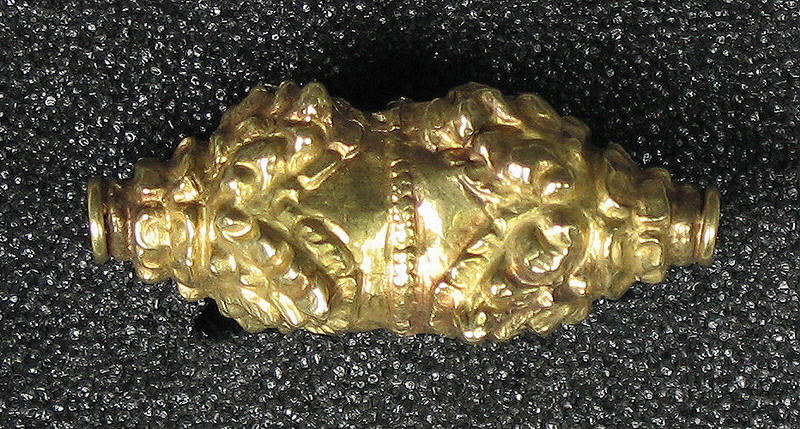
The Ornate Upper Roof Pendant from Central Java represents a pinnacle of Indonesian goldsmithing, a materiality that transcends mere adornment to become a spatial narrative. This artifact, traditionally suspended from the apex of a Javanese pendopo (open pavilion), served not only as a structural keystone but as a metaphysical anchor, channeling cosmic energy downward. Its form, a dense, filigree-laden sphere of hammered gold, is a study in controlled chaos. The surface is a riot of stylized flora—split-leaf motifs that echo the fronds of the sacred banyan—interwoven with geometric lattices that mimic the cosmic order of the mandala. Each leaf is meticulously engraved, its veins rendered as fine, parallel grooves that catch the light, creating a shimmering, almost liquid surface.
The pendant’s resonance with our archive node—Mirror with Split-Leaf—is profound. The node describes a duality: one side a polished silver mirror inlaid with gold, the other a cold stone sarcophagus narrating life through relief. The Javanese pendant embodies this same tension. Its exterior is a radiant, golden sunburst of organic form, a celebration of life and growth. Yet, its interior, if one could peer within, is a hollow void, a silent, empty space that speaks of the inevitable decay and the cycle of rebirth. This dichotomy—the luminous surface versus the hollow core—is the core aesthetic principle we will deconstruct for 2026.
Materiality and Silhouette: Translating Gold into Fabric
Gold, in its raw form, is a metal of extreme density and weight. For haute couture, we must translate its material properties—its reflectivity, its malleability, its structural rigidity—into a language of fabric and form. The 2026 silhouette will not mimic the shape of the pendant; rather, it will embody its structural logic.
First, consider the reflectivity. The pendant’s surface is not a flat, mirror-like finish. It is a complex topography of convex and concave curves, each facet catching light at a different angle. For the 2026 silhouette, this translates into sculptural draping using high-lustre, metallic-coated silks and liquid lamé. We will employ asymmetrical, spiral-cut panels that wrap the body, creating a dynamic interplay of light and shadow. The fabric itself will be treated with a micro-pleating technique that mimics the engraved leaf veins, creating a surface that is both reflective and textured, never static. The silhouette will be a second skin, a golden carapace that moves with the wearer, yet retains a sense of architectural weight.
Second, the malleability of gold. The pendant’s filigree is a testament to the metal’s ability to be drawn into the finest threads, then twisted and soldered into intricate lattices. For 2026, we will translate this into laser-cut leather and metallic mesh applied as appliqué or as a secondary, sheer layer over a solid base. The silhouette will feature cut-out panels that reveal the body beneath, echoing the pendant’s hollow interior. This is not a nude illusion; it is a deliberate revelation, a structural void that creates a dialogue between the garment and the form it encloses. The neckline, for instance, will be a complex, asymmetrical lattice of gold-toned leather straps, mimicking the pendant’s filigree, while the bodice remains a solid, sleek column of matte gold silk.
Third, the structural rigidity. The pendant is a dense, weighty object that commands its spatial environment. For the 2026 silhouette, this translates into architectural tailoring that defies gravity. We will use corseted bodices constructed from multiple layers of horsehair canvas and boned with carbon fiber, then covered in gold leaf-embossed leather. The silhouette will not be soft or flowing; it will be a controlled, sculptural form that stands away from the body, creating its own volume. Think of a peplum jacket with exaggerated, wing-like shoulders that flare outward, then curve inward at the waist, echoing the pendant’s spherical yet compressed form. The skirt will be a mermaid silhouette that is tight through the hips, then explodes into a cascade of gold-lamé ruffles at the hem, each ruffle a separate, stiffened petal that mimics the pendant’s split-leaf motifs.
Silhouette Archetypes for 2026: The Javanese Pendant Collection
From this deconstruction, we propose three distinct silhouette archetypes for the 2026 collection, each a direct translation of the pendant’s aesthetic principles.
Archetype I: The Keystone Silhouette. This is the direct homage to the pendant’s function as a spatial anchor. The silhouette is a high-neck, long-sleeved gown that is entirely encased in a lattice of gold-toned metal mesh, applied over a base of matte black silk. The lattice is not uniform; it is densest at the shoulders and neckline, then gradually opens up as it descends, creating a sense of weight and gravity. The hem is a solid, heavy band of gold-embroidered velvet, anchoring the garment to the floor. This is a ceremonial, almost priestly silhouette, evoking the pendant’s role as a connector between heaven and earth.
Archetype II: The Split-Leaf Silhouette. This archetype focuses on the pendant’s organic, floral motifs. The silhouette is a tiered, asymmetrical dress composed of multiple, overlapping panels of gold lamé, each panel cut into a stylized leaf shape. The panels are not sewn together at the seams; they are attached at a single point on the shoulder, allowing them to float and flutter with movement. The effect is that of a living, breathing form, a golden flower in perpetual bloom. The inner layer is a simple, body-hugging sheath of nude silk, providing the “hollow core” that is revealed as the outer panels shift. This silhouette is dynamic, ethereal, and deeply sensual.
Archetype III: The Hollow Core Silhouette. This archetype is the most conceptual, directly referencing the pendant’s interior void. The silhouette is a two-piece ensemble: a cropped, sculptural jacket and a floor-length pencil skirt. The jacket is constructed from a single piece of gold-embossed leather, molded into a rigid, shell-like form that stands away from the body. The front is completely open, revealing a sheer, gold-mesh bodysuit beneath. The skirt is a solid column of matte gold silk, with a single, dramatic cut-out at the hip, revealing a flash of bare skin. This silhouette is a study in absence and presence, a deliberate exposure of the void that is the true subject of the garment.
Technical Execution and Craftsmanship
The 2026 collection will require a return to artisanal techniques that mirror the pendant’s own creation. The gold lamé will be hand-woven on a traditional loom, using a core of silk and a weft of gold-plated copper thread. The metal mesh will be hand-soldered, not machine-woven, to achieve the irregular, organic lattice of the Javanese filigree. The leather will be embossed using a custom-made die, carved by a master engraver, to replicate the pendant’s split-leaf motifs. Each garment will be a singular artifact, a wearable piece of aesthetic archaeology that carries the weight of its heritage into the future of luxury.
The 2026 silhouette is not a costume; it is a philosophical statement. It is the translation of a golden pendant’s classical elegance into a language of form, light, and void. It is a celebration of the tension between surface and depth, between the radiant exterior and the silent, hollow interior that defines all great art. This is the new luxury: not the accumulation of material, but the mastery of absence.