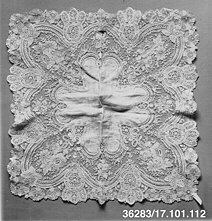
The Handkerchief as Architectural Membrane: Needle Lace and Point de Gaze in the 2026 Silhouette
The handkerchief, a quotidian object of intimate utility, has long been dismissed by the uninitiated as a mere accessory. Yet within the rigorous practice of aesthetic archaeology at Natalie Fashion Atelier, it is recognized as a foundational textile artifact—a portable micro-architecture of the body. Its historical trajectory, from the mouchoir de poche of the French court to the embroidered tokens of Victorian sentiment, encodes a profound lesson in negative space, structural delicacy, and the dialectic between concealment and revelation. This research artifact isolates the handkerchief’s classical elegance through the lens of needle lace, specifically the Point de Gaze technique, to extrapolate its influence on the 2026 high-end silhouette. The handkerchief, in its purest form, is not a cloth but a membrane of light. Its translation into contemporary couture demands a radical rethinking of volume, transparency, and the very definition of a garment’s boundary.
Archaeology of the Object: The Handkerchief as Isolated Signifier
To deconstruct the handkerchief is to strip it of its sentimental veneer and examine its core technical and aesthetic DNA. The classical handkerchief, particularly those produced in the 18th and 19th centuries, operates on a principle of controlled fragility. Its edges are not finished; they are dissolved. Its surface is not solid; it is a lattice. The Point de Gaze—a needle lace originating in Brussels and perfected in France—epitomizes this paradox. It is a lace of extraordinary fineness, characterized by its réseau (a hexagonal mesh ground) and its toilé (the solid, often raised, pattern motifs). The resulting fabric is simultaneously airy and structured, a web of thread that defines space by what it omits.
In the isolated archive of the handkerchief, we find a masterclass in negative space design. The lace does not cover the skin; it frames it. The handkerchief’s function—to wipe, to wave, to conceal a tear—is secondary to its aesthetic role as a portable void. For the 2026 silhouette, this principle is revolutionary. The garment no longer needs to be a continuous shell. Instead, it can be a series of lacunae, where the body is revealed through the absence of fabric, much as the skin is revealed through the mesh of Point de Gaze. The handkerchief’s geometry—its perfect square, its folded triangle, its draped asymmetry—becomes a generative grammar for silhouette construction.
Materiality and Technique: Point de Gaze as Structural Language
The technical specificity of needle lace, and Point de Gaze in particular, is non-negotiable for the 2026 couture application. Unlike bobbin lace, which is twisted, Point de Gaze is built stitch by stitch with a needle and thread, allowing for an unparalleled sculptural precision. The point de brides (buttonhole stitches) that form the motifs are not merely decorative; they are load-bearing elements. The jours (open spaces) are not holes; they are structural apertures.
Translating the Réseau to the Silhouette
The hexagonal mesh of the Point de Gaze réseau offers a direct template for the 2026 silhouette’s architectural armature. Consider the following material translations:
1. The Structured Void: The garment’s volume is no longer generated by the weight of the fabric, but by the tension of the lace. A 2026 evening gown, informed by the handkerchief, would employ Point de Gaze panels as tensile membranes. The hexagonal mesh, scaled up and reinforced with micro-crinoline or horsehair, creates a self-supporting structure that holds its shape without a lining. The silhouette becomes a cage of light, where the body is the core and the lace is the exoskeleton. This is a direct inversion of the classical corset: not a compression of the body, but a definition of the air around it.
2. The Toilé as Armature: The raised motifs of Point de Gaze—often floral or geometric—are not flat. They are embossed through the use of a thicker thread (the gimp) and a dense buttonhole stitch. In the 2026 silhouette, these motifs become structural ribs. A jacket, for example, might feature a Point de Gaze toilé that runs along the shoulder seam, extending into a sculptural collar that stands away from the neck. The motif is no longer a decoration; it is a cantilever. The handkerchief’s edge, often finished with a scalloped or picot border, becomes the garment’s hemline—not a cut, but a dissolution into the air.
3. The Point de Gaze as Second Skin: For a more restrained application, the lace can be used as a veil over a solid base. However, the 2026 directive demands that the veil be the primary structural element. A sheath dress, for instance, would be constructed entirely from Point de Gaze, with the seams acting as the brides (connecting bars) that join the motifs. The dress would have no darts; its fit would be achieved through the stretch of the réseau and the strategic placement of the toilé to create tension points at the waist and hips. The result is a garment that breathes, moves, and reveals the body’s topography with every gesture.
Silhouette Architecture: The Handkerchief’s Geometry in 2026
The classical handkerchief exists in three primary states: the square (full spread), the triangle (folded diagonally), and the asymmetric drape (gathered or twisted). Each state offers a distinct silhouette strategy for 2026.
The Square: A New Volumetric Paradigm
The square handkerchief, when held by its corners, creates a catenary curve. This is the foundational shape for a 2026 cape or overcoat. The garment would be cut as a single, large square of Point de Gaze, with the corners weighted by crystal beads or metallic thread. When worn, the fabric drapes into a series of soft, architectural folds, creating a volume that is both generous and transparent. The negative space between the folds becomes as important as the fabric itself. This silhouette rejects the rigid, sharp tailoring of the 2020s in favor of a fluid, atmospheric geometry. The body is not confined; it is enveloped by a cloud of thread.
The Triangle: The Asymmetric Drape
Folding the handkerchief diagonally yields a right-angle triangle. This shape is the basis for the 2026 asymmetric bodice. The long edge of the triangle becomes the neckline, sweeping from one shoulder to the opposite hip. The Point de Gaze is worked so that the réseau is denser at the hip and more open at the shoulder, creating a gradient of transparency. The toilé motifs are concentrated along the fold line, acting as a structural spine that holds the drape in place. This silhouette subverts the traditional bias cut; it is not about following the grain, but about manipulating the lace’s inherent tension. The resulting garment is a study in diagonal lines, where the body is revealed in fragments, much like the handkerchief’s edge reveals the skin beneath.
The Asymmetric Drape: The Twisted Handkerchief
The most radical application is the twisted handkerchief. When a square of Point de Gaze is twisted and knotted, it creates a series of torqued volumes. For 2026, this translates into a dress that is essentially a single, continuous piece of lace, twisted around the body and secured at the shoulder and hip. The twist points become the garment’s only closures, and the fabric between them forms a spiral of transparency. This silhouette is a direct challenge to the convention of the seam. The garment is not assembled; it is wrought. The Point de Gaze’s inherent rigidity prevents the twist from collapsing, creating a structure that is both organic and architectural. The body is the core of a helix, and the lace is the DNA that defines its form.
Conclusion: The Handkerchief as a Manifesto for 2026
The handkerchief, isolated from its historical context and subjected to aesthetic archaeology, reveals itself as a prototype for the 2026 couture silhouette. Needle lace, particularly Point de Gaze, is not a decorative trim; it is a structural language of voids, tensions, and cantilevers. The 2026 silhouette, informed by this heritage, will reject the solid in favor of the permeable, the heavy in favor of the tensile, and the tailored in favor of the architecturally draped. The body will no longer be clothed; it will be framed by a membrane of thread. The handkerchief, that most humble of objects, has shown us that the future of luxury lies not in what we add, but in what we dare to omit. The void is the new volume. The lace is the new structure. And the skin is the new canvas.