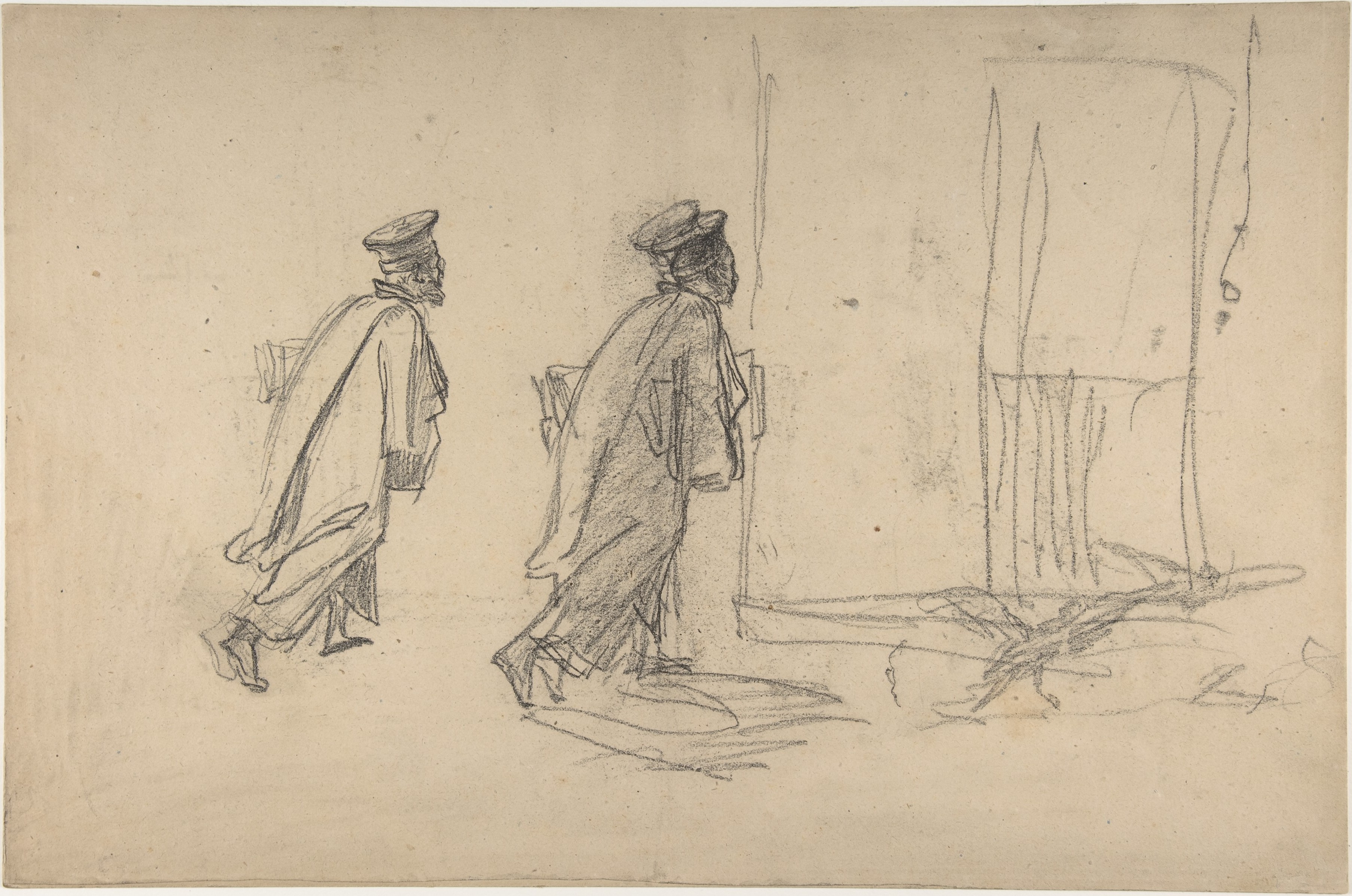
Aesthetic Archaeology: The Lawyer on His Way to Court
The isolated figure of the Lawyer on His Way to Court (Se Rendant à l'Audience), rendered in the austere medium of Black chalk, presents a singular artifact within the archive of global heritage. This is not a portrait of individual vanity, but a study of functional gravitas—the deliberate, almost ritualistic preparation for a performance of authority. The Black chalk, with its inherent capacity for both precise line and soft, atmospheric shadow, captures a silhouette of profound restraint. For Natalie Fashion Atelier, this aesthetic archaeology reveals a blueprint for the 2026 luxury silhouette: a language of power articulated through controlled volume, disciplined line, and the materiality of darkness.
Deconstructing the Classical Elegance
The classical elegance of this subject is not found in ornament, but in the architecture of purpose. The lawyer’s attire, likely a formal robe or a severely tailored coat, is defined by its relationship to the body in motion. The Black chalk technique allows us to see the drape of heavy wool, the precise fall of a shoulder seam, and the subtle tension of fabric as the figure strides forward. The medium’s ability to render deep, almost impenetrable blacks against lighter, chalky greys creates a chiaroscuro that defines form without unnecessary detail.
This is a silhouette of verticality and containment. The line from the crown of the head to the heel is unbroken, a single, authoritative stroke. The shoulders, while not exaggerated, possess a defined structure—a suggestion of padding or a rigid collar that frames the head as the seat of intellect and judgment. The absence of color is a statement of absolute focus. Every fold, every crease, is a record of a specific gesture: the hand adjusting a document, the slight turn of the head. This is elegance born from the elimination of the superfluous, a principle that resonates deeply with the 2026 haute couture ethos.
Materiality of Black Chalk: A Textural Lexicon for 2026
The Black chalk is not merely a drawing tool; it is a material metaphor. Its texture is dry, slightly granular, capable of producing both a velvety matte finish and a sharp, incisive edge. This duality informs the 2026 silhouette in two critical ways. First, the matte finish—a rejection of high-gloss, reflective surfaces in favor of a deep, absorbent darkness. For couture, this translates to fabrics like double-faced cashmere, heavy faille, and matte micro-suede that absorb light rather than reflect it, creating a silhouette that is present but not loud.
Second, the incisive line of the chalk. The sharp, unyielding stroke that defines the lawyer’s collar or the edge of his sleeve becomes a design principle for architectural seaming. In 2026, we see this in garments where seams are not hidden but celebrated—laser-cut edges, bonded hems, and sculptural darts that create a second, structural skin. The Black chalk’s ability to suggest volume through hatching and cross-hatching inspires a new approach to draping: layers of fabric that are not simply gathered, but systematically built up in planes, like the strokes of a master draughtsman, to create a three-dimensional form that is both soft and rigid.
Informing the 2026 Luxury Silhouette: The Power of Restraint
The 2026 luxury silhouette, as decoded from this Black chalk study, is defined by three key principles: the monolithic form, the disciplined shoulder, and the kinetic drape.
The Monolithic Form
The lawyer’s silhouette is a single, cohesive block. This translates into the monolithic coat—a long, single-seam garment that falls from the shoulder to the ankle. The cut is deliberately narrow, skimming the body without clinging, creating a column of fabric that moves as one. The absence of visible closures (hidden zippers, magnetic snaps) reinforces this sense of seamless power. The color is absolute: midnight black, charcoal, and deep anthracite, echoing the tonal range of the chalk. The fabric must have a substantial weight, a density that holds its shape like the chalk line holds its edge.
The Disciplined Shoulder
This is not the aggressive, oversized shoulder of the 1980s. It is a subtle, architectural extension of the natural line. The Black chalk drawing shows a shoulder that is present, but not exaggerated—a structured cap that provides a clear, defined line without creating a separate, horizontal plane. In 2026, this is achieved through internal boning and couture shoulder pads that are integrated into the sleeve head, creating a smooth, continuous curve from the neck to the arm. The effect is one of contained authority, a silhouette that commands space without demanding it.
The Kinetic Drape
The Black chalk masterfully captures the fabric in motion. The lawyer’s stride is visible in the subtle pull of the fabric across the front of the thigh and the gentle flare at the hem. This kinetic drape is the antithesis of static elegance. For 2026, this informs the asymmetric skirt and the side-slit trouser. The fabric is cut on the bias or with a deliberate spiral seam that allows it to fall and move with the body, revealing the leg or the line of the hip only in motion. The weight of the fabric is critical: it must be heavy enough to fall cleanly, but fluid enough to create that single, beautiful line of movement. A double-faced crepe or a matte jersey with a high elastane content achieves this balance.
Conclusion: The Chalk Line as a Couture Imperative
The Lawyer on His Way to Court, rendered in Black chalk, is not an image of fashion, but a diagram of power. The medium itself—dry, precise, and unyielding—becomes the blueprint for a new luxury. The 2026 silhouette, as conceived by Natalie Fashion Atelier, is a direct translation of this aesthetic archaeology: a monolithic form, a disciplined shoulder, and a kinetic drape, all rendered in the deepest, most absorbent blacks. It is a silhouette that speaks not of fleeting trends, but of permanent authority. The Black chalk teaches us that the most powerful statement is often the quietest, the most elegant line the most restrained. This is the heritage of the future, drawn in a single, perfect stroke.