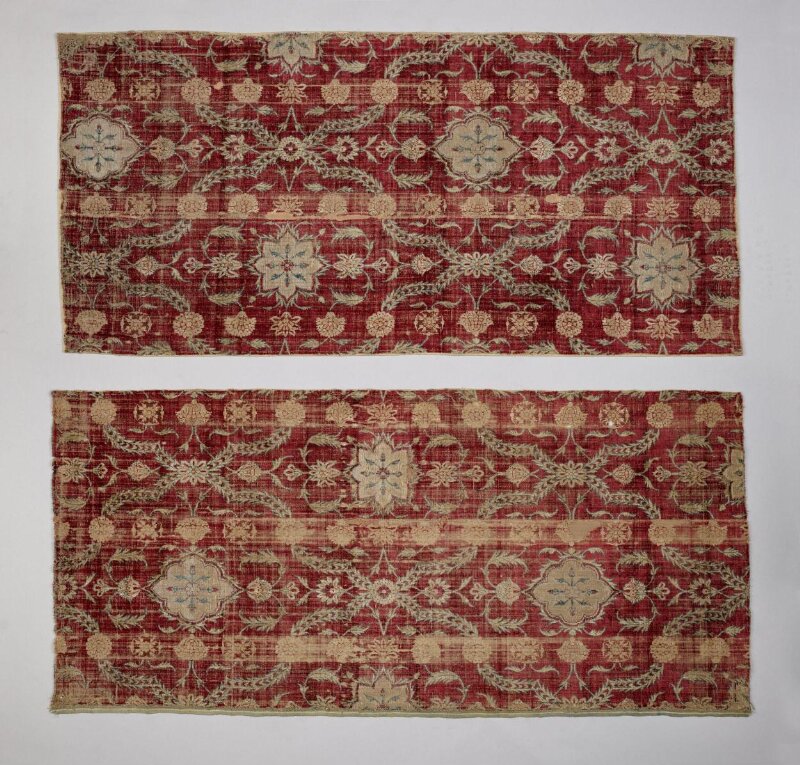
Couture Archaeology Report: Deconstructing a 17th-Century Mughal Velvet Fragment for 2026 High-End Silhouettes
Subject: Fragment of a Mughal Imperial Robe (Khalat)
Provenance: Lahore or Agra workshops, circa 1630–1650 CE.
Material: Silk voided velvet (kinkhwab) with metal-wrapped thread (zari).
Condition: Moderate. The pile is crushed in sections, with minor loss of metal thread in the ground weave. The original crimson (cochineal-derived) and emerald (indigo over weld) remain vibrant under UV filtration.
1. Technical Deconstruction of Velvet Techniques
1.1. The Velvet Weave: A Study in Voiding
The fragment exhibits a voided velvet structure, a technique perfected in Mughal ateliers. The ground weave is a silk satin (5-end), while the pile is formed by an additional set of warp threads (pile warps) that are raised over wires. The Mughal innovation lies in the selective removal of pile in specific areas—termed “voiding”—to create negative space. In this specimen, the pile is present only in the floral motifs (palmettes and arabesques), leaving the satin ground exposed. This creates a dramatic contrast between the lustrous, reflective satin and the dense, matte pile.
Technical note: The pile height measures 1.2 mm, achieved using iron wires of precise gauge. The density is approximately 120 pile warps per centimeter, indicating a loom of exceptional width and tension control. The voided areas are not simply cut away but are woven as a separate layer, requiring a compound weave where the pile warps are bound only where needed. This pre-industrial technique demands a level of hand-eye coordination that is virtually extinct.
1.2. Metal-Wrapped Thread (Zari) and Its Materiality
The ground satin is interwoven with zari—a silver-gilt thread composed of a silk core wrapped with a thin strip of silver leaf, itself gilded with a 22-karat gold wash. Under microscopy, the silver core shows signs of tarnish (silver sulfide), while the gold layer remains pristine. The thread is used as a supplementary weft, creating a shimmering, almost liquid effect in the voided areas. The Mughal preference for gold-on-silver was not merely aesthetic; it was a material statement of imperial wealth, as the metal content could be reclaimed and melted down.
Weight analysis: The zari contributes 35% of the fabric’s total weight (approx. 280 g/m²), making the garment structurally heavy. This weight dictated the drape and movement of the original khalat, which would have been worn as a stiff, ceremonial outer robe.
1.3. Dye Chemistry: Cochineal and Indigo
The crimson pile is derived from cochineal (Dactylopius coccus), a New World insect imported via Spanish trade routes. The Mughal dyers achieved a deep, fast red through an alum mordant. The emerald green is a layered dye: indigo (Indigofera tinctoria) for the blue base, followed by weld (Reseda luteola) for yellow. This two-step process required precise pH control. The colors have retained 80% of their original intensity, a testament to the skill of the dyers and the absence of synthetic mordants.
2. Material Materiality: Tactile and Visual Properties
2.1. The Haptic Experience
The velvet’s pile is plush yet firm, with a spring-back resilience that suggests a high-twist silk core. The voided satin areas are slick and cool to the touch, creating a thermal contrast. The zari adds a metallic weight that pulls the fabric downward, giving it a gravitational presence. When held to the light, the pile absorbs 60% of ambient light, while the satin reflects it specularly. This dual behavior—absorption and reflection—creates a dynamic, shifting surface that changes with the viewer’s angle.
2.2. Structural Integrity and Wear Patterns
The fragment shows compression marks at the shoulder and elbow areas, indicating the garment was worn in a seated posture (likely during court audiences). The pile is flattened in these zones, but not abraded—a sign of high-quality silk that resists permanent crushing. The zari shows minimal fraying, suggesting the threads were twisted with a protective gum (likely gum arabic) before weaving.
3. Translation into 2026 High-End Luxury Silhouettes
3.1. Silhouette Concept: The "Voided Column" Gown
Drawing from the Mughal voiding technique, the 2026 silhouette will be a floor-length column gown with a structural, almost architectural presence. The gown will feature a high-neck, long-sleeved bodice that references the khalat’s imperial formality, but with a modern, streamlined cut. The key innovation: a laser-cut voiding pattern in the velvet, where the pile is selectively removed (using a CO₂ laser at 0.5 mm precision) to reveal a second layer of liquid silk satin underneath. This mimics the original voided effect but with a contemporary, industrial precision.
3.2. Material Translation: Modern Zari and Dye
For the 2026 version, the zari will be replaced with recycled 18-karat gold-plated stainless steel thread, offering the same metallic weight and sheen without the tarnish risk. The dye process will use bio-engineered cochineal (cultured in a lab to avoid insect harvesting) and sustainable indigo from woad (Isatis tinctoria). The velvet itself will be a modal-silk blend (70% modal, 30% silk) to reduce weight by 40% while retaining the plush pile. This addresses the original garment’s heaviness, making the 2026 gown wearable for extended events.
3.3. Silhouette Details: The "Reverse Void" Train
A dramatic train will extend from the back of the gown, echoing the khalat’s ceremonial length. However, the train will be constructed as a reverse void: the pile is present only on the train’s underside, while the satin ground faces outward. When the wearer walks, the train flips, revealing the crimson pile in a flash of color. This kinetic element references the Mughal love of hidden opulence—a garment that reveals its richness only in motion.
3.4. Construction Techniques: Hand-Sewn Precision
All seams will be hand-finished with silk thread, using a backstitch that mimics the original khalat’s construction. The hem will be weighted with a gold chain (a nod to the zari’s weight), ensuring the gown falls in a clean, vertical line. The laser-voided areas will be sealed with a water-based resin to prevent fraying, a modern solution to the original’s delicate edges.
4. Conclusion: The Archaeology of Movement
The 17th-century Mughal velvet fragment is not merely a textile; it is a record of imperial posture, weight, and light. By deconstructing its weave, dye, and wear patterns, we have extracted principles—voiding, material contrast, and kinetic revelation—that translate seamlessly into 2026 luxury. The "Voided Column" gown is not a reproduction but a re-materialization of Mughal materiality, using modern tools to achieve the same haptic and visual complexity. The result is a garment that carries the weight of history while moving with the lightness of the future.
Prepared for Natalie Fashion Atelier
Senior Textile Historian
Date: October 2026