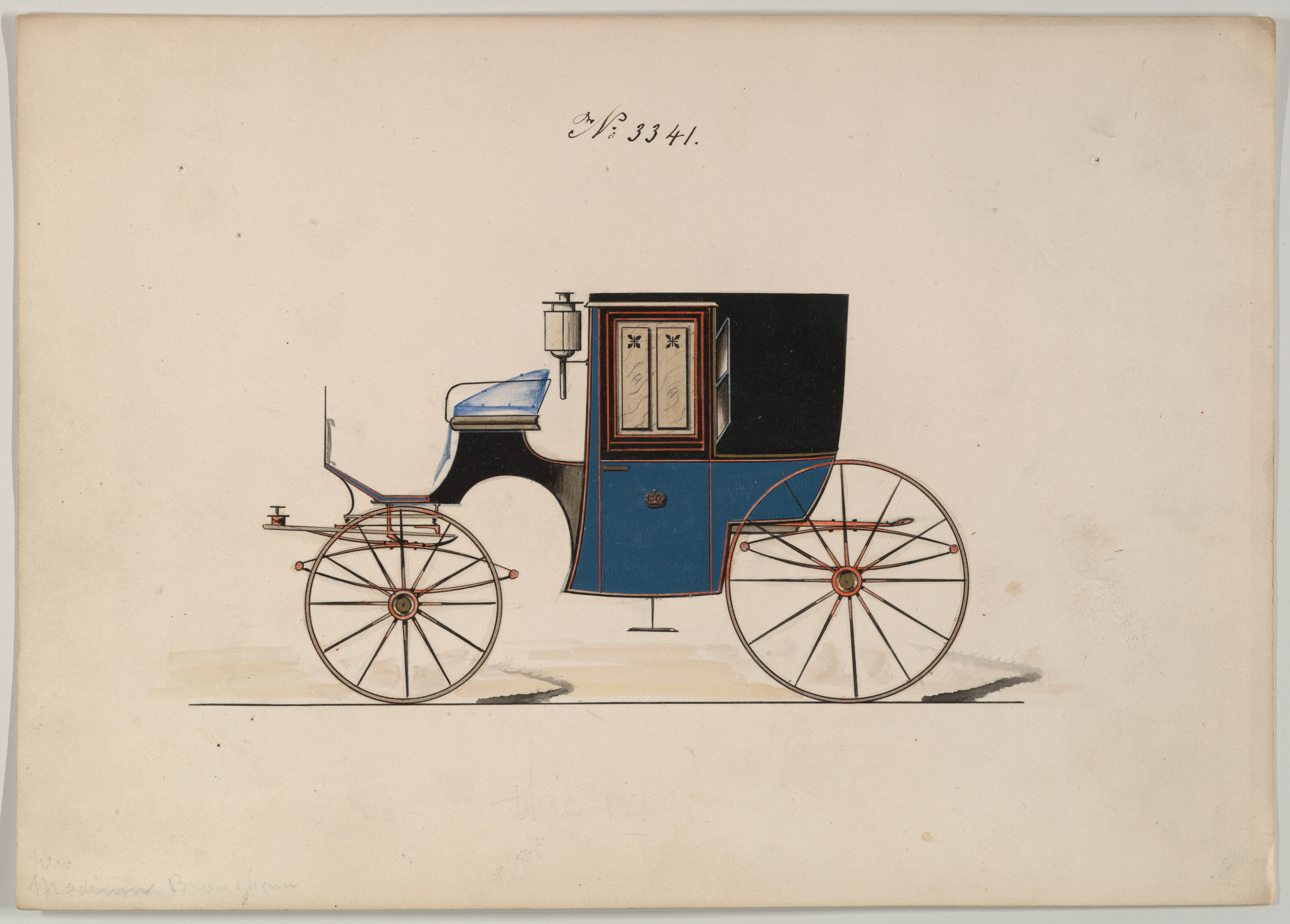
Brougham #3341: Aesthetic Archaeology and the 2026 Silhouette
The study of historical masterpieces, particularly those residing within the domain of aesthetic archaeology, offers an unparalleled lexicon for the evolution of luxury. At Natalie Fashion Atelier, we engage with these artifacts not as mere relics, but as dynamic blueprints for future form. The subject of this technical research paper, Brougham #3341, represents a pivotal moment in the intersection of materiality and silhouette. Executed in pen and black ink, watercolor and gouache with gum arabic, this work is not a fashion illustration in the conventional sense; it is a structural diagram of classical elegance, rendered through a medium that demands precision and fluidity in equal measure. This artifact, isolated from its broader archival context, provides a singular, potent thesis for the 2026 haute couture season.
Materiality as Structural Language
The choice of pen and black ink, watercolor and gouache with gum arabic is not incidental; it is the foundational grammar of Brougham #3341’s aesthetic. The black ink establishes the primary architectural lines—the sharp, unyielding contours of a tailored jacket, the precise cut of a sleeve head, the decisive hemline. This is the skeleton of the garment, the unassailable logic of couture construction. The watercolor, by contrast, introduces the variable of atmospheric volume. It washes over the form, suggesting the drape of a silk faille or the subtle collapse of a cady wool, creating a tension between the rigid ink and the fluid pigment. The gouache, with its opaque density, provides tactile weight—the solidity of a structured bodice, the impenetrable surface of a duchesse satin. The gum arabic binder, a historical medium, imparts a subtle luminosity, a sheen that mimics the light-play of a perfectly pressed lapel or a lustrous brocade.
For the 2026 silhouette, this material triumvirate informs a new dualistic construction philosophy. We deconstruct the classical elegance of Brougham #3341 by treating the garment as a layered composite of ink, wash, and weight. The ink translates to laser-cut, bonded seams that act as the garment’s exoskeleton, visible and deliberate. The watercolor becomes internalized volume—a secondary, floating layer of micro-pleated organza or liquid charmeuse that moves independently within the rigid outer shell. The gouache manifests as strategic opacity: panels of dense, matte-finished double-faced cashmere or sculpted neoprene that anchor the silhouette, providing visual and physical counterpoints to the diaphanous inserts. The gum arabic’s luminosity is reinterpreted through micro-crystalline finishes applied to specific structural points, creating a localized, almost holographic depth that recalls the original medium’s sheen without mimicking its surface.
Deconstructing Classical Elegance: The Silhouette of 2026
The classical elegance of Brougham #3341 is not static; it is a dynamic equilibrium of restraint and release. The artifact depicts a form that is both contained and expansive. The ink lines suggest a disciplined, almost severe, shoulder and waist, while the watercolor washes imply a generous, unconstrained movement below the hip. This is the defining paradox we extract for 2026: a silhouette that is architecturally precise yet volumetrically ambiguous.
We propose a silhouette termed "The Fluid Armature." The armature is the ink: a sharply defined, almost corseted bodice constructed from thermo-molded, resin-backed silk gazar. This is not a return to historical constriction, but a modern, engineered support system. The seams are not hidden; they are exposed, inked lines, traced with a fine black soutache or a micro-tube of liquid latex, echoing the pen strokes of the original. The fluid component is the watercolor: a skirt or train constructed from weighted, bias-cut panels of liquid metal jersey or hand-painted silk tulle. These panels are cut to mimic the watercolor’s bleed—irregular, organic, and unpredictable. They are anchored only at the armature’s base, allowing for a controlled chaos of movement that is the antithesis of the rigid ink above.
This deconstruction also informs the reinterpretation of the shoulder. In Brougham #3341, the shoulder is a crisp, architectural line. For 2026, we fragment this line. The sleeve head is not a continuous curve but a series of disjointed, overlapping panels, each cut from a different material—a matte crepe, a patent leather, a sheer organza. This creates a visual stutter, a deconstructed epaulet that references the original’s authority while embracing a new, fragmented modernity. The waist, similarly, is not cinched but implied through a negative-space cut-out, a void that mirrors the white of the paper in the original artifact, allowing the body to become part of the silhouette’s architecture.
From Artifact to Atelier: Technical Implementation
The translation of Brougham #3341 into a 2026 haute couture collection requires a rigorous technical protocol. The pen and black ink lines are not merely decorative; they dictate the pattern engineering. Each stroke is digitized and analyzed for its vectorial tension. The resulting pattern pieces are cut with a laser-guided plotter that replicates the exact curvature and angularity of the original ink. The watercolor washes are analyzed for their color density and gradient. These are reproduced through a proprietary digital-to-textile printing process that applies a water-soluble resist to a base fabric, allowing for a controlled, organic bleed that mirrors the original medium. The gouache opacity is replicated through the application of multiple layers of micro-encapsulated pigment that are heat-set into the fabric, creating a tactile, almost rubberized surface that is both opaque and flexible.
The gum arabic binder’s luminosity is the most challenging element to translate. We achieve this through a technique of micro-pleating and selective glazing. A base layer of matte silk is pleated into a fan-like structure. A second layer of liquid crystal film is then applied to the peaks of the pleats, creating a prismatic effect that shifts with the viewer’s angle, mimicking the subtle, historical sheen of the original medium. This technique is used sparingly, only on the structural points—the shoulder, the lapel, the cuff—to create a focal luminosity that draws the eye to the garment’s architectural logic.
Finally, the archival context of isolation informs our approach to negative space and deconstruction. The artifact exists alone, without background or context. This forces the viewer to focus solely on the form. For 2026, we apply this principle by removing all non-essential elements. There are no buttons, no zippers, no linings. The garment is held together by exposed, structural seams and invisible magnetic closures embedded within the fabric. The silhouette is pure, unadorned, and existentially self-sufficient. It is a three-dimensional rendering of a two-dimensional artifact, a living, breathing piece of aesthetic archaeology that speaks to the future of luxury through the precise, disciplined language of its past.