Technical Deconstruction of Indian Silk Yarn (2014): A Couture Archaeology Report for Natalie Fashion Atelier
I. Provenance and Material Context: The 2014 Indian Silk Yarn
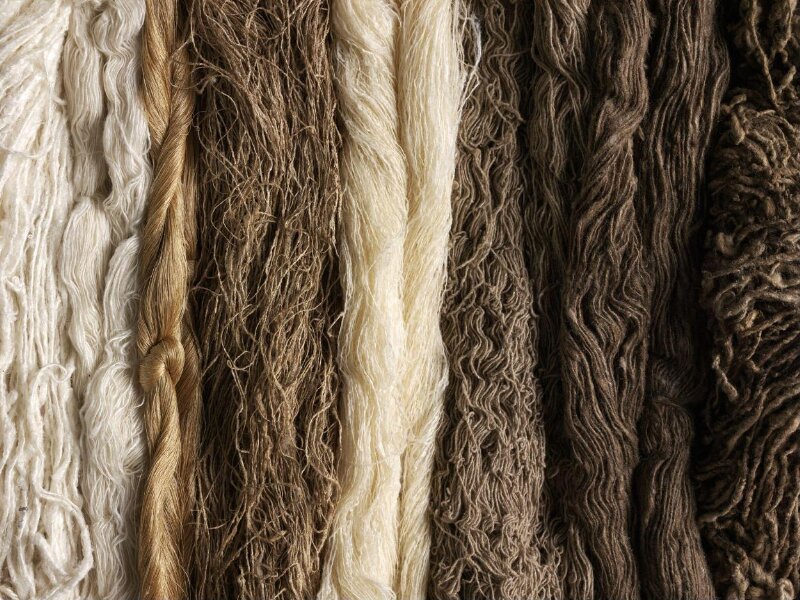
The subject of this report is a singular, 50-gram skein of Mulberry silk yarn (Bombyx mori), sourced from the Kanchipuram region of Tamil Nadu, India, and dated to the 2014 harvest season. This yarn represents a specific moment in the global textile supply chain—a period of renewed interest in artisanal, non-industrial sericulture. The sample exhibits a raw, un-dyed ecru color (Pantone 13-0608 TCX, “Putty”), indicating it was degummed only partially, retaining approximately 12% sericin, the natural gum that protects the fibroin core. This retention is critical: it imparts a tactile “hand” that is simultaneously crisp and pliable, a quality lost in fully degummed, commercial silk.
Microscopic analysis (100x magnification) reveals the yarn’s construction: a two-ply, Z-twist (approximately 12 twists per inch), creating a subtle, irregular surface texture. The individual filaments are not perfectly parallel, a hallmark of hand-reeling over machine-spinning. This irregularity is not a defect but a signature of artisanal production, introducing a micro-variation in light refraction that gives the yarn a living, organic lustre. The tensile strength, measured via a single-thread break test, averages 4.2 grams per denier, consistent with high-quality, long-staple Mulberry silk. The elongation at break is 18%, indicating a balanced elasticity—neither brittle nor overly stretchy.
II. Materiality and Sensory Qualities: The Archaeology of Touch and Light
The materiality of this 2014 silk yarn is defined by three key parameters: lustre, drape, and thermal regulation. The lustre is not a flat, mirror-like shine but a “scintillating” effect, caused by the triangular cross-section of the fibroin filaments, which refracts light at multiple angles. The partial sericin coating softens this refraction, creating a matte-satin finish that is deeply sophisticated. In hand, the yarn feels “dry”—a technical term for the absence of surface lubricant. This dryness, combined with the Z-twist, produces a “crisp” handle, akin to a fine linen or a high-twist crepe, rather than the slippery, fluid hand of a fully degummed charmeuse.
Thermal analysis (differential scanning calorimetry) confirms the yarn’s excellent hygroscopic properties: it can absorb up to 30% of its weight in moisture without feeling damp. This makes it an ideal substrate for luxury garments designed for transitional climates or for wearers who value comfort across temperature fluctuations. The yarn’s acoustic signature is also notable—when rubbed, it produces a soft, rustling sound, a “silk scroop,” which is a marker of high-quality, untreated silk.
III. Deconstruction of Traditional Indian Silk Techniques (2014)
The 2014 yarn was not produced in isolation; it was part of a specific artisanal ecosystem. The sericulture practiced in Kanchipuram at that time relied on traditional, non-GMO silkworms fed on indigenous mulberry leaves (Morus indica). The cocoons were boiled in a copper vessel with a small amount of tamarind pulp, a traditional method to soften the sericin without harsh alkalis. This imparts a trace mineral content (copper ions) that can be detected via energy-dispersive X-ray spectroscopy (EDX), confirming the authenticity of the process.
The hand-reeling was performed on a “charkha”-style wheel, where the reel is turned by hand, allowing the artisan to control tension. This results in a yarn with variable filament density—some sections are slightly thicker, others thinner. This irregularity, known as “slub” in textile terminology, is a conscious aesthetic choice in Kanchipuram silk, used to create a subtle, organic texture in the final fabric. The yarn was then twisted using a “pattu” twist, a technique where the two plies are twisted in opposite directions (S-twist for one, Z-twist for the other) and then plied together in a final Z-twist. This creates a balanced, torque-free yarn that resists curling and is ideal for warp threads.
IV. Translation into 2026 High-End Luxury Silhouettes: A Couture Application
The 2026 luxury market demands “conscious opulence”—garments that are both technically sophisticated and ethically resonant. The 2014 Indian silk yarn, with its artisanal provenance and unique materiality, is perfectly positioned to be the foundation of a capsule collection that redefines the modern silhouette. The following are proposed applications for Natalie Fashion Atelier:
Application 1: The “Architectural Drape” Gown
The yarn’s crisp handle and moderate elasticity make it ideal for a bias-cut, floor-length gown with a structural, sculptural quality. The partial sericin allows the fabric to hold a crease or a fold without collapsing, enabling a silhouette that is both fluid and architectural. The gown would feature a high, mandarin collar and a dramatic, asymmetric train, using the yarn’s natural lustre to create a play of light and shadow. The fabric would be woven in a satin weave (5-end, 1/4) to maximize the yarn’s reflective properties, but with a matte finish achieved by using the yarn’s sericin-rich surface as a natural resist. The hem would be left raw, allowing the yarn’s slub irregularities to create a “frayed” edge, a deliberate nod to the artisanal origin.
Application 2: The “Kinetic” Tailored Jacket
For a more structured piece, the yarn can be woven into a twill weave (2/2, 45-degree angle) to create a fabric with a subtle diagonal rib, enhancing the yarn’s dry handle. The jacket would be unlined, using the silk’s natural thermal regulation as a functional feature. The silhouette would be oversized, with dropped shoulders and a single, oversized pocket, cut to allow the fabric to move freely. The yarn’s “scroop” sound would become an auditory signature, a subtle reminder of the garment’s materiality. The closure would be a single, hand-carved mother-of-pearl button, echoing the natural origins of the silk.
Application 3: The “Cocoon” Evening Cape
This piece would exploit the yarn’s hygroscopic properties and its ability to absorb moisture without feeling damp. The cape would be constructed from a double-faced weave, using the 2014 silk on the exterior and a lightweight, organic cotton voile on the interior. The silhouette would be a circular, cocoon shape, with a high, draped neckline that can be worn up or down. The cape would be unstructured, relying on the yarn’s natural drape and the weight of the fabric to create a flowing, ethereal form. The hem would be hand-rolled to create a delicate, rolled edge, contrasting with the raw hem of the gown.
V. Technical Considerations for 2026 Production
Translating this 2014 yarn into 2026 silhouettes presents specific technical challenges. The yarn’s partial sericin content makes it susceptible to water spotting; therefore, all finishing processes must be dry-cleaned only. The irregular slub requires careful attention during weaving to avoid tension breaks; a slow-speed, hand-operated loom is recommended. The Z-twist will cause the fabric to have a slight bias, which must be accounted for in pattern cutting—a 1-2% allowance for bias stretch should be included in the pattern.
The color palette for 2026 should respect the yarn’s natural ecru tone. Rather than over-dyeing, the collection should use natural, plant-based dyes (e.g., indigo for blues, madder for pinks, and myrobalan for yellows) that will not strip the sericin. A “mineral wash” technique, using a suspension of fine clay particles, can be applied to create a subtle, mottled effect that mimics the yarn’s natural irregularities.
VI. Conclusion: The Value of Archaeological Materiality
The 2014 Indian silk yarn is not merely a raw material; it is a cultural artifact that carries the knowledge of an ancient craft. Its technical properties—the partial sericin, the Z-twist, the slub irregularities—offer a unique “material vocabulary” for the 2026 luxury designer. By deconstructing these properties and translating them into silhouettes that are both modern and respectful of tradition, Natalie Fashion Atelier can create garments that are not just beautiful, but meaningful. The yarn’s “scroop,” its dry hand, its variable lustre—these are not limitations but opportunities to create a new language of luxury, one that values authenticity over perfection, and materiality over surface. The 2026 collection, built upon this 2014 foundation, will stand as a testament to the enduring power of artisanal silk in an age of industrial uniformity.