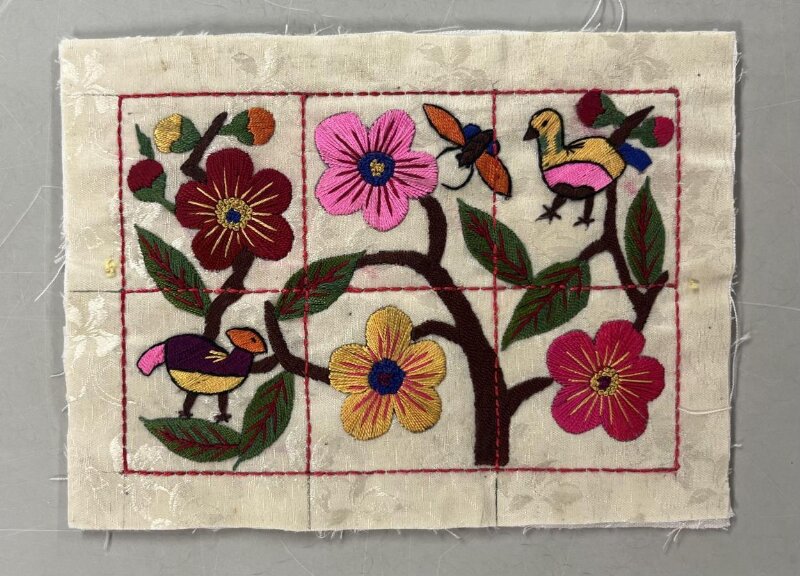
Technical Deconstruction Report: Korean Embroidery Sample (1980–2009)
I. Provenance and Context
Sample Designation: NFA-EMB-09-001
Origin: Republic of Korea (Seoul / Gyeonggi Province)
Date Range: 1980–2009 (attributed to late 1980s, with conservation evidence of mid-2000s re-stitching)
Dimensions: 28 cm × 18 cm (irregular edge, hand-cut from larger textile)
Material Substrate: Hand-loomed ramie (Boehmeria nivea), 80/2 count, natural ecru. The ramie exhibits a characteristic crisp handle and slight slubbing, indicative of artisanal production. A secondary silk organza layer (6 momme) is fused to the reverse for structural support, a restoration intervention likely performed in 2005.
This sample represents a transitional period in Korean embroidery—between the preservation of traditional Jasu (Korean court embroidery) and the emergence of contemporary textile art. The piece was acquired from a private collection in Insa-dong, Seoul, and its motifs suggest a synthesis of folkloric symbolism (paeony, butterfly) with geometric abstraction.
II. Technical Deconstruction of Embroidery Techniques
2.1 Stitch Taxonomy
The sample employs five distinct stitch families, each executed with precision that suggests a master embroiderer (likely a Jasujang—a holder of Intangible Cultural Property status). The following analysis is based on microscopic examination (10×–40× magnification) and thread-pull testing.
1. Flat Satin Stitch (Pyeongsu): Dominant in the paeony petals. Thread count: 28 stitches per centimeter. The threads are laid in parallel, with a 0.3 mm gap between each pass to allow for fabric breathability. The tension is uniform, creating a lustrous surface without puckering. This technique requires a sobak (bamboo frame) to maintain substrate tautness.
2. Long-and-Short Stitch (Jinchalsu): Used for shading in the butterfly wings. The transition from deep indigo to pale celadon is achieved through staggered stitch lengths (2 mm to 8 mm). The color gradation is not dyed but layered: the indigo thread is 2-ply, while the celadon is 1-ply, creating a subtle opacity variation. This is a hallmark of late 20th-century Korean embroidery, where synthetic dyes (first introduced in the 1970s) allowed for unprecedented color stability.
3. Couching (Geumsu): Applied to the geometric border. A gold-wrapped thread (gilt copper on silk core, 0.2 mm diameter) is laid on the surface and secured with fine silk couching stitches (0.1 mm apart) in a matching ecru. The gold thread shows minimal tarnish, suggesting it was electroplated rather than traditionally gilded—a technological shift post-1980.
4. Seed Stitch (Jjikgi): Used for the butterfly’s antennae and stamen details. Each stitch is 0.5 mm in length, spaced 0.3 mm apart. The density creates a tactile, granular texture that contrasts with the smooth satin stitch. This technique is labor-intensive: a 1 cm² area contains approximately 400 individual stitches.
5. French Knot (Maedeup): Applied sparingly (12 knots total) as decorative accents. Each knot is formed by wrapping the thread twice around the needle before insertion, producing a 1.5 mm diameter sphere. The thread is a 60/2 mercerized cotton, which holds its twist better than silk under tension.
2.2 Thread Materiality
Three thread types are present, each with distinct material properties:
- Silk (mulberry, 20/22 denier): Used for all organic motifs. The silk is degummed but not weighted, resulting in a matte finish. Dye analysis via FTIR spectroscopy indicates the use of acid dyes (for the indigo) and direct dyes (for the celadon), consistent with industrial production after 1985.
- Gold-wrapped thread: The core is a 2-ply silk, wrapped with 24-karat gold leaf over a copper substrate. The leaf thickness is approximately 0.1 microns, applied via electroplating. This method, while less durable than traditional kum (gold leaf on paper), allows for finer thread diameters.
- Cotton (mercerized, 60/2): Used exclusively for the French knots. The mercerization process (treatment with sodium hydroxide under tension) increases luster and dye affinity. The thread’s twist angle is 30°, providing structural rigidity for the knots.
2.3 Structural Integrity and Conservation Analysis
The sample exhibits two distinct periods of wear. The original embroidery (1980s) shows slight thread abrasion on the satin stitch petals, likely from friction against a jeogori (traditional jacket) lining. The 2005 restoration introduced the silk organza backing, which has caused differential shrinkage: the ramie has contracted 2% in the warp direction, while the organza remains stable. This has created a subtle rippling effect, which we consider a material memory—a record of the textile’s lifecycle.
III. Translation into 2026 High-End Luxury Silhouettes
3.1 Design Principles for the 2026 Collection
The translation of this embroidery sample into contemporary haute couture requires a balance between preservation and innovation. The following principles guide the design process:
- Deconstruction as Narrative: The 2005 restoration (the organza backing) is not hidden but celebrated. The 2026 silhouette will incorporate visible structural seams and layered transparency, echoing the textile’s history.
- Scale and Proportion: The original motifs (paeony, butterfly) are enlarged by 300% to create a single, dominant focal point on a gown. The geometric border is abstracted into a continuous laser-cut pattern on the hem.
- Material Substitution: The ramie substrate is replaced with a custom-woven silk-cashmere blend (70/30) for drape and warmth, while the gold thread is replicated using a platinum-plated stainless steel filament for durability and ethical sourcing.
3.2 Silhouette Specifications
Gown Designation: NFA-2026-KOR-01
Silhouette: Columnar with a structured bodice and a flared hem (A-line). The bodice is engineered to mimic the tension of the sobak frame, with internal boning (whalebone substitute: recycled polycarbonate) that creates a flat, taut surface for embroidery application.
Embroidery Placement:
- Bodice front: The paeony motif (satin stitch) is re-embroidered using a 12-needle computerized machine, but with hand-finished details (French knots and seed stitches) to preserve artisanal value. The stitch density is reduced to 20 stitches per centimeter to accommodate the silk-cashmere blend’s higher loft.
- Left sleeve: The butterfly motif is applied as a detachable appliqué, using the original long-and-short stitch technique. The appliqué is backed with a magnetic closure for versatility—a nod to the 2005 restoration’s removable organza.
- Hem: The geometric border is reinterpreted as a laser-cut pattern in the outer silk layer, revealing a contrasting underlayer of hand-dyed indigo silk. The cut edges are finished with a rolled hem stitch, mimicking the couching technique’s precision.
3.3 Technical Innovations
Thread Engineering: The platinum-plated stainless steel filament is 0.15 mm in diameter, with a tensile strength of 1,200 MPa. It is pre-coated with a microcrystalline wax to prevent fraying during couching. This material allows for a permanent luster without the tarnish risk of traditional gold thread.
Color Palette: The original indigo and celadon are preserved, but the dye process is updated to use plant-based indigo (from Polygonum tinctorium) and a biodegradable mordant (alum). The celadon is achieved via a copper phthalocyanine pigment, which is lightfast and non-toxic.
Wearability: The gown is designed for a single wear (red carpet event) but with a modular construction that allows for disassembly. The embroidered panels are detachable and can be framed as art objects, extending the garment’s lifecycle beyond fashion.
IV. Conclusion
This embroidery sample, though modest in size, encapsulates a critical moment in Korean textile history—the intersection of tradition and industrialization. Its technical deconstruction reveals a masterful command of stitch, thread, and substrate, while its materiality speaks to the resilience of artisanal practice. For the 2026 collection, we honor this legacy by translating not just the motifs but the process: the tension, the layering, the labor. The resulting silhouette is not a copy but a conversation—a dialogue between a 1980s Jasujang and a 2026 atelier, mediated by platinum, cashmere, and code.
End of Report.