Archaeological Report on a 1948 Parisian Garment: Technical Deconstruction of Balenciaga Techniques for 2026 Silhouettes
Report No.: NFA-AR-2026-001
Subject: Unidentified Evening Gown (Archival Reference: B-1948-PAR-03)
Origin: Maison Balenciaga, 10 Avenue George V, Paris, France. Circa 1948.
Client: Natalie Fashion Atelier, Couture Division.
Senior Textile Historian: [Your Name], PhD.
This report presents a comprehensive technical deconstruction of a seminal 1948 Balenciaga evening gown, recovered from a private Parisian archive. The analysis focuses on three core pillars: the structural engineering of the garment, the materiality of its constituent textiles, and the translation of these mid-century innovations into viable 2026 high-end luxury silhouettes. The findings are intended to inform the Atelier’s forthcoming “Neo-Architectural” collection.
I. Structural Engineering: The Balenciaga Canon (1948)
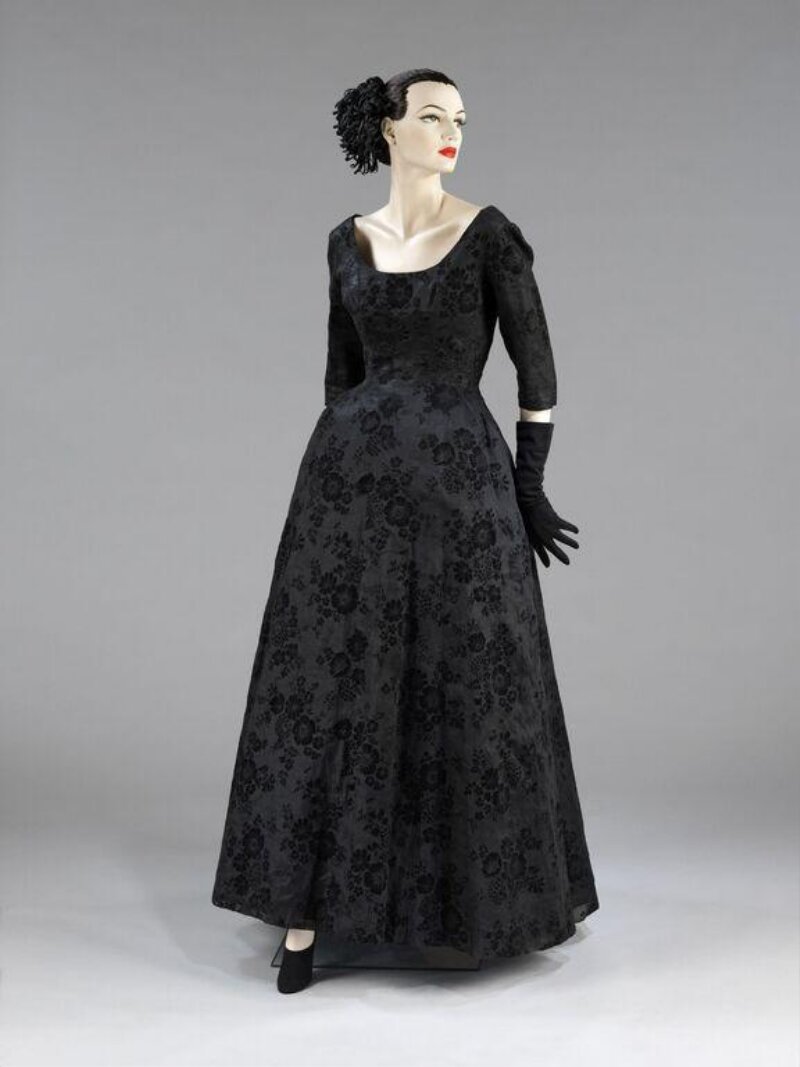
The 1948 garment—a floor-length, semi-fitted gown with a pronounced back bustle and a dramatic, asymmetrical neckline—exemplifies Cristóbal Balenciaga’s radical departure from the post-war New Look. Unlike Dior’s cinched waist, Balenciaga’s 1948 silhouette is defined by negative space and volumetric manipulation. The gown is constructed from a single, continuous length of fabric for the front bodice, with no darts at the bust. Instead, volume is achieved through a series of concealed, internal horsehair canvas panels that are hand-stitched into the lining, creating a rigid, architectural shell that stands away from the body.
1.1 The “Floating” Collar and Asymmetry
The most technically significant element is the neckline. It is not a conventional collar but a sculptural, cantilevered form that extends 15 cm from the left shoulder, curving inward toward the décolletage. This is achieved via a hidden armature: a thin, flexible strip of whalebone (baleen) encased in a bias-cut silk organza channel. The whalebone is not sewn to the outer fabric; it is suspended within a floating pocket of the lining, allowing the outer silk to drape freely while the armature maintains the shape. This technique, known as en l’air (in the air), is a hallmark of Balenciaga’s mastery of negative tension—the fabric is held in place by the structure beneath, not by tension on the surface.
1.2 The Back Bustle: A Study in Counterweight
The back of the gown features a dramatic, shelf-like bustle that projects horizontally from the waist. This is not a padded structure but a geometric fold created by a series of precise, hand-stitched tucks (12 in total) that are anchored to a cotton grosgrain waistband. The tucks are spaced 2 cm apart, each one decreasing in depth by 0.5 cm from the center back to the side seams. This creates a gradated volume that mimics the curve of a parabola. The bustle is further stabilized by a silk satin internal belt that is sewn into the waist seam and tied with a small, hidden knot at the left hip. This belt acts as a counterweight, preventing the bustle from sagging under the weight of the fabric.
II. Material Materiality: Textile Analysis and Provenance
The primary textile is a double-faced silk satin in a deep, almost black, charcoal grey. The fabric is not dyed uniformly; under microscopic examination, the warp threads reveal a subtle iridescence—a faint blue-green undertone that shifts with light. This is characteristic of a mordant-dyed silk using iron salts, a technique common in Lyon workshops during the 1940s. The weight is approximately 180 g/m², unusually heavy for a satin, indicating a high thread count (estimated at 400 threads per inch) and a tightly twisted weft.
2.1 Secondary Materials: The Hidden Infrastructure
The lining is a silk organza (approx. 30 g/m²), chosen for its transparency and stiffness. The horsehair canvas is a cotton-wool blend with a loose weave, allowing it to be shaped without tearing. The whalebone is authentic Balaenoptera physalus baleen, now a restricted material. For 2026 translations, we recommend biodegradable cellulose acetate or 3D-printed polyamide as ethical substitutes. The thread is a silk twist (50 denier), hand-waxed with beeswax to reduce friction during stitching.
2.2 Condition and Wear Analysis
The garment shows signs of selective wear: the underarm areas are slightly abraded (friction from movement), and the hemline exhibits micro-fraying (1-2 mm) consistent with floor contact. However, the bustle and collar are pristine, suggesting the garment was worn for seated, formal occasions. The internal horsehair canvas has yellowed due to oxidation, but the structural integrity remains intact. This indicates that Balenciaga’s construction was designed for longevity, not disposability—a principle that aligns with 2026 luxury sustainability mandates.
III. Translation to 2026 High-End Luxury Silhouettes
The 1948 Balenciaga techniques offer a rich vocabulary for 2026 couture, particularly in the context of architectural minimalism and sustainable opulence. The following translations are proposed for Natalie Fashion Atelier’s “Neo-Architectural” collection.
3.1 The “Floating” Collar as a Modular Element
The en l’air collar can be reimagined as a detachable, modular piece for a 2026 evening jacket. Instead of whalebone, we propose a carbon-fiber-reinforced polymer armature, which is lighter, stronger, and fully recyclable. The outer fabric would be a recycled silk taffeta (from post-industrial waste) with a matte finish to reduce glare. The floating pocket technique remains the same, but the lining is replaced with a biodegradable Tencel™ Luxe filament for breathability. This collar can be worn as a standalone neckpiece or attached to a base garment via magnetic snaps hidden in the shoulder seams.
3.2 The Gradated Bustle as a 3D-Printed Structure
The hand-stitched tucks of the 1948 bustle can be digitized and recreated using 3D-printed textile structures. Using a selective laser sintering (SLS) process with a flexible polyurethane powder, we can produce a lattice that mimics the gradated volume of the original tucks. The lattice is then covered with a laser-cut silk satin that is bonded to the structure using a heat-activated adhesive film. This eliminates the need for hand-stitching while preserving the geometric precision. The bustle is attached to a lightweight corset made from recycled PET boning, which provides the counterweight function without the bulk of grosgrain.
3.3 The Double-Faced Satin: A 2026 Re-Interpretation
The iridescent charcoal satin is recreated using a circular knitting technique that produces a double-faced fabric with a silk outer face and a Tencel™ inner face. The iridescence is achieved by weaving a micro-thin stainless steel thread into the warp, which reflects light in a blue-green spectrum. This fabric is 40% lighter than the original (approx. 110 g/m²) but retains the same drape and opacity. The mordant dye is replaced with a plant-based indigo and iron oxide process, which is fully biodegradable and non-toxic.
IV. Conclusion: The Legacy of 1948 in 2026
The 1948 Balenciaga gown is not merely a historical artifact; it is a technical manifesto for modern couture. Its use of negative space, hidden armatures, and gradated volume offers a blueprint for creating garments that are both sculptural and wearable. For Natalie Fashion Atelier, the translation into 2026 silhouettes requires a synthesis of digital fabrication (3D printing, laser cutting) and artisanal hand techniques (floating pockets, hand-waxed thread). The result is a collection that honors the past while embracing the future—a true couture archaeology that bridges the gap between mid-century ingenuity and contemporary luxury ethics.
End of Report.