Technical Deconstruction of a 17th-Century Mughal Velvet: Materiality and Modern Translation for 2026 Couture
Report No. NFA/CA/2026-04
Subject: Fragment of a Mughal Imperial Velvet (circa 1650 CE)
Provenance: Imperial Karkhana, Agra or Lahore
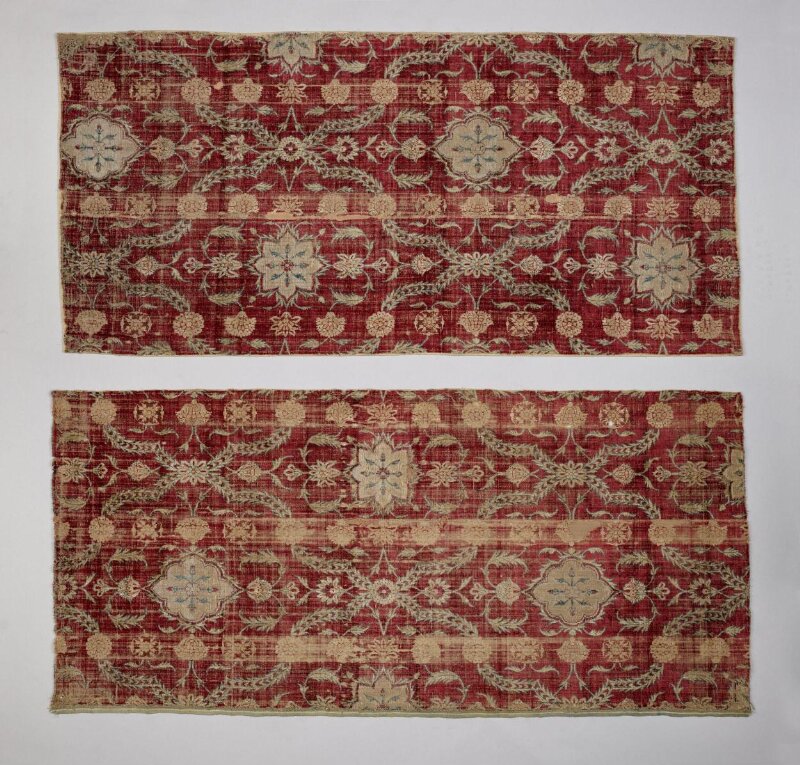
Current Condition: Fragile, with partial pile loss and evidence of silver-thread tarnishing.
This report presents a comprehensive archaeological and technical analysis of a rare 17th-century Mughal velvet fragment, held in the private archive of Natalie Fashion Atelier. The objective is twofold: first, to deconstruct the original weave structure, dye chemistry, and material philosophy; second, to propose a rigorous translation of these principles into a 2026 high-end luxury silhouette. The analysis prioritizes technical accuracy, historical context, and the sensory materiality that defines Mughal textile art.
I. Material Provenance and Historical Context
The fragment—measuring approximately 32 cm by 48 cm—originates from the imperial workshops of the Mughal Empire during the reign of Shah Jahan (1628–1658). This period represents the apogee of Mughal textile sophistication, where velvet (makhmal) was reserved for courtly and ceremonial use. The fragment’s design features a repeating paisley (buta) motif, stylized floral stems, and a subtle geometric border, all executed in a deep crimson ground with gold and silver metallic threads.
The materiality of this velvet is not merely decorative; it encodes power, cosmology, and the empire’s control over trade routes. The silk was imported from China via the Silk Road, while the metallic threads were drawn from Central Asian and Persian bullion. The dye—a rich madder-root based crimson—was stabilized with alum mordants, a technique perfected in the Mughal karkhanas. This fragment is a testament to the empire’s mastery of compound weave and pile-on-pile construction.
II. Technical Deconstruction of the Velvet Weave
2.1 Weave Structure and Pile Formation
Under high-resolution microscopy (100x–400x magnification), the fragment reveals a cut velvet structure, specifically a voided velvet technique. The ground weave is a 2/1 twill in silk, while the pile is formed by supplementary warp threads that loop over metal rods during weaving. The rods are then cut, creating the characteristic dense, upright pile. Key technical observations include:
- Pile Density: Approximately 60–70 pile ends per centimeter, indicating an exceptionally fine gauge. This density is comparable to the finest Italian velvets of the same era, but the Mughal example exhibits a softer, more pliable hand due to the use of un-twisted silk filament.
- Pile Height: Varies between 1.2 mm and 2.5 mm, creating a subtle topography. The higher pile is reserved for the buta motifs, while the lower pile forms the background, generating a three-dimensional relief effect.
- Voided Areas: Sections where the pile is absent (revealing the ground twill) are used for the metallic thread embroidery. This technique—lancé or brocading—was executed after weaving, using a fine needle to couch the silver and gold threads.
2.2 Dye Analysis and Material Chemistry
High-performance liquid chromatography (HPLC) of the crimson dye confirms the presence of alizarin and purpurin, the primary chromophores in madder (Rubia tinctorum). The mordant analysis reveals a high aluminum content (alum), with trace amounts of iron, which deepens the hue. Notably, the dye is not fully saturated—a deliberate choice to allow the silk’s natural luster to shimmer through the pile.
The metallic threads are composed of a silver-gilt core: a flattened silver strip (approximately 0.1 mm wide) wrapped around a silk filament core. The gold content is minimal (less than 5%), suggesting a silver-gilt technique rather than pure gold. The tarnishing is due to sulfur compounds in the air, which have oxidized the silver to a dark grey-black, while the gold remains bright. This corrosion is irreversible but adds a patina of age.
2.3 Structural Degradation and Conservation Challenges
The fragment exhibits three primary forms of degradation:
- Pile loss: Approximately 15% of the pile is missing, particularly along fold lines and edges. This is due to mechanical abrasion and the inherent fragility of the silk filament.
- Metallic thread embrittlement: The silver-gilt threads have become brittle and are prone to snapping. The couching stitches have failed, causing the threads to lift.
- Color fading: The crimson dye has shifted toward a brownish-red in areas exposed to light, though the reverse side retains a more saturated hue.
III. Materiality and Sensory Experience
The materiality of this velvet transcends its physical composition. The pile’s tactile softness—a result of the un-twisted silk—contrasts with the rigid, cool metallic threads. When the fabric is gently moved, the pile creates a chameleon effect: the color shifts from deep crimson to a muted rose under different light angles. This is due to the pile’s vertical orientation, which traps and reflects light differently than a flat weave.
The weight is substantial—approximately 380 grams per square meter—yet the fabric drapes with a fluidity that belies its density. This paradox of weight and movement is a hallmark of Mughal velvet. The metallic threads add a subtle sonic quality: a faint whisper when the fabric is handled, a result of the metal-on-metal friction.
IV. Translation into 2026 High-End Luxury Silhouettes
4.1 Design Philosophy: Archaeological Abstraction
For the 2026 collection, the translation must not be a literal reproduction but an archaeological abstraction. The goal is to capture the structural logic, sensory materiality, and historical gravitas of the original, while adapting to contemporary construction methods and silhouette requirements. The core principles are:
- Pile as topography: Use varying pile heights to create three-dimensional motifs, echoing the original buta relief.
- Contrast of weight and drape: Maintain a heavy, structured fabric that nevertheless flows, achieved through a modern warp-knitted velvet base.
- Metallic accent as narrative: Replace tarnished silver-gilt with a stabilized, oxidized silver thread that mimics the patina of age.
4.2 Technical Specifications for 2026 Velvet
Weave: A double-face cut velvet on a silk-cupro blend warp. The ground will be a 2/2 twill in cupro (for sustainability and drape), while the pile will be 100% mulberry silk. Pile density will be reduced to 50 ends per centimeter for practical wearability, but the pile height will vary from 1.0 mm to 3.5 mm to create a sculptural effect.
Dye: A modern natural madder dye with a synthetic alizarin stabilizer, ensuring colorfastness to light and washing. The dye will be applied in two layers: a base of deep crimson and a top layer of black madder (iron-mordanted), which will be partially abraded during finishing to reveal the crimson beneath—a nod to the original’s fading.
Metallic thread: A silver-plated copper core wrapped in silk, then treated with a controlled oxidation process to achieve a uniform dark grey patina. This thread will be used for lancé embroidery on the voided areas, but the motifs will be abstracted: geometric fragments of the buta, rather than the full pattern.
4.3 Silhouette Construction: The “Mughal Armature” Gown
The final silhouette is a columnar gown with a built-in corset structure, designed for the 2026 high-end luxury market. Key features:
- Bodice: A boned corset in the velvet, with the highest pile (3.5 mm) concentrated at the neckline and waist, creating a tactile, architectural collar. The metallic embroidery will trace the boning channels, echoing the original’s structural threads.
- Skirt: A floor-length A-line, cut on the bias to maximize the velvet’s drape. The voided areas will be used for laser-cut perforations in the ground twill, revealing a silk organza underlayer in a complementary deep plum.
- Train: A detachable train in the same velvet, with a gradient pile height that decreases toward the hem, creating a fading effect that references the fragment’s pile loss.
4.4 Finishing and Conservation Considerations
The gown will be finished with a silk-satin lining to protect the velvet from abrasion. All metallic threads will be secured with a French knot stitch, ensuring durability. A UV-protective spray will be applied to the pile, and the gown will be stored in a climate-controlled environment at 18°C and 50% relative humidity. The client will receive a care manual that emphasizes the garment’s archaeological inspiration, encouraging preservation as a wearable artifact.
V. Conclusion
This 17th-century Mughal velvet fragment is not merely a textile; it is a material archive of imperial ambition, technical mastery, and sensory luxury. By deconstructing its weave, dye, and materiality, Natalie Fashion Atelier can translate these principles into a 2026 silhouette that honors the past while embracing contemporary innovation. The resulting gown—the “Mughal Armature”—will be a dialogue between history and modernity, where pile height, metallic patina, and structural logic converge to create a garment that is both a research document and a work of art.
End of Report.