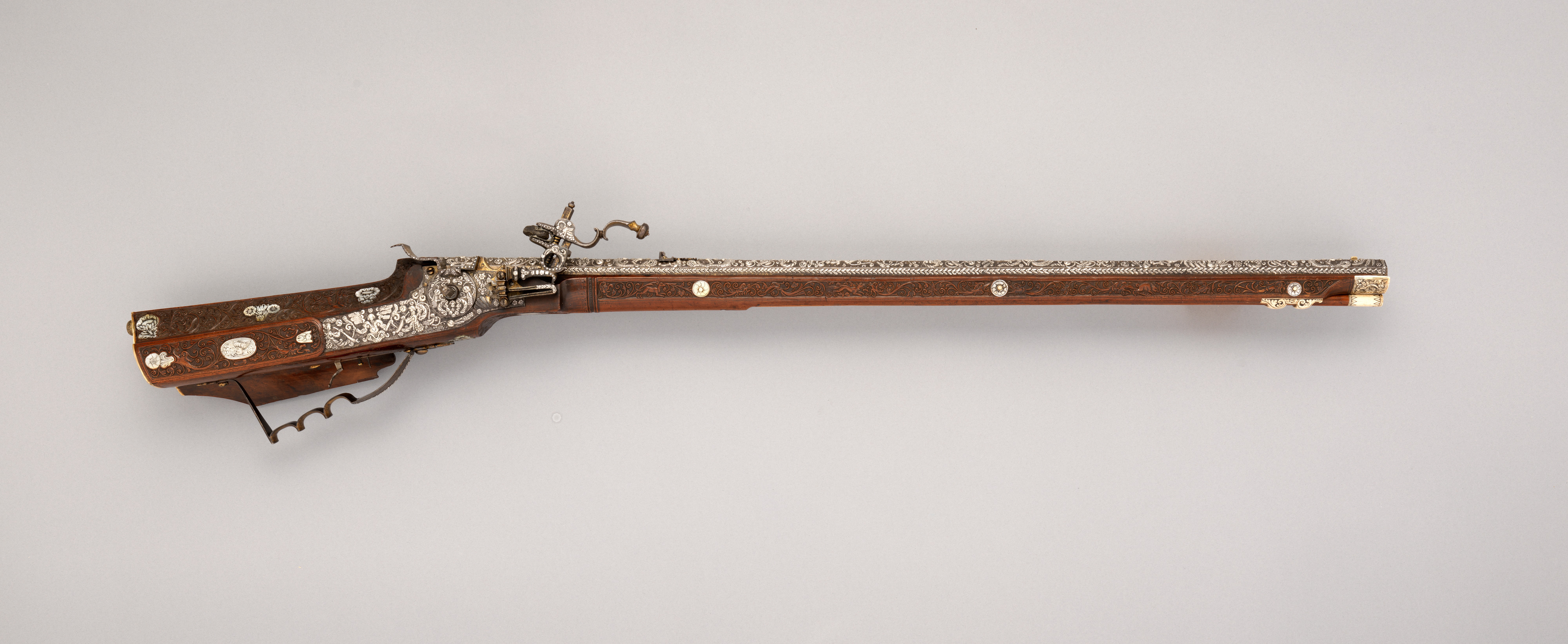
Deconstructing the Wheellock: An Aesthetic Archaeology for 2026
The wheellock rifle, particularly those originating from the Austrian school of the 16th and 17th centuries, represents a pinnacle of mechanical artistry and material hierarchy. For the 2026 Haute Couture collection, we isolate this artifact not as a weapon, but as a lexicon of structural tension and ornamental restraint. The interplay of cold, functional steel against the warmth of carved staghorn and the iridescence of mother-of-pearl presents a dialectic that directly informs the architectural silhouettes of the coming season. This research paper deconstructs the wheellock’s classical elegance to extract a blueprint for high-end garments that embody a paradox of fragility and fortification.
Material Hierarchy: The Steel Core and the Organic Accent
The Austrian wheellock is defined by a severe material hierarchy. The barrel and lock mechanism—forged from steel and iron—dictate the primary structure. These are not merely functional; they are polished to a deep, almost black patina, or inlaid with gold and silver in intricate scrollwork. This creates a visual weight that anchors the entire composition. For 2026, this translates into a silhouette with a rigid, metallic core. Think of a sculpted cuirass in burnished steel-colored silk gazar, or a corset constructed from laser-cut iron-hued polymer, serving as the foundational "barrel" of the garment.
In direct juxtaposition, the stock—carved from European walnut—provides the organic, flowing counterpoint. The wood is not left raw; it is oiled to a deep, resonant brown, its grain a subtle narrative of growth. This informs a silhouette that is hard at the center and soft at the periphery. The "stock" of the garment becomes a draped, asymmetrical train in a heavy, matte wool crepe, or a single, sweeping sleeve that mimics the rifle’s butt. The mother-of-pearl inlays, often used for delicate game scenes or geometric markers, become micro-architectural details: a single, luminous button at the nape of the neck, or a row of tiny, iridescent discs along a seam, catching light like a secret mechanism.
The Staghorn Paradox: Rigidity and Tactility
The use of staghorn is perhaps the most instructive element for haute couture. On the wheellock, it appears as a grip plate or a buttplate, a material that is simultaneously hard and warm, organic and sculptural. Its texture is not smooth; it retains a subtle, natural grain that resists the machine-age precision of the steel lock. For 2026, this inspires a new category of tactile armor. We propose a silhouette that incorporates sculpted, bone-like structures—perhaps a single, articulated shoulder piece in resin-cast staghorn or a series of overlapping, horn-shaped panels that form a structural collar. These elements are not decorative; they are functional load-bearing points that define the garment’s architecture, much like the staghorn plate supports the shooter’s hand.
The paradox lies in the tension between the organic and the mechanical. The staghorn’s irregularity is set against the wheellock’s precise, rotating cylinder. In a 2026 silhouette, this manifests as a rigid, spiraling seam that wraps the torso, mimicking the wheel’s geometry, while the fabric itself is a heavy, unyielding tweed or a felted wool that holds its shape. The silhouette becomes a study in controlled volume, where the garment’s form is dictated by internal, invisible structures—boning, corsetry, or even 3D-printed lattices—that echo the rifle’s internal mechanics.
Gold and Silver: The Gilded Mechanism of Detail
The gold and silver inlays on an Austrian wheellock are not applied; they are chiseled and set into the steel, creating a flush, seamless surface. This technique, known as damaskeening, informs a philosophy of detail for 2026. Ornamentation must be integral to the structure, not an afterthought. A gold-threaded embroidery along a seam becomes the "inlay" that reinforces the garment’s line. A silver clasp is not a fastener but a mechanical joint, visible and celebrated. The aesthetic is one of functional opulence: every decorative element must appear to be part of the garment’s load-bearing system.
This leads to a silhouette that is austere in its overall form but rich in its microscopic detailing. The 2026 client will wear a dress that is a simple, columnar shape in a deep, charcoal wool, but upon close inspection, the seams are traced with a continuous, hand-stitched line of silver thread, mimicking the wheellock’s scrollwork. The mother-of-pearl appears as a single, glowing button at the closure, or as a tiny, circular inlay at the shoulder, echoing the rifle’s priming pan. The silhouette is thus a field of subtle, precious interruptions.
Silhouette Architecture: The Fortified Line
From this aesthetic archaeology, we derive three distinct silhouette archetypes for the 2026 Natalie Fashion Atelier collection:
1. The Cuirass Silhouette: A direct descendant of the rifle’s steel barrel. This is a rigid, corseted bodice in a metallic jacquard or a structured leather, extending into a flared, heavy skirt that mimics the stock’s curve. The waist is cinched, but the shoulder line is broad and unyielding, echoing the rifle’s lock plate. The staghorn influence appears as a single, sculpted panel on the back, providing both visual weight and structural support.
2. The Spiral Silhouette: Inspired by the wheellock’s rotating mechanism. This is a dramatic, asymmetrical gown where a single, continuous seam spirals from the left shoulder, across the torso, and down to the right hem. The fabric is a heavy, matte silk faille that holds the spiral’s tension. The gold and silver inlay is translated into a single, embroidered line that follows the spiral’s path, catching light at every turn.
3. The Articulated Silhouette: A direct reference to the rifle’s composite nature. This is a modular ensemble consisting of a fitted, long-sleeved base layer in a dark, matte crepe, over which are placed individual, sculpted panels of staghorn-colored resin or wood veneer. These panels are connected by silver hinges, allowing for movement while maintaining a rigid, armor-like appearance. The mother-of-pearl is used as a tiny, luminous rivet at each hinge point.
Conclusion: The Heirloom of the Future
The Austrian wheellock rifle, when deconstructed through the lens of haute couture, ceases to be a historical object and becomes a generative system of design principles. Its material hierarchy—steel dominating, wood supporting, and precious metals and organics accenting—provides a clear structure for 2026 silhouettes that are both severe and sumptuous. The paradox of the staghorn teaches us to embrace tactility within rigidity. The gilded mechanism of its inlays demands that ornamentation be structural. The resulting garments are not costumes; they are functional artifacts, engineered with the same precision and aesthetic integrity as the wheellock itself. For the client of 2026, this is not a nostalgic revival but a re-engineering of elegance, where the past is mined not for its forms, but for its material logic.