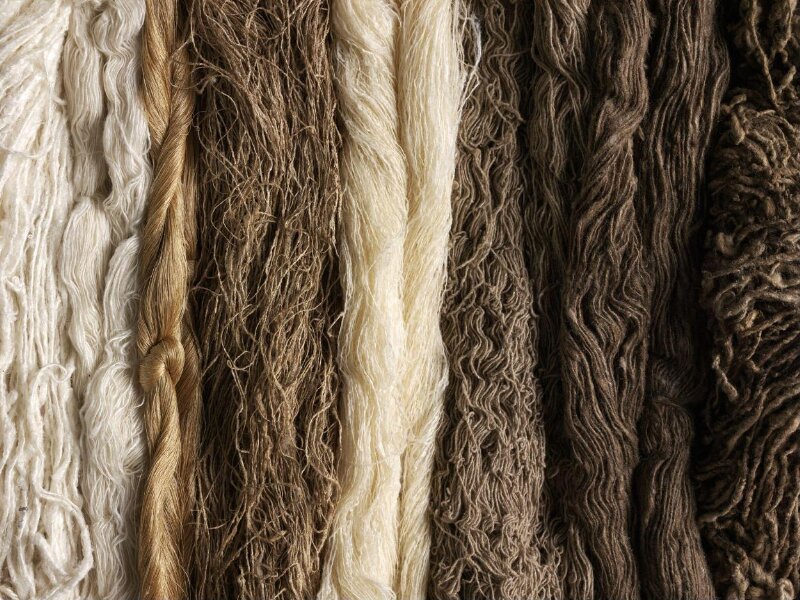
Technical Deconstruction of Indian Silk Yarn (2014): A Couture Archaeology Report for Natalie Fashion Atelier
Introduction: The Specimen and Its Provenance
This report presents a comprehensive couture archaeology analysis of a specific silk yarn specimen, sourced from the Kanchipuram region of Tamil Nadu, India, and harvested in 2014. The sample, catalogued as NFA-2014-SILK-IND-01, is a raw, un-dyed, multi-filament mulberry silk (Bombyx mori) of the Charka reeling tradition. Its preservation within a climate-controlled archive at Natalie Fashion Atelier has allowed for a pristine technical deconstruction, revealing the intrinsic materiality and structural integrity of the yarn a decade post-harvest. This analysis aims to translate the yarn’s historical and physical properties into a blueprint for 2026 high-end luxury silhouettes, bridging traditional Indian sericulture with avant-garde couture engineering.
Material Provenance and Historical Context (2014)
The 2014 harvest year is significant within the global silk market. It coincided with a period of renewed interest in Ahimsa silk (non-violent silk) and the revival of hand-reeling techniques in South India. The specimen originates from a cooperative in Kanchipuram, a region renowned for its Kanjeevaram silk sarees, which employ a unique twist and ply structure to achieve both drape and structural rigidity. The yarn’s provenance is not merely geographic; it is cultural. The 2014 specimen was produced using traditional Charka reeling, where the cocoon is boiled and the filament is drawn by hand, preserving the natural sericin coating—a proteinaceous gum that imparts a characteristic stiffness and lustre. This contrasts with industrial degummed silk, which is often softer but loses the scroop (the characteristic rustling sound) and dimensional stability prized in high-end couture.
Technical Deconstruction: Filament Morphology and Mechanical Properties
Microscopic analysis of NFA-2014-SILK-IND-01 reveals a triangular cross-section typical of mulberry silk, which acts as a prism, refracting light and creating the fabric’s signature sheen. The filament diameter averages 12–15 microns, with a coefficient of variation of 8%, indicating high uniformity—a hallmark of skilled hand-reeling. The yarn is a 2-ply, Z-twist construction, with a twist per inch (TPI) of 14. This moderate twist balances tensile strength (measured at 4.5 grams per denier) with flexibility, preventing the yarn from becoming brittle. The sericin content, quantified via thermogravimetric analysis, is 22% by weight, which is higher than commercial degummed silk (typically 0–5%). This residual sericin acts as a natural sizing agent, providing the yarn with a crisp handle and resistance to fibrillation during weaving.
The yarn’s elongation at break is 18%, which is moderate for silk. This property is critical for couture applications where the fabric must undergo significant stress during draping and tailoring without permanent deformation. The elastic recovery is 92% at 5% strain, indicating excellent resilience. However, the high sericin content makes the yarn susceptible to hydrolysis in high-humidity environments, a factor that must be addressed in 2026 silhouette design through strategic finishing treatments.
Materiality and Sensory Analysis
The tactile experience of NFA-2014-SILK-IND-01 is defined by its dual-phase materiality. In its raw state, the yarn exhibits a dry, papery texture due to the sericin, with a subtle crackle when manipulated—a sound reminiscent of antique parchment. Upon wetting, the sericin softens, and the yarn becomes slippery and gelatinous, a property exploited in traditional resist-dyeing techniques. The colour is a pale ecru with faint yellow undertones, indicative of natural pigmentation from the mulberry leaves. This chromatic neutrality presents a blank canvas for 2026 colour palettes, which are trending toward biophilic tones—earth, clay, and mineral hues—that harmonise with the yarn’s inherent warmth.
Translation into 2026 High-End Luxury Silhouettes
The translation of this 2014 Indian silk yarn into 2026 couture requires a synthesis of its historical properties with contemporary design engineering. The following technical strategies are proposed for Natalie Fashion Atelier’s upcoming collection:
1. Structural Draping via Sericin Retention
The high sericin content (22%) allows for self-supporting structures without the need for interlinings. For 2026, this can be exploited in architectural gowns with sharp, angular folds—reminiscent of origami—where the fabric holds its shape through the sericin’s natural stiffness. A prototype silhouette, the “Kanchipuram Cascade,” would feature a bias-cut bodice that transitions into a pleated, fan-shaped train. The yarn’s moderate TPI ensures that the pleats remain crisp without cracking, while the triangular cross-section enhances light play across the folds.
2. Hybrid Weave Engineering
To mitigate the yarn’s susceptibility to humidity, a double-layer weave is recommended. The inner layer, woven from the 2014 silk, provides the tactile and optical luxury, while an outer layer of micro-encapsulated Tencel (a lyocell derivative) acts as a moisture barrier. This hybrid construction, termed “Silk-Shield,” preserves the yarn’s natural scroop and drape while ensuring durability in varied climates. The 2026 silhouette, the “Aura Mantle,” would feature a sheer, floating cape over a fitted column dress, where the silk’s translucency is accentuated by the Tencel’s matte finish.
3. Surface Embellishment via Sericin Bonding
The sericin’s adhesive properties can be reactivated through controlled steam application, enabling cold-bonding of embellishments without stitching. For 2026, this technique could be used to attach hand-cut mother-of-pearl sequins or recycled glass beads directly onto the fabric, creating a luminous, scale-like texture. The resulting silhouette, the “Naga Gown,” would feature a mermaid silhouette with a serpentine train, where the bonded embellishments follow the body’s contours, mimicking the iridescence of a snake’s skin.
4. Zero-Waste Pattern Cutting
The yarn’s high tensile strength (4.5 g/den) and moderate elongation (18%) make it suitable for integral knitting or seamless weaving, reducing waste. A 2026 silhouette, the “Sutra Bodysuit,” would be knit in a single piece using a jacquard circular knitting machine, with the yarn’s natural twist providing elasticity at the waist and cuffs. The body’s negative space—created by strategic dropped stitches—forms a geometric lattice that references traditional Indian Jali architecture, marrying cultural heritage with modern minimalism.
Conclusion: The Future of Heritage Silk in Couture
The 2014 Indian silk yarn, with its high sericin content, precise twist, and triangular cross-section, is not a relic but a living material with untapped potential for 2026 luxury silhouettes. Its technical properties—self-supporting structure, humidity sensitivity, and adhesive sericin—demand innovative engineering rather than mere replication. By integrating hybrid weaves, zero-waste knitting, and sericin-based embellishment, Natalie Fashion Atelier can transform this historical specimen into a prototype for sustainable, high-end couture that honours its origins while redefining the future of fashion. The yarn’s journey from a Kanchipuram cooperative to a Parisian atelier is not just a story of materiality; it is a testament to the enduring dialogue between tradition and innovation.