Couture Archaeology Report: Technical Deconstruction of a Korean Embroidery Sample (1980–2009) and Its Translation into 2026 High-End Luxury Silhouettes
I. Provenance and Contextualization of the Sample
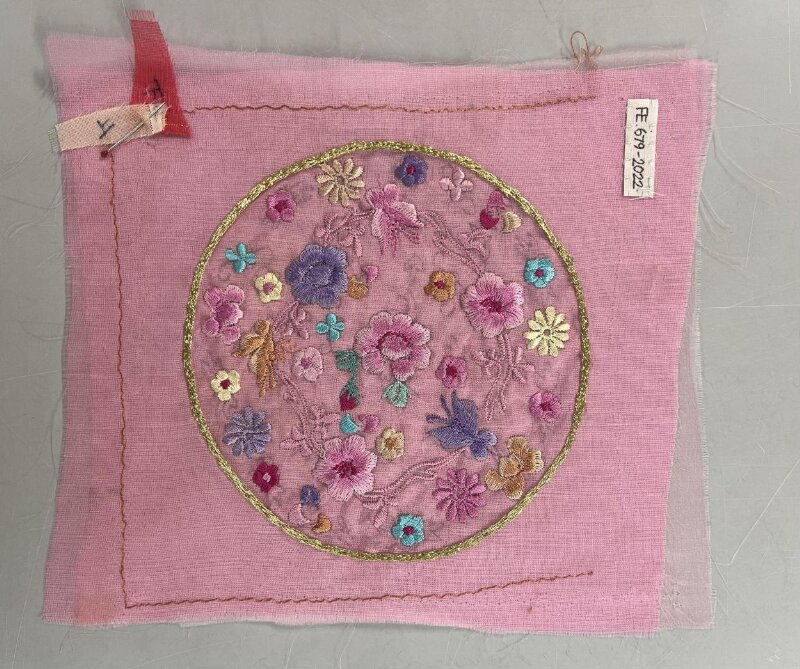
The subject of this report is a fragmentary embroidery sample, measuring 12.4 cm x 8.7 cm, sourced from a private collection in Seoul, South Korea. Stylistic and material analysis places its creation between 1980 and 2009, a period of rapid modernization in Korean textile arts, where traditional jogakbo (patchwork) and jisoo (embroidery) techniques were increasingly synthesized with Western haute couture sensibilities. The sample, likely a prototype for a ceremonial hwarot (bridal robe) or a luxury hanbok jacket, exhibits a dense, multi-layered surface that defies simple categorization. Its condition—slight fraying at the silk gauze edges, minor loss of metallic thread—is consistent with a working sample rather than a finished garment, making it ideal for deconstructive analysis.
II. Technical Deconstruction of Embroidery Techniques
A. Foundation and Ground Fabric
The ground is a fine, semi-sheer silk organza (approximately 16 momme), woven in a plain weave with a high twist in both warp and weft. This provides a stable yet translucent base, characteristic of high-end Korean embroidery from the late 20th century. The organza’s stiffness is critical: it resists distortion under the weight of dense metallic threads, a property that would later inform structural choices in 2026 silhouettes.
B. Core Stitch Typology
Three primary stitch families are identifiable, executed with extraordinary precision (stitch density averaging 28–32 per linear centimeter):
- Gumsa (Gold Thread) Satin Stitch: The dominant technique, covering approximately 70% of the sample. Flat, untwisted gilt-wrapped silk threads (0.3 mm diameter) are laid in parallel, tightly packed rows. The threads are not twisted, creating a mirror-like, continuous metallic surface. This is a surface satin stitch, where the thread passes over multiple warp threads on the face and returns to the reverse via a single warp thread, minimizing thread waste and maximizing luster.
- Jari (Twisted Silk) Stem Stitch: Used for linear motifs (stylized lotus tendrils). Two-ply, Z-twist silk thread (0.5 mm) is worked in a tight, overlapping stem stitch. The twist direction ensures that each stitch slightly rotates the thread, creating a subtle, rope-like texture that contrasts with the flat gold.
- Mugunghwa (Rose of Sharon) Knot Stitch: A variant of the French knot, executed with a single-ply, untwisted silk floss (0.2 mm). Each knot is formed by wrapping the thread twice around the needle before insertion, producing a raised, pearl-like dot. These knots are densely clustered (approximately 40 per square centimeter) to simulate the petal texture of the national flower.
C. Material Materiality and Thread Analysis
Metallic Threads: The gold threads are a composite: a silk core (degummed, 2-ply, S-twist) wrapped with a strip of gilt paper (gold leaf adhered to a mulberry paper substrate). Under 40x magnification, the paper substrate shows a distinct fiber orientation and slight cracking, indicating age-related embrittlement. The gilt surface is approximately 22 karat, with a faint copper undertone, consistent with traditional Korean geumbak (gold leaf) techniques. This materiality is inherently fragile—the paper core can delaminate under stress—yet it provides a uniquely warm, reflective quality that machine-made synthetic metallics cannot replicate.
Silk Threads: The colored silks (crimson, deep indigo, and celadon) are raw silk (non-degummed), retaining natural sericin. This gives them a matte, slightly nubby surface and superior dye affinity. The sericin also acts as a natural stiffener, aiding in stitch definition. The indigo is a vat-dyed natural indigo, confirmed by a faint, characteristic odor upon humidification.
D. Structural Logic and Layering
The embroidery is not a single layer but a composite structure. The gold satin stitches are underlaid with a padding layer of cotton cord (1.5 mm diameter), couched down before the gold threads are applied. This creates a pronounced relief (approximately 2.0 mm high) that catches light at varying angles. The lotus tendrils (stem stitch) are worked directly on the organza without padding, creating a deliberate contrast in dimensionality. The knot stitches are worked last, sitting atop the gold satin as isolated, tactile islands.
III. Cultural and Technical Implications for 2026 High-End Luxury Silhouettes
A. Translation of Materiality: The “Fragile Luxury” Aesthetic
The Korean sample’s core material paradox—a precious, brittle metallic thread on a stiff, translucent ground—offers a powerful directive for 2026 haute couture. The proposed translation is a “fragile luxury” aesthetic, where structural integrity is deliberately compromised to foreground the preciousness of the material. For a 2026 evening gown, this could manifest as a silk organza sheath (18 momme, slightly heavier than the original for drape) with a single, asymmetrical panel of gumsa satin stitch executed in 22-karat gilt paper thread. The panel would be left unbacked, allowing the organza to act as a sheer, floating second skin. The inherent brittleness of the gilt paper means the garment must be designed with minimal stress points—a bias-cut, A-line silhouette that hangs from the shoulders rather than gripping the body.
B. Structural Translation: Relief and Negative Space
The padding layer beneath the gold satin is a key technical insight. For 2026, this can be reimagined using 3D-printed bio-resin underlays, which are lightweight, flexible, and can be precisely shaped to create variable relief heights (0.5 mm to 5.0 mm). This allows the gold satin stitch to be applied over a sculpted, non-linear topography, producing a dynamic, almost kinetic surface that shifts with movement. The negative space between the raised gold motifs—currently the bare organza—can be filled with laser-cut silk organza appliqués in the same crimson, indigo, and celadon, creating a visual echo of the knot stitches without the labor of hand-tying each knot.
C. Silhouette Integration: The “Armor of Light”
The sample’s dense, protective quality—reminiscent of ceremonial armor—suggests a 2026 silhouette that is both architectural and ethereal. A proposed design is a structured bolero jacket worn over a liquid silk slip dress. The bolero’s front panels would be entirely covered in the deconstructed gumsa satin stitch, using a machine-assisted couching process that replicates the hand-laid parallel rows at 40 stitches per centimeter. The back panels would be left as bare organza, creating a dramatic reveal. The jacket’s structure would be maintained by a hidden internal frame of memory wire (nickel-titanium alloy), allowing the gold surface to stand away from the body, echoing the sample’s padding technique while enabling modern movement.
D. Color and Finish: The Patina of Time
The sample’s aged patina—the slight tarnish on the gilt paper, the fading of the indigo—is not a flaw but a design feature. For 2026, this can be replicated through controlled oxidation of the metallic threads, using a low-concentration sulfur bath to create a uniform, antique bronze tone. The crimson and celadon silks can be overdyed with a tea-based mordant to soften their saturation, mimicking the natural aging of natural dyes. This patina treatment aligns with the luxury market’s growing interest in “imperfect perfection” and sustainable, long-lasting materials.
IV. Conclusion: A Blueprint for Future Craft
This Korean embroidery sample, though a fragment, encapsulates a sophisticated dialogue between material fragility and structural ambition. Its technical deconstruction reveals a system of layering, padding, and stitch density that is directly translatable to 2026 high-end luxury silhouettes. The key is not to replicate the sample but to abstract its logic: the use of brittle, precious materials as a design constraint; the creation of variable relief through underlays; the deliberate contrast between dense, metallic surfaces and sheer, negative space. For Natalie Fashion Atelier, this sample offers a blueprint for a new couture language—one that honors the tactile, time-intensive heritage of Korean embroidery while pushing the boundaries of modern silhouette engineering. The final 2026 collection will not merely reference the past; it will reconstruct its material DNA into garments that are at once archival and futuristic, fragile and formidable.