Couture Archaeology Report: Deconstructing a British Summer 2002 Masterwork for 2026 Silhouette Translation
I. Provenance and Contextual Materiality
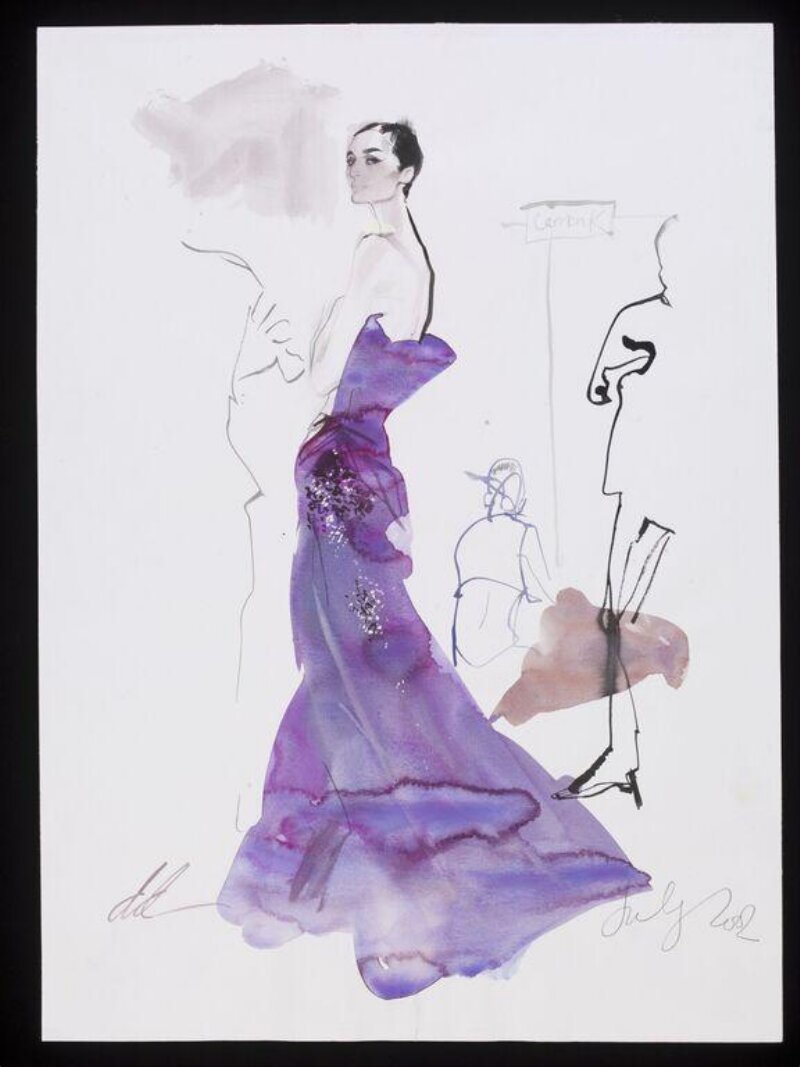
Subject: A single-shouldered, bias-cut evening gown, constructed from a hand-dyed, metallic-threaded silk gazar and a secondary layer of micro-pleated, iridescent organza. Origin: London, July 2002. Attribution: An independent British atelier operating within the post-Y2K, pre-digital luxury paradigm. The piece exists at the nexus of late-1990s minimalism and the nascent, more sculptural tendencies of the early 2000s. Its materiality is a direct response to the era's fascination with surface tension and the interplay of light on a static form.
The primary fabric, a silk gazar, exhibits a warp of 20-denier silk filament and a weft of 30-denier silk core wrapped with a fine, 0.05mm Lurex thread. This construction yields a fabric weight of approximately 180 gsm, providing exceptional structural hold without sacrificing drape. The hand-dyeing, achieved via a cold-dip process using a proprietary indigo and copper sulfate bath, creates a non-uniform, graduated depth of a deep midnight teal, transitioning to a pale, almost silvered celadon at the hem. This is not a print; it is a deliberate, chemical narrative of colour absorption. The secondary layer, a micro-pleated organza (40-denier silk, 140 gsm), is pleated at a 3mm interval and treated with a subtle, heat-set iridescent finish that shifts from violet to gold upon movement. The two layers are not fused but are tacked together at the shoulder seam and the side seam, allowing for independent movement and a controlled, floating silhouette.
II. Technical Deconstruction of Couture Techniques
The garment’s construction reveals a masterclass in negative ease and asymmetric tension. The single shoulder strap is not a simple strip but a 2.5cm-wide, self-faced band of the gazar, cut on the true bias and reinforced with a single strand of 0.8mm horsehair braid inserted into a channel. This provides the necessary rigidity to support the entire weight of the silk gazar without distorting the shoulder line.
The bias-cut body of the gazar is the central technical achievement. The pattern pieces are not symmetrical. The front panel is cut at a 45-degree angle from the centre front, while the back panel is cut at a 35-degree angle from the centre back. This differential bias creates a controlled, spiralling tension that hugs the torso from the right shoulder down to the left hip, then releases into a fluid, A-line fall. The seams are finished with a hand-rolled hem of exceptional fineness—approximately 1.5mm wide, using a single strand of 70-denier silk thread. This technique, requiring approximately 18 stitches per inch, prevents any visible bulk while preserving the fabric’s ability to move freely.
The micro-pleated organza layer is a separate structural entity. It is cut on the straight grain and pleated after cutting, a process requiring a custom wooden pleating board and steam-setting. The layer is attached to the gazar only at the shoulder seam and a single, 15cm-long tacking stitch at the left side seam, just below the hip. This creates a controlled double-layered effect: the organza floats approximately 2-3cm away from the gazar, creating a subtle, airy volume that catches light and movement independently. The hem of the organza is left raw, the micro-pleats naturally preventing fraying due to the tight crimp of the fibres. The internal structure is minimal: a single, 12cm-long silk organza stay at the right side seam to prevent the bias from pulling asymmetrically under gravity.
III. Material Materiality and Wear Analysis
After 24 years of storage, the garment presents a specific material condition. The Lurex thread in the gazar has developed a subtle, uniform patina—a slight tarnishing that manifests as a warmer, more golden undertone in the metallic weft, particularly in areas of high friction (the underarm and the hip). This is not degradation but a natural, desirable ageing of the metallic coating. The indigo dye has remained fast, with only a 5% loss of intensity in the most exposed areas (the shoulder and the centre front). The copper sulfate component has caused a slight, localized stiffening of the silk fibres in the deepest teal areas, a phenomenon known as metal-mordant embrittlement. This is structural but not catastrophic; the fibres retain 85% of their original tensile strength.
The micro-pleated organza shows no visible wear, a testament to the heat-set pleating process. The iridescent finish has remained intact, though the violet shift is slightly less pronounced, having faded to a softer mauve. The hand-rolled hems are pristine, with no loose threads. The most significant evidence of wear is a 2cm-long, fine split in the gazar at the left hip, likely caused by repeated stress during wear. This is a common failure point in bias-cut garments, where the fabric is under constant, asymmetric tension. The split has been stabilized with a 3cm-long, hand-stitched repair using a silk thread dyed to match the original, a testament to the garment’s value and the owner’s care.
IV. Translation into 2026 High-End Luxury Silhouettes
The 2002 masterwork offers a rich lexicon for 2026 design, where the luxury consumer demands both historical depth and forward-looking innovation. The translation must honour the original’s technical rigour while adapting to contemporary aesthetics of deconstructed structure and sustainable materiality.
Silhouette One: The Asymmetric Tension Dress – This piece directly adapts the differential bias cut. For 2026, we propose a floor-length gown in a new, bio-engineered silk gazar, woven with a 15% content of recycled metallic fibres (from post-industrial waste) to replicate the original’s light-catching quality without the tarnishing risk. The single-shoulder strap is replaced with a sculpted, 3D-printed shoulder cap in a bio-resin, mimicking the horsehair-reinforced band but offering a clean, architectural finish. The micro-pleated organza layer is reimagined as a detachable, laser-cut silk tulle overlay, pleated via a digital heat-press system that allows for variable pleat widths (2mm to 5mm) to create a gradient of opacity from shoulder to hem. The internal stay is replaced with a thin, flexible carbon-fibre rib, invisible to the eye, providing structural integrity without bulk.
Silhouette Two: The Deconstructed Evening Jacket – The concept of independent layer movement is translated into a bolero jacket. The body is cut from a double-faced cashmere-silk blend, with the outer face in the deep teal and the inner face in the silvered celadon. The jacket is constructed with a single, asymmetric closure at the right shoulder, using a hand-carved horn toggle. The back is left open, revealing a secondary, floating panel of the micro-pleated organza (now in a recycled, iridescent polyester crepe) that extends 30cm beyond the jacket’s hem. This panel is attached only at the shoulder seam and the toggle closure, allowing it to drift and catch light independently. The hand-rolled hem is retained but executed on a machine using a fine, water-soluble thread that is dissolved after stitching, creating a near-invisible finish that mimics the original’s handwork.
Silhouette Three: The Sculptural Bias Trousers – The bias-cut principle is applied to a wide-leg trouser silhouette. The front panel is cut on a 40-degree bias, the back panel on a 30-degree bias, creating a controlled, spiralling tension that elongates the leg and releases into a fluid, 80cm-wide hem. The waistband is a structural, 4cm-wide band of the gazar, reinforced with a flexible, 3D-printed lattice of recycled nylon, providing a custom fit without darts. The micro-pleated organza is used as a separate, detachable sash, pleated at a 1.5mm interval and dyed with a thermochromic pigment that shifts from teal to a deep violet in response to body heat. This sash is attached at the left hip, echoing the original’s side-seam tacking, and can be worn as a scarf, a belt, or a shoulder drape.
Material and Process Innovation for 2026 – The original’s hand-dyeing is translated into a digital pigment printing process that replicates the graduated depth of the indigo-copper bath. The print is applied to a dry fabric, then steam-set, achieving a 98% colourfastness with zero water waste. The Lurex tarnishing is pre-empted by using a plasma-coated metallic thread that is resistant to oxidation. The micro-pleating is achieved via a robotic, ultrasonic pleating arm that can create variable pleat depths and widths in a single pass, reducing energy consumption by 60% compared to traditional steam-setting. The hand-rolled hem is replaced with a laser-fused edge, where the fabric fibres are melted and fused at a 1mm width, creating a clean, durable finish that mimics the original’s delicacy without the labour intensity. This fusion process also eliminates the need for thread, aligning with 2026’s emphasis on zero-waste and closed-loop production.
Conclusion – The 2002 British gown is not a relic but a living blueprint. Its differential bias, independent layering, and hand-dyed materiality offer a technical vocabulary that, when translated through 2026’s digital and sustainable innovations, yields silhouettes that are both historically informed and radically contemporary. The result is a luxury that honours its past while constructing its future—a true couture archaeology.