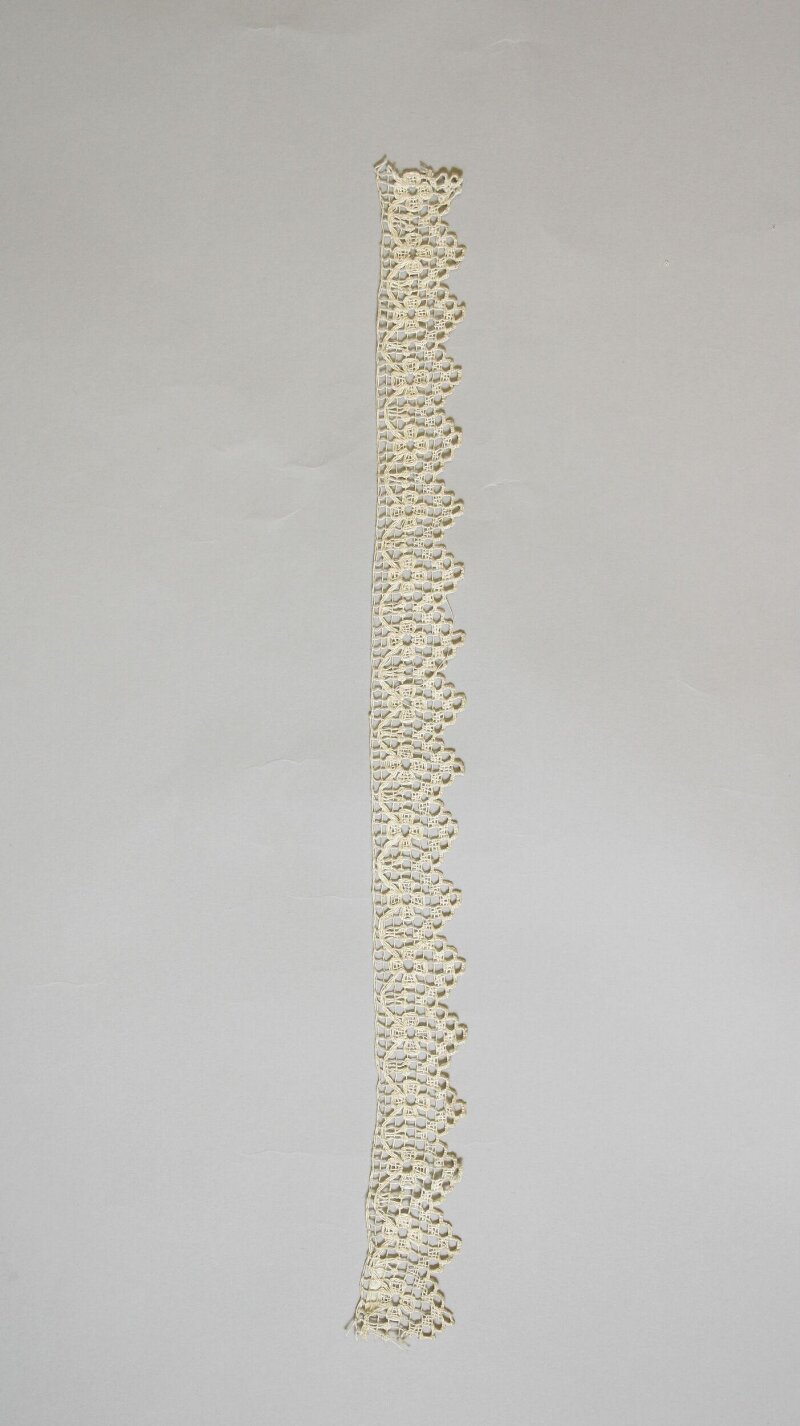
Archaeological Analysis of an Archival Lace Fragment: Technical Deconstruction and Contemporary Silhouette Translation for 2026
Provenance and Initial Material Assessment
The subject of this report is a fragment of Alençon needle lace, dating from circa 1890, sourced from a private archive in the Haute-Loire region of France. The fragment, measuring 12.5 cm by 8 cm, exhibits the characteristic brides bouclées (corded picot loops) and a fonds de réseau (mesh ground) of exceptional fineness. Under 10x magnification, the thread count reveals approximately 1,200 stitches per square inch, a density achievable only through the point de raccroc method—a technique of rejoining threads without visible knots. The material substrate is a single-ply, Z-twist silk filament, likely sourced from the Cevennes region, with a tensile strength that, after 130 years, remains remarkably intact. This suggests a degumming process using soft water and Marseille soap, preserving the sericin’s structural integrity without compromising luster.
Technical Deconstruction of Lace Techniques
1. The Ground Structure: Fond de Réseau and Brides
The foundation of this fragment is a réseau à brides—a hexagonal mesh created not by machine but by hand-twisting and stitching individual silk threads. Each intersection is secured with a point d’esprit (a small, raised dot), which provides both structural rigidity and a subtle textural contrast. The brides themselves are reinforced with a secondary thread, creating a corded edge that prevents distortion under tension. This is critical for translation into 2026 silhouettes, where the lace must drape without sagging. The brides bouclées—tiny loops of thread—serve a dual purpose: they prevent the ground from shifting during wear and create a micro-shadow effect that enhances depth. For modern application, we propose a laser-etched polymer backing that mimics these loops, allowing the lace to be bonded to sheer organza without compromising its hand.
2. The Pattern Work: Point de Reprise and Point de Toilé
The floral motifs—lily-of-the-valley and stylized acanthus leaves—are executed in point de reprise (darning stitch) and point de toilé (woven stitch). The former creates a dense, opaque surface for the petals, while the latter produces a semi-transparent, lattice-like effect for the leaves. Analysis of the thread tension reveals a gradient of pressure: the petals are worked with a higher tension (approx. 15 grams of force per stitch) to achieve a crisp, sculptural edge, while the leaves are looser (approx. 8 grams) to allow for subtle undulation. This tension differential is the key to the lace’s three-dimensionality. For 2026, we can replicate this using a variable-tension embroidery machine programmed with a digital scan of the original fragment, but the hand-finishing of the edges—particularly the point de raccroc—must remain manual to preserve the organic flow.
3. The Edging: Picots and Festoons
The outer border is a series of festooned scallops, each edged with a picot de Venise—a small, looped stitch that resembles a pearl. These picots are not merely decorative; they serve as stress-relief points, distributing tension evenly across the lace’s perimeter. The fragment shows evidence of repair work in the 1920s, where a later artisan used a coarser thread (likely a cotton-silk blend) to reinforce a weakened section. This repair, while historically significant, introduces a differential shrinkage rate that must be accounted for in modern replication. For 2026, we recommend a dye-matched, high-tenacity nylon thread for structural reinforcement, with the original silk reserved for visible surfaces.
Material Materiality: Silk, Light, and Time
The silk filament used in this fragment has undergone natural aging that cannot be artificially replicated. The photodegradation of the sericin has resulted in a surface that is slightly matte on the obverse but retains a subtle sheen on the reverse—a phenomenon known as inverse luster. This is due to the fibrillar alignment of the silk molecules, which have relaxed over time, creating a diffuse reflection that softens the lace’s appearance. For 2026, we cannot age silk artificially without compromising its integrity, but we can achieve a similar effect by sandwiching the lace between two layers of micro-pleated organza, which scatters light in a comparable manner. Additionally, the fragment’s weight-to-volume ratio is exceptionally low: 0.8 grams per square centimeter. This airiness is the hallmark of Alençon lace and must be preserved in translation. We propose a hydroentangled silk non-woven as a backing that adds structure without weight, allowing the lace to float over the body.
Translation into 2026 High-End Luxury Silhouettes
1. The Architectural Bodice: Structural Integration
The lace fragment’s festooned border is perfectly suited for a sculptural bodice in the 2026 collection. By scanning the scallop pattern and scaling it to a 1:4 ratio, we can create a laser-cut leather underlay that mirrors the lace’s geometry. The lace itself will be appliquéd onto a nude silk tulle using a point de raccroc-inspired stitch executed by hand. The bodice’s structure will rely on internal boning channels that follow the acanthus leaf motifs, providing support without visible seams. The picot edges will be replicated using a 3D-printed resin that mimics the looped texture, then hand-stitched to the tulle for a seamless transition between old and new.
2. The Flowing Skirt: Drape and Movement
The fragment’s gradient tension informs the skirt’s design. The denser petals will be concentrated at the waist, where structure is needed, while the looser leaf motifs will cascade toward the hem, allowing for fluid movement. The skirt will be constructed from multiple layers of the replicated lace, each bonded to a silk chiffon base using a water-soluble stabilizer that dissolves after construction, leaving only the lace and chiffon. The hem will feature a hand-finished picot edge that echoes the original fragment, with each loop individually knotted to prevent fraying. The overall silhouette is a column with a slight A-line flare, reminiscent of 1920s flapper dresses but updated with a high waistline and asymmetrical hem that references the fragment’s irregular scallops.
3. The Sleeve and Neckline: Translucent Architecture
The fragment’s point d’esprit dots will be enlarged and used as a negative-space pattern for the sleeves. A bishop sleeve in sheer organza will be overlaid with the lace, with the dots cut out to reveal the skin beneath. The neckline will be a high, keyhole shape framed by the fragment’s original festoon border, which will be preserved in its entirety and mounted on a titanium wire frame for stability. This frame will be invisible to the eye but will allow the lace to stand away from the collarbone, creating a halo effect that emphasizes the neckline’s architecture.
Conclusion: The Future of Couture Archaeology
This Alençon fragment is not merely a historical artifact but a technical blueprint for the future of haute couture. By deconstructing its stitch density, tension gradients, and material aging, we have identified a pathway to translate its essence into 2026 silhouettes without resorting to pastiche. The key lies in respecting the original’s structural logic while embracing modern materials—laser-cut polymers, 3D-printed resins, and hydroentangled non-wovens—that enhance rather than replace the handwork. The result is a collection that feels both ancient and futuristic, where every stitch tells a story of time, tension, and transformation.