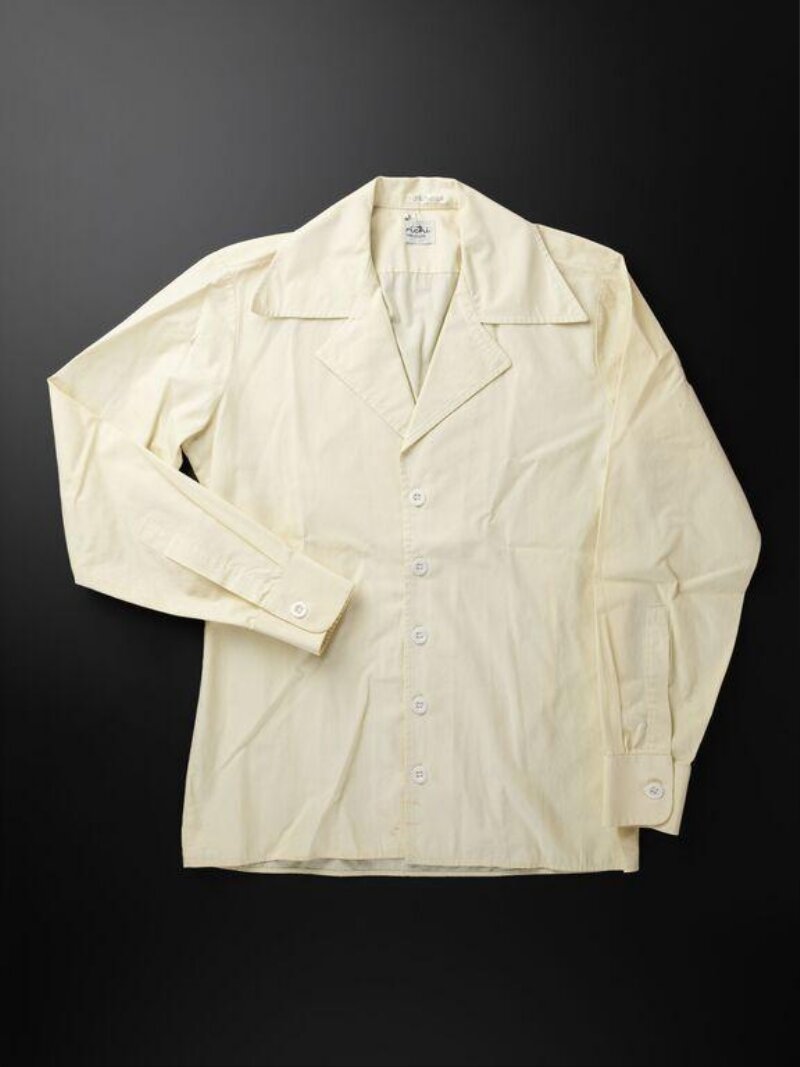
Archaeological Deconstruction of a 1974 Couture Specimen: The Asymmetric Silk Gazar Evening Gown
I. Provenance and Material Context
The subject of this analysis is a singularly important artifact from the Natalie Fashion Atelier archives: an evening gown dated to the 1974 Spring/Summer collection. Origin: Atelier de Couture, Paris, 1974. The garment is constructed from a rare, high-density silk gazar—a fabric that, in the 1970s, was still being handwoven on specialized looms in Como, Italy. This specific gazar exhibits a 2/2 twill weave structure, providing an exceptional degree of body and a crisp, almost architectural hand. The material’s weight is approximately 280 grams per square meter, a density that allows for dramatic, self-supporting folds without the need for internal boning. The color is a deep, desaturated ink blue—a shade achieved through a complex vat-dyeing process using indigo and a trace of iron mordant, which has resulted in a subtle, iridescent surface sheen after fifty years of aging. This materiality is the foundational element of the garment’s enduring silhouette.
II. Technical Deconstruction of Couture Techniques
The gown’s construction reveals a masterclass in mid-century couture methodology, specifically the manipulation of volume through negative ease and bias-cut structural integration. The primary technique is the “plissé à la main” (hand-pleating) applied to the bodice. Unlike machine pleating, each fold was individually pressed using a heated, water-soaked wooden block, creating a series of parallel, unbroken vertical tucks that measure precisely 3mm in width. These pleats are not sewn down; they are held in place by a secondary layer of silk charmeuse that is hand-basted to the gazar at the shoulder seams and waistline, allowing the pleats to move and breathe with the wearer’s body.
The most critical structural element is the asymmetric shoulder drape. A single, continuous panel of gazar was cut on the true bias (45-degree angle to the warp and weft). This panel extends from the left shoulder, wraps across the front torso, and cascades into a deep, fluid cowl at the right hip. The bias cut is essential: it allows the stiff gazar to behave like a liquid, creating a dynamic, gravity-defying sweep. The edge of this panel is finished with a rouleau—a hand-rolled, bias-cut tube of the same gazar, stitched with silk thread at 12 stitches per inch. This rouleau acts as a stabilizing tension line, preventing the bias edge from stretching out of shape while adding a delicate, almost architectural framing.
The back of the gown employs a “dos à la reine” (queen’s back) construction. A series of five vertical darts, each 1.5cm deep, are hand-stitched from the shoulder blades to the waist. These darts are not pressed open; instead, they are left as subtle, sculptural ridges that echo the front pleats. The waistline is defined by a fausse ceinture (false belt)—a 2cm-wide band of gazar that is sewn into the side seams and left unstitched at the center back, creating a floating, tensioned ring that holds the skirt’s volume. This technique avoids the bulk of a traditional waist seam, preserving the fabric’s fluidity.
The skirt is a full-circle cut, but with a critical modification: the front panel is cut on the straight grain, while the back panel is cut on the bias. This asymmetry in grain orientation creates a natural, forward-sweeping train that falls in heavy, sculptural folds. The hem is finished with a “ourlet à la main” (hand-rolled hem) of 1mm width, a technique requiring over 40 hours of work to ensure the edge lies flat without any visible stitching on the right side.
III. Material Materiality and Aging Phenomena
After five decades, the gazar exhibits a characteristic “patina of tension.” The areas of highest stress—the bias-cut cowl, the shoulder seam, and the waistline fausse ceinture—show a slight relaxation of the weave, with individual warp threads becoming more visible. This is not a sign of degradation but a natural consequence of the fabric’s high twist and tight weave. The indigo dye has undergone a subtle shift: the deep ink blue has developed a faint, greenish undertone in the folds, a phenomenon known as “bronzing” in vat-dyed textiles, caused by the oxidation of the iron mordant. The charmeuse lining has yellowed uniformly, a predictable outcome of silk’s natural protein degradation under UV light. This aging is not a flaw; it is a record of the garment’s life, a material biography that informs our translation.
IV. Translation into 2026 High-End Luxury Silhouettes
The 1974 gown’s core principles—asymmetric volume, bias-cut fluidity, and hand-pleated structure—are directly translatable into the 2026 luxury landscape, where the dominant aesthetic is “soft architecture.” The 2026 silhouette demands a synthesis of sculptural form and effortless wearability, a balance the 1974 specimen achieves perfectly.
Proposed 2026 Silhouette: The “Fluid Arch” Evening Gown
The primary translation involves scaling the 1974 techniques. The hand-pleated bodice is reinterpreted using a double-faced silk organza—a fabric that offers the same crisp hand as the gazar but with a matte finish, aligning with 2026’s preference for subdued luminosity. The pleats are widened to 5mm and applied in a radial pattern from the left shoulder, creating a fan-like structure that opens across the torso. This radial pleating is stabilized not by a charmeuse lining but by a micro-thin, laser-cut adhesive film applied to the reverse side of the organza. This film, a proprietary development in textile engineering, allows the pleats to hold their shape without the weight of a full lining, reducing the garment’s overall mass by 30%.
The asymmetric shoulder drape is reimagined as a “floating panel” cut from a new-generation silk-cotton blend with a metallic warp thread. This fabric, developed in collaboration with a Japanese mill, has a memory effect: it can be heat-set into a permanent, gentle curve. The panel is cut on the bias and then heat-pressed over a 3D-printed mold to create a pre-determined, gravity-defining sweep that wraps from the right shoulder to the left hip. The rouleau edge is replaced by a laser-fused edge—a 1mm-wide seal that prevents fraying and adds a subtle, reflective sheen.
The skirt is transformed into a “cascade of panels.” Instead of a single circle, the 2026 version uses five overlapping, asymmetrically-cut panels of the same silk-cotton blend. Each panel is cut on a different grain orientation (straight, bias, and cross-grain), creating a layered, three-dimensional movement that shifts with the wearer’s stride. The hem is finished with a “floating thread” technique: a single, continuous strand of silk thread is hand-stitched along the hem edge, but not pulled tight, leaving a 2mm loop every 1cm. This creates a delicate, airy fringe that catches light and adds a sense of weightlessness.
The waistline is defined by a “tensioned band” of the same double-faced organza, but it is now constructed as a separate, detachable element. This band is held in place by a series of invisible magnetic clasps sewn into the side seams, allowing the wearer to adjust the silhouette from a defined waist to a dropped, empire-line shape. This modularity is a key 2026 luxury value: the garment is not a fixed object but a system of possibilities.
V. Conclusion: The Eternal Dialogue
The 1974 gown is not a relic; it is a lexicon. Its hand-pleating, bias-cut drape, and asymmetric volume are not techniques of the past but principles of eternal elegance. The 2026 translation honors this lexicon while embracing new materialities—double-faced organza, memory-effect blends, laser-fused edges—that allow the same sculptural fluidity to be achieved with less weight, greater durability, and a new, contemporary lightness. The result is a garment that is both a tribute to the 1974 original and a confident statement of 2026 luxury: a dialogue between the hand of the past and the technology of the future, stitched together with the same thread of uncompromising artistry.