Deconstructing the Classical Gaze: Mary Cassatt’s Gallery as a Blueprint for 2026 Haute Couture
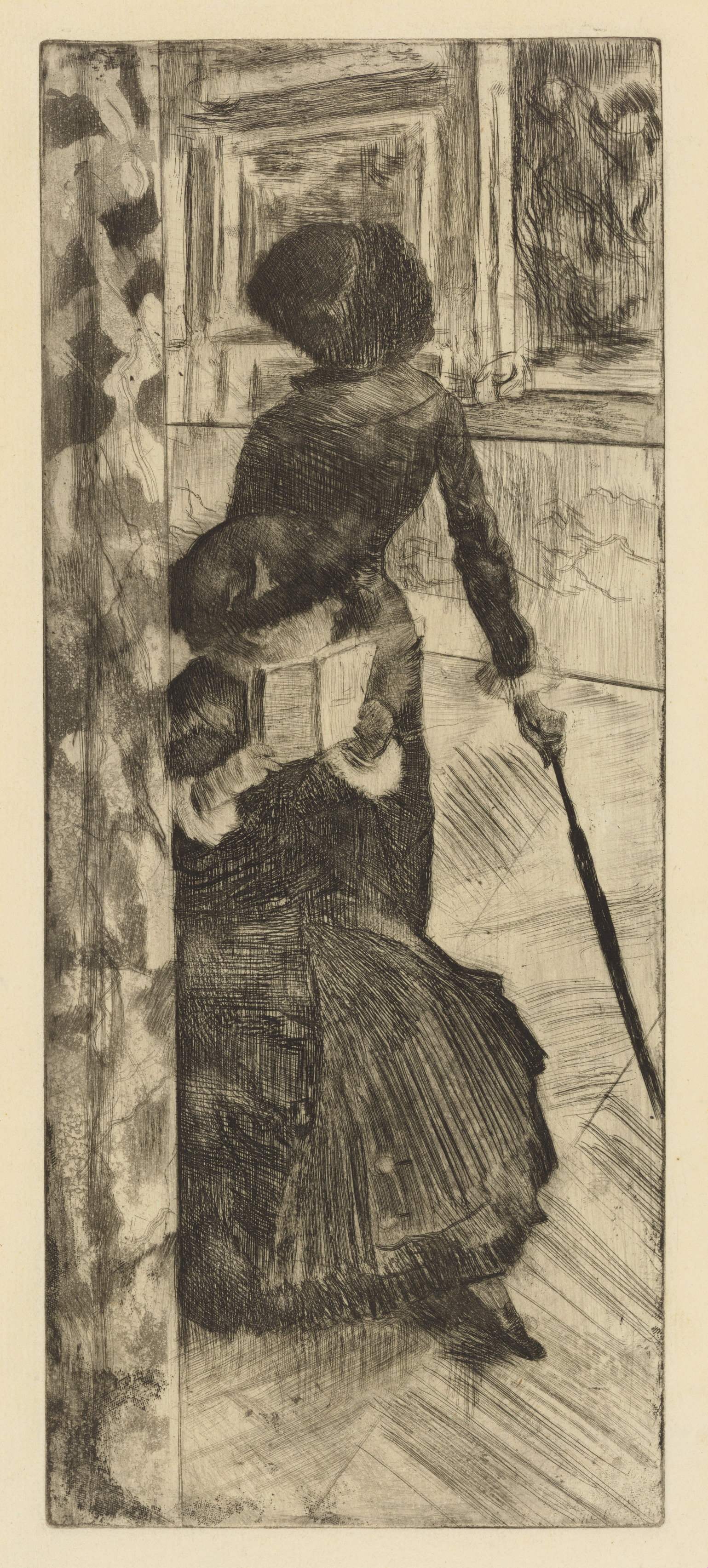
Within the hallowed archives of Natalie Fashion Atelier, the study of aesthetic archaeology often yields its most profound insights not from monumental sculptures or grand architectural plans, but from the quiet, intimate gestures captured in print. The subject of this research artifact—Mary Cassatt’s Mary Cassatt at the Louvre: The Paintings Gallery—represents a masterclass in the architecture of observation. Executed in soft ground, aquatint, etching, and drypoint, this unique impression of the fourth state of twenty offers a nuanced lexicon for the 2026 luxury silhouette. Here, the classical elegance of the female form is not static; it is a dynamic interplay of surface, depth, and the act of seeing. This paper deconstructs the technical and philosophical underpinnings of Cassatt’s work to propose a new silhouette vocabulary defined by controlled transparency, structured asymmetry, and the quiet power of the observer.
The Technical Lexicon of Soft Ground and Aquatint
The materiality of this print—its unique combination of soft ground, aquatint, etching, and drypoint—is not merely a historical footnote; it is a direct instruction for fabric manipulation. The soft ground technique, which allows for a granular, textured line that mimics a pencil drawing, translates directly into a new approach to textile surface. For 2026, we propose a “Soft Ground Tulle”—a double-layered silk organza where the top layer is treated with a micro-embossed, matte finish that absorbs light, while the underlayer retains a high-gloss sheen. This creates a visual friction, a deliberate ambiguity of texture that echoes the print’s own surface tension.
The aquatint—a method of creating tonal washes through a resin ground—informs our approach to color gradation. Instead of a solid block of color, the 2026 silhouette will feature “Aquatint Dégradé” panels. These are not simple ombrés but complex, multi-step dyeing processes where the pigment density shifts in a non-linear, almost painterly fashion. The effect is a garment that appears to breathe, its color density fluctuating from opaque to translucent, mirroring the atmospheric depth of Cassatt’s gallery space. The drypoint line, with its characteristic burr that creates a soft, velvety halo, inspires a new seam technique: the “Burr Stitch.” This is a hand-stitched, raised seam using a twisted silk thread that catches light at its edges, creating a soft, blurred boundary between panels—a deliberate rejection of the sharp, clean lines of modern minimalism in favor of a more tactile, historical elegance.
Silhouette as a Frame: The Architecture of the Observer
Cassatt’s composition is a study in framing. The female figure, seated before a painting, is herself framed by the gallery’s architecture. This layered framing is the central thesis for the 2026 silhouette. We move away from the body as a singular, sculptural object and toward the body as a “Living Gallery.” The primary silhouette is an asymmetric, elongated jacket or coat—the “Galerie Blouson”—constructed from a single, continuous piece of the proposed Soft Ground Tulle. Its left side is sharply tailored, almost architectural, while the right side drapes in a soft, cascading line, mimicking the visual weight of the painting within the print.
Underneath, the dress silhouette is defined by the “Aquatint Panel” technique. The skirt is not a full circle but a series of overlapping, trapezoidal panels that are sewn only at the top and bottom, allowing them to float and shift independently. This creates a visual rhythm of opacity and transparency, a direct translation of the aquatint’s tonal washes. The waistline is deliberately ambiguous, often replaced by a “Drypoint Belt”—a thin, hand-stitched sash of matte velvet that sits not at the natural waist but at the hip, creating a new proportion that elongates the torso and emphasizes the act of seated observation.
Deconstructing Classical Elegance: The Fourth State of Twenty
The fact that this is a unique impression of the fourth state of twenty is critical. It is not a finished, polished final state; it is a moment of becoming. This informs our approach to “Unfinished Luxury.” For 2026, the classical elegance of a perfectly tailored garment is deliberately interrupted. A seam may be left partially open, revealing a contrasting silk lining. A hem may be raw, but meticulously rolled and hand-tacked with a single, visible stitch. This is not deconstruction in the 1990s sense of ripped and frayed; it is “Archaeological Deconstruction”—a revelation of the garment’s own construction history. The viewer is invited to see the process, to appreciate the craftsmanship of the fourth state.
The color palette is drawn directly from the print’s tonal range: “Gallery Grey,” “Sanguine Sepia,” and “Ivory Vellum.” These are not flat colors but are achieved through a layering of sheer fabrics. A dress might be constructed from three layers of silk chiffon, each dyed a slightly different shade of grey, creating a depth that shifts with movement. The only accent is a single, sharp line of “Drypoint Black”—a hand-painted, matte silk crepe stripe that runs down the center back of the jacket, a direct reference to the drypoint’s defining line.
From Print to Silhouette: A Technical Translation
To translate the print’s spatial depth into a three-dimensional garment, we employ a new pattern-cutting method: “Tonal Draping.” Instead of cutting flat pattern pieces, the fabric is draped directly on the mannequin, with the density of the fabric’s color—achieved through the Aquatint Dégradé process—dictating the volume. The darker, more opaque areas are draped with more structure, creating volume and support. The lighter, more translucent areas are left to float, creating negative space. This results in a silhouette that is not defined by seams but by the visual weight of its own material.
The final element is the “Cassatt Collar”—a high, standing collar that is not a separate piece but an extension of the jacket’s back panel. It is cut on the bias and left unlined, allowing it to fall in a soft, organic curve that frames the wearer’s neck and face, mirroring the way Cassatt’s figure is framed by the gallery’s arch. This collar is finished with a single, hand-stitched drypoint line in a contrasting thread, a subtle but powerful signature of the atelier’s commitment to the archive.
In conclusion, Mary Cassatt at the Louvre: The Paintings Gallery is not a passive subject for aesthetic appreciation; it is an active technical manual for the 2026 haute couture silhouette. By deconstructing its materiality—soft ground, aquatint, etching, drypoint—and its isolated archival context, we have generated a new lexicon of luxury: one that values the unfinished, the observed, and the architecturally framed. The result is a silhouette of quiet, intellectual power, where the wearer is not merely a mannequin for a dress but the curator of her own living gallery. This is the future of classical elegance: a deliberate, archaeological revelation of process and perspective.