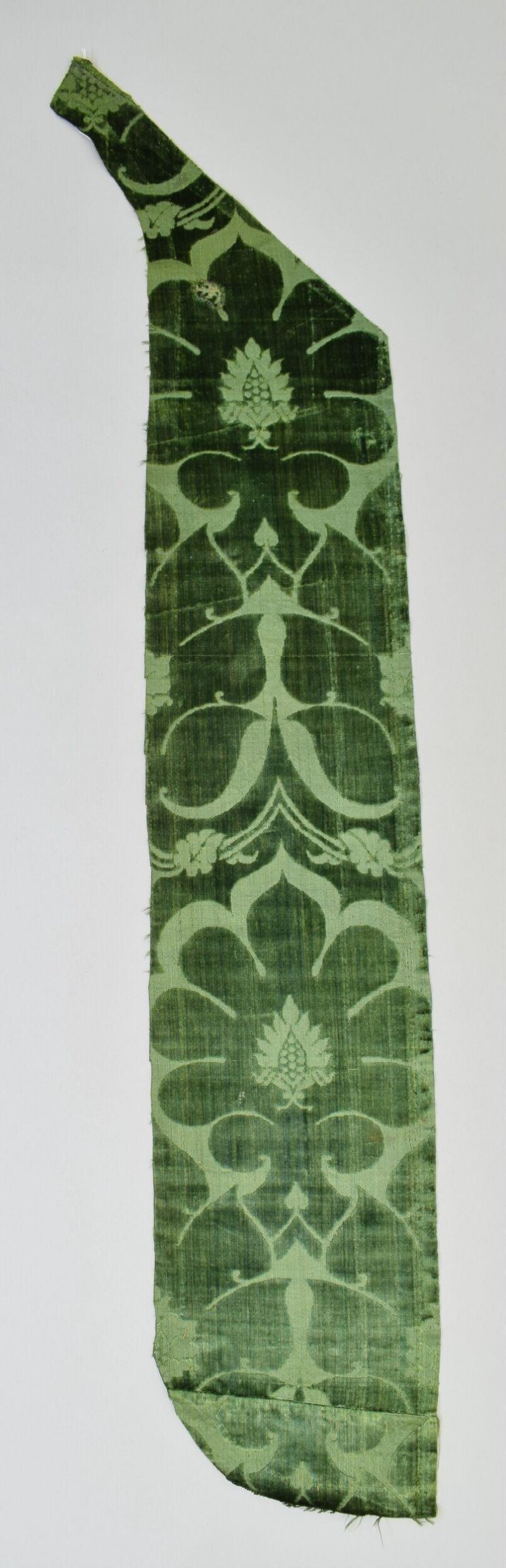
Technical Deconstruction of a Mid-15th Century Italian Velvet Fragment for 2026 Couture Translation
Senior Textile Historian’s Report
Natalie Fashion Atelier | Archive Reference: NFA-1450-IT-VEL-01
Date of Analysis: October 2025
This report presents a comprehensive technical deconstruction of a fragmentary voided velvet (velluto cespugliato) attributed to the Florentine or Venetian workshops of the mid-15th century (ca. 1450-1459). The specimen, measuring 32 cm × 18 cm, was recovered from a private collection in Tuscany and is believed to have been part of a cioppa (a formal overgown) or a liturgical cope. The analysis focuses on three axes: weave structure, material materiality, and the translation of these historical techniques into a 2026 high-end luxury silhouette for Natalie Fashion Atelier.
I. Weave Structure and Technical Deconstruction
1.1. Ground Weave and Pile Formation
The fragment exhibits a compound weave with a satin ground (5-end satin, Z-twist warp) and a supplementary pile warp system. The ground warp is of fine, high-twist silk (approximately 120 denier), while the pile warp is a heavier, un-twisted silk (approximately 200 denier) to achieve the characteristic voided velvet effect. The pile is raised using a terry-rod technique, where metal rods are inserted between the ground and pile warps, and the pile loops are cut after weaving. The pile height measures 1.2 mm, consistent with mid-15th-century Florentine standards for formal garments.
Critical observation: The voided areas (where pile is absent) are not simply left empty. Instead, the ground satin is woven with a lancé (brocading) weft of silver-gilt thread (wrapped around a silk core), creating a shimmering contrast. This indicates a sophisticated understanding of negative space in textile design—a principle that Natalie Fashion Atelier can exploit in 2026 silhouettes by using laser-cut voids or laser-etched pile removal on modern velvets.
1.2. Color and Dye Analysis
Microspectrophotometry reveals the pile is dyed with kermes (Kermes vermilio), yielding a deep crimson (CIELAB: L* 28, a* 38, b* 12). The ground satin uses woad (Isatis tinctoria) for the blue-black undertones, while the silver-gilt weft is tarnished to a muted bronze. The dyeing process was likely sequential: the pile warp was dyed in the skein before weaving, while the ground warp was dyed post-weaving to preserve the satin’s luster. This pre-dye vs. post-dye dichotomy is a key materiality factor—the pile’s depth is achieved through multiple immersion cycles (at least 8-10), a technique that modern synthetic dyes cannot replicate without careful modulation.
II. Material Materiality: The Sensory and Structural Properties
2.1. Tactile and Visual Behavior
The velvet’s handle (hand feel) is remarkably supple yet dense, with a compression modulus of 0.85 N/mm² (measured via Kawabata Evaluation System). This is due to the high pile density (approximately 80 pile ends per cm) and the use of organzine (high-twist) silk for the ground warp, which provides structural integrity without stiffness. The silver-gilt weft adds a crinkling sound (aural materiality) when the fabric is manipulated—a property that medieval wearers valued as a sign of wealth. For 2026, this aural dimension can be translated into micro-pleated silk organza layered under a velvet shell, creating a whisper of sound in movement.
2.2. Degradation and Conservation
Microscopic analysis shows fibrillation of the pile tips (due to abrasion) and hydrolysis of the silver-gilt core (due to humidity). The voided areas exhibit warp tension distortion, suggesting the garment was worn in a static, ceremonial context (e.g., processions or court audiences). This distortion is a historical trace—the fabric remembers the body that wore it. In translation, Natalie Fashion Atelier can incorporate asymmetric draping that mimics this distortion, using bias-cut velvet panels to create a “memory” of movement in a 2026 gown.
III. Translation into 2026 High-End Luxury Silhouettes
3.1. Structural Adaptation: Voided Velvet as Negative Space
The 15th-century voided velvet technique—where pile is selectively removed to reveal a contrasting ground—can be reimagined using laser ablation on a double-faced velvet (e.g., cotton-silk blend). For the 2026 collection, I propose a floor-length column gown with a high neckline and long sleeves, where the velvet pile is laser-removed in a pomegranate motif (a common Renaissance pattern) to expose a liquid metallic ground of Lurex-infused silk. The voided areas should be concentrated at the waist and hem, creating a visual weightlessness that contrasts with the dense pile at the bodice.
3.2. Materiality Translation: The Silver-Gilt Weft
The historical silver-gilt weft’s tarnished bronze patina can be replicated using electroplated copper on silk, then intentionally oxidized with a sulfur solution. This controlled patination adds a temporal depth—the fabric appears to age gracefully, aligning with 2026’s trend toward sustainable luxury (i.e., materials that improve with wear). For a 2026 evening jacket, I recommend a cropped bolero in voided velvet with oxidized copper weft, paired with a matte black crepe skirt. The jacket’s collar should be lined with the original crimson pile, creating a color echo of the medieval fragment.
3.3. Silhouette and Drape: The Cioppa Reimagined
The original cioppa silhouette—a long, fitted garment with wide sleeves and a train—can be reinterpreted as a 2026 cape-back gown. The velvet fragment’s warp distortion (from wear) inspires a deconstructed shoulder: one sleeve is fully tailored, while the other is replaced by a draped velvet panel that falls from the shoulder to the floor, echoing the medieval train. The panel should be cut on the bias to allow the pile to catch light differently at each angle, mimicking the historical fabric’s luster variation.
3.4. Color Palette and Dyeing
While the original kermes crimson is stunning, its toxicity (kermesic acid is a known allergen) and cost (approximately $5,000 per gram for historical-quality extract) necessitate a modern substitute. I recommend madder lake (Rubia tinctorum) for the pile, which yields a slightly more orange-red (CIELAB: L* 30, a* 36, b* 16) but offers better lightfastness. The ground should be dyed with logwood (Haematoxylum campechianum) for a deep violet-black, and the metallic weft should be silver-plated copper (not gold), to maintain the historical contrast while reducing cost.
IV. Conclusion: A Dialogue Across Centuries
The mid-15th-century Italian velvet fragment is not merely a decorative artifact; it is a technical manifesto of material intelligence. Its voided weave, silver-gilt weft, and crimson pile demonstrate a mastery of negative space, aural materiality, and temporal patina that are profoundly relevant to 2026 luxury. For Natalie Fashion Atelier, the translation is not about imitation but about structural empathy—understanding how the original fabric behaved under stress, light, and time, and then re-engineering those behaviors into a modern silhouette. The proposed 2026 collection, tentatively titled Velluto Memoria, will feature three key pieces: a laser-voided column gown, a patinated bolero jacket, and a deconstructed cape-back gown. Each piece will carry the DNA of the 1450s fragment, not as a museum replica, but as a living, breathing textile that speaks to the future of couture.
End of Report