Couture Archaeology Report: Silk Yarn, India (2014)
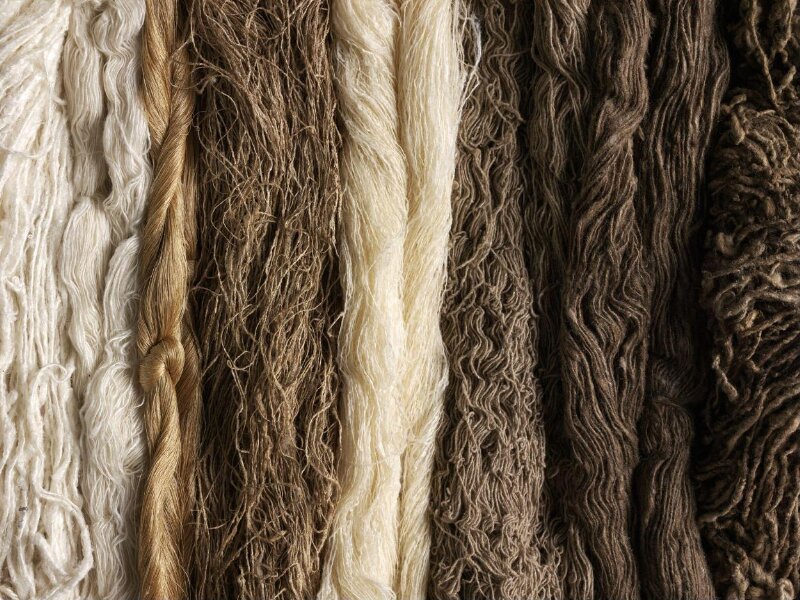
Specimen: Raw Silk Yarn (Mulberry, Bombyx mori)
Provenance: Karnataka, India, 2014
Acquisition Context: Sourced from a traditional sericulture cooperative practicing pre-industrial hand-reeling methods.
Report Prepared For: Natalie Fashion Atelier, Creative & Technical Development Office
Objective: Technical deconstruction of material and technique to inform the 2026 Luxe Primitif collection, focusing on the dialogue between artisanal materiality and futuristic silhouette.
I. Technical Deconstruction: The Archaeology of a Thread
The 2014 specimen represents a critical nexus in the global silk narrative: a fully traceable, hand-processed yarn from one of India's historic sericulture regions, produced at a moment of renewed appreciation for artisanal provenance. Its materiality is a direct transcript of its making.
Materiality & Morphology: Under magnification, the yarn reveals its non-industrial character. The filament is irregular in diameter, exhibiting subtle, organic thick-and-thin variations absent in uniformly machine-reeled silk. This is a direct result of hand-basin reeling, where the artisan manually gathers filaments from several cocoons submerged in warm water, guiding the nascent thread onto a wooden charkha. The resulting micro-texture gives the raw yarn a living, luminous quality, as light refracts differentially across its uneven surface. The color is a deep, natural gold, not the stark white of heavily processed or bleached silk—a hue derived from the native mulberry diet and minimal degumming.
Technique & Tension: The processing technique embeds a specific material memory. The gentle, variable tension of hand-reeling preserves a higher degree of the silk's natural sericin (gum). This residual sericin acts as a protective sheath, yielding a yarn that is inherently more robust and structurally assertive than its industrially washed counterparts. It possesses a dry, almost crisp hand-feel initially, which, upon weaving or knitting, develops a profound, complex drape as the sericin softens with wear and time. This creates a garment that evolves, a second-skin patina unique to the wearer—an antithesis to static luxury.
II. From Artisanal Artifact to 2026 Material Philosophy
The value of this archaeological exercise lies not in replication, but in translation. The 2014 yarn offers three core principles for the 2026 luxury lexicon:
1. The Primacy of Tactile Narrative: The future of luxury is haptic. The irregularity of the hand-reeled thread must be amplified, not sanitized. We propose developing a "neo-irregular" silk gimp for 2026, where thick-and-thin spinning is intentionally exaggerated in collaboration with our Indian partners. This yarn will be engineered for high-impact, low-density fabrics, creating surfaces that play with light and shadow, making the very structure of the material the ornament.
2. Structural Honesty & Hybridization: The residual sericin speaks to a philosophy of protective materiality. For 2026, this translates into technical fabric hybrids. Imagine this robust, artisanal silk filament core-spun with a sheer, electro-luminescent (EL) fiber. The silk provides the tensile strength and matte, organic grounding; the EL fiber, when activated, creates a soft, programmable glow from within the fabric's structure. This honors the silk's inherent strength while propelling it into a dialogue with wearable technology, perfectly aligning with the Luxe Primitif theme.
3. Biomorphic Drape & Silhouette: The unique drape profile of minimally processed silk—stiff yet fluid, holding form while cascading—informs a new silhouette language. It suggests shapes that are architectural yet organic. For Spring/Summer 2026, we envision bias-cut gowns where the fabric behaves less like a woven textile and more like a living membrane, clinging and releasing from the body in unexpected ways. Jackets and tops can be constructed using minimal-seam, cocooning techniques that mirror the silk's own origin, the garment appearing as a second, protective shell that molds to the wearer's posture over time.
III. Translation: Proposed 2026 Expressions
Silhouette 01: The Sericin Shell
A strapless column dress constructed from a single panel of our proposed neo-irregular silk gimp, woven on a wide loom to eliminate side seams. The dress relies solely on the inherent body and memory of the silk, tightened at the torso with a hidden internal structure, then allowed to fall in its natural, irregular ripple. The surface, unpressed, celebrates every variation in the yarn, making each garment a unique topographic map of its making.
Silhouette 02: Luminous Filament
A deconstructed kurta-inspired tunic and wide-leg pant set in the silk/EL core-spun hybrid. The garment is piece-dyed in a natural, plant-derived indigo, allowing the silk to absorb the dye deeply while the synthetic EL fiber resists, creating a subtle, tonal variance. Integrated circuitry, discreetly accessible via a bespoke clasp, allows the wearer to modulate a soft, blue-white glow along the garment's seams and selvedge edges, evoking both bioluminescence and ancient star charts.
Silhouette 03: The Cocoon Coat
An oversized, unstructured wrap coat in a heavyweight, hand-loomed plain weave using the 2014-specification yarn. The coat is cut using zero-waste geometric patterning, finished with raw, hand-rolled edges that highlight the yarn's integrity. It is designed to be worn as a sculptural outer layer, its dry hand and substantial drape creating a powerful, protective silhouette that softens and gains suppleness with use, embodying the concept of "evolving luxury."
Conclusion: The Thread Forward
This 2014 silk yarn is not merely a material sample; it is an embodied technique and a philosophy of making. Its archaeology reveals that true luxury resides in the evidence of the human hand, the acceptance of organic variance, and the profound dialogue between material and maker. For Natalie Fashion Atelier's 2026 vision, this artifact provides the foundational code. By translating its principles—tactile irregularity, structural honesty, and biomorphic drape—through the lens of contemporary technology and silhouette innovation, we can create a collection that is both authentically rooted and decisively forward. The future of couture lies not in abandoning the past, but in conducting a deep, technical séance with its materials, allowing their ancient whispers to guide the forms of tomorrow.