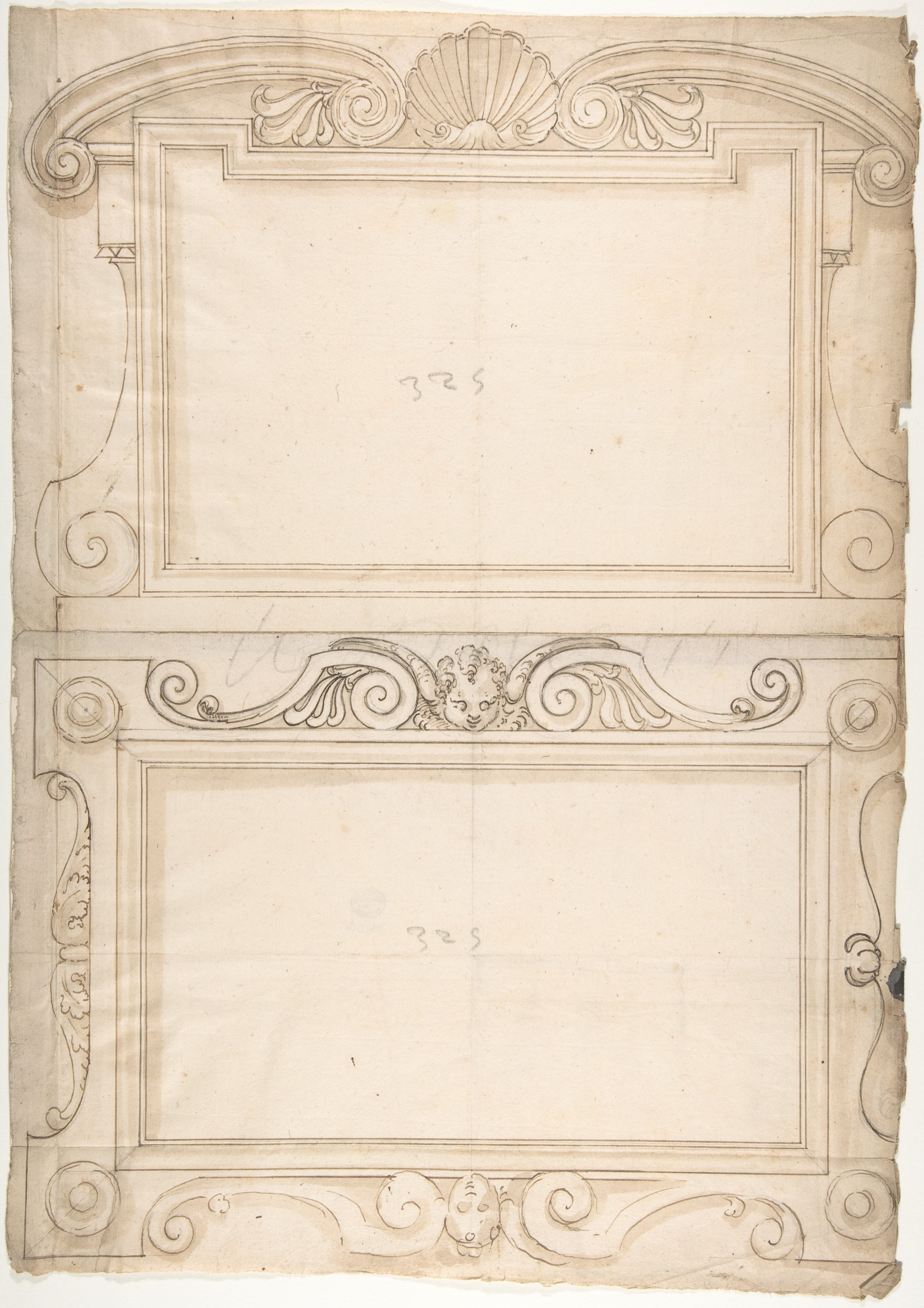
Deconstructing the Classical Line: A Technical Artifact on Two Carved Panel Designs
This research artifact, prepared for the exclusive archives of Natalie Fashion Atelier, undertakes a rigorous aesthetic archaeology of two designs for carved panels. The source material, rendered in black chalk, pen and brown ink, brush and brown wash, presents a unique challenge: to isolate the foundational elegance of these historical fragments and translate their volumetric logic into the high-end silhouettes projected for the 2026 season. The methodology employed is one of forensic deconstruction, analyzing not the subject matter, but the materiality of the line itself—the tension between the chalk’s soft diffusion, the ink’s decisive contour, and the wash’s atmospheric depth. This is not a study in revival; it is a treatise on the structural DNA of classical form as it informs the future of Parisian couture.
Materiality as Architectural Blueprint
The chosen medium—black chalk, pen and brown ink, brush and brown wash—is not incidental. It is the primary vocabulary of the artifact. The black chalk provides a preliminary, almost tactile, suggestion of mass and shadow, analogous to the initial draping of a toile on a mannequin. The pen and brown ink then inscribe the definitive, unyielding contour, the ligne de force that dictates the final silhouette’s boundary. Finally, the brush and brown wash introduces a graduated, atmospheric volume, a chiaroscuro that models the surface and suggests the interplay of light across a three-dimensional form. For the 2026 silhouette, this tripartite materiality dictates a specific design protocol: the silhouette must begin with a soft, volumetric foundation (the chalk), be defined by a sharp, architectural edge (the ink), and be finished with a nuanced, liquid depth (the wash).
Design One: The Torsional Panel and the Silhouette of Resistance
Analysis of the Classical Elegance
The first design depicts a carved panel of apparent architectural origin, possibly a frieze or a metope fragment. Its classical elegance is not found in its figurative elements, but in its torsional geometry. The carving is not flat; it possesses a subtle, axial twist. The black chalk under-drawing reveals a dynamic, almost spiral, energy that is then locked into place by the pen-and-ink contour. The brown wash deepens the recesses, creating a sense of material tension—the stone resisting its own torsion. This is a design of controlled energy, of potential movement arrested in a state of perfect equilibrium.
Translation to 2026 High-End Silhouettes
This torsional logic directly informs a new silhouette for 2026: the “Resistance Gown.” The silhouette is constructed not as a simple A-line or column, but as a continuous, spiraling volume. The structural foundation, akin to the black chalk, is a bias-cut base of double-faced satin, which allows for a natural, organic torsion around the body. The definitive contour, the pen-and-ink line, is provided by a series of sculptural, laser-cut panels of rigid silk gazar. These panels are not sewn flat; they are applied along a diagonal axis, creating a visual and structural twist from the left shoulder to the right hem. The brown wash effect is achieved through a gradated application of micro-pleats within the gazar panels, where the density of the pleating increases towards the base of the twist, creating a shadow of increasing depth. The result is a silhouette that appears to be in a state of elegant resistance, a frozen moment of torsion that echoes the classical panel’s own material tension. The high-end luxury lies in the precision of this engineered twist, a feat of pattern-making that requires a master artisan to align the grain of the silk with the mathematical curve of the design.
Design Two: The Negative Space Panel and the Silhouette of Absence
Analysis of the Classical Elegance
The second design is more abstract. It appears to be a study of a carved panel where the negative space—the void carved out by the chisel—is the primary subject. The black chalk defines the residual mass, the material that remains. The pen and brown ink, however, does not trace the outer edge of the mass; instead, it meticulously outlines the contours of the carved-out cavities. The brush and brown wash is then applied heavily within these cavities, creating pools of deep, almost opaque shadow. The classical elegance here is one of absence and presence, a dialogue between the solid and the void. The beauty is not in what is depicted, but in what has been removed, the negative shape that defines the positive form.
Translation to 2026 High-End Silhouettes
This principle of negative space as a primary design element yields the “Absence Silhouette” for 2026. This is not a simple cut-out dress. It is a study in architectural excision. The silhouette is a full-length, high-neck column in a dense, opaque crepe. The black chalk mass is the unbroken fabric itself. The pen-and-ink contour is then translated into a series of precisely engineered, asymmetrical incisions that follow the body’s skeletal structure—along the ribcage, the ilium, the clavicle. These are not decorative slits; they are structural voids, carved as a sculptor would carve stone. The brush and brown wash effect is interpreted through the interior finishing of these voids. Each incision is lined with a deep, matte, charcoal-black faille that creates an optical pool of shadow, a visual depth that reads as a carved cavity. The silhouette’s elegance is derived entirely from the relationship between the solid fabric panels and these negative spaces. The luxury is in the invisible engineering: the internal structure of boning and micro-tulle that maintains the integrity of the column despite the significant removal of material. The wearer is defined by what she reveals through absence, a silhouette that is both powerful and ethereal, a direct descendant of the classical panel’s dialogue with the void.
Synthesis: The 2026 Silhouette Lexicon
The two designs, analyzed through the lens of black chalk, pen and brown ink, brush and brown wash, yield two distinct but complementary silhouettes for the 2026 collection. The first, the Resistance Gown, speaks to a dynamic, torsional energy—a silhouette in motion. The second, the Absence Silhouette, speaks to a static, contemplative power—a silhouette defined by what it omits. Together, they form a new lexicon for high-end couture, one that prioritizes structural logic over decorative flourish. The classical elegance is not copied; it is reverse-engineered. The materiality of the historical drawing—the chalk’s volume, the ink’s edge, the wash’s depth—becomes the materiality of the future garment. This is the mission of Natalie Fashion Atelier: to excavate the aesthetic archaeology of the past and to forge from its fragments the definitive silhouettes of tomorrow.