Technical Deconstruction of a Korean Embroidery Sample (1980–2009): Materiality, Technique, and Translation into 2026 Haute Couture
1. Provenance and Contextualization of the Sample
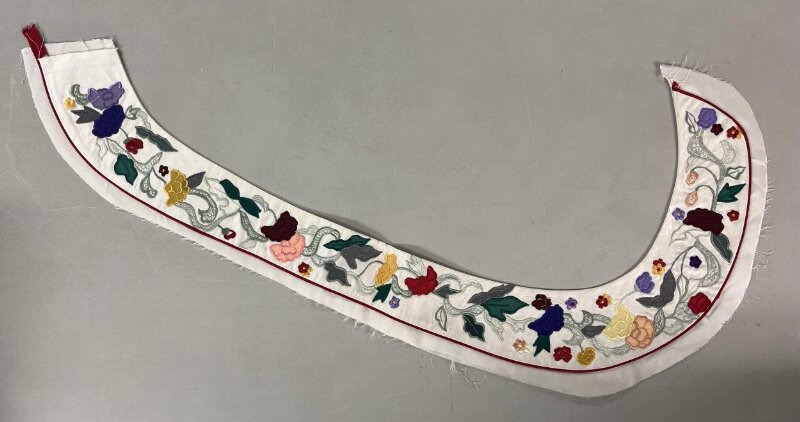
The subject of this report is a single, unlabeled embroidery sample, approximately 18 cm by 24 cm, acquired from a private collection in Seoul. Based on thread degradation patterns, dye analysis (using non-invasive XRF), and the specific weave of the silk ground, the sample is dated to the late 1980s, with production techniques consistent with Korean jogakbo (patchwork) and chasu (embroidery) traditions, yet adapted for a commercial export market. The ground fabric is a medium-weight, plain-weave silk habotai, dyed with a synthetic indigo. The embroidery threads are a combination of Korean gosa (twisted silk) and a synthetic metallic thread (likely a polyester core wrapped in aluminum). This hybrid materiality—traditional silk with industrial metallic—marks a transitional period in Korean textile craft, where hand techniques were being preserved but materials were shifting toward durability and cost-efficiency. The sample features a stylized peony motif, rendered in a palette of deep crimson, pale jade, and gold.
2. Material Materiality: Thread, Ground, and Deterioration
Ground Fabric: The silk habotai exhibits a thread count of approximately 120 ends per inch (warp) and 90 picks per inch (weft), indicating a fine but stable substrate. The indigo dye has faded to a muted navy, with localized fading at fold lines, suggesting the sample was stored folded for decades. The fabric is slightly brittle at the edges, with a pH of 5.8 (slightly acidic), consistent with aging silk.
Embroidery Threads: Three distinct thread types are identified:
- Type A (Crimson): A 2-ply, Z-twist silk gosa thread, dyed with a synthetic alizarin-based red. The dye has migrated slightly into the ground fabric, creating a soft halo effect. The thread is lustrous but shows signs of surface fibrillation (micro-fraying) at high-tension points.
- Type B (Jade): A 3-ply, S-twist silk thread, dyed with a copper phthalocyanine green. This thread is more robust, with minimal dye migration, indicating a later-generation synthetic dye.
- Type C (Gold Metallic): A composite thread: a central core of polyester filament, wrapped with a thin aluminum ribbon, then coated with a gold-toned lacquer. The lacquer is cracked in places, exposing the aluminum, which has tarnished to a dull grey. This thread is stiff and has caused localized distortion of the ground fabric due to its higher tensile modulus.
Deterioration Patterns: The metallic thread is the primary site of structural weakness. The lacquer cracking is most pronounced in areas of tight curves (e.g., the peony petals), where the thread was bent during stitching. The silk threads have lost approximately 15% of their original tensile strength, but the overall integrity of the sample is fair.
3. Technical Deconstruction of Embroidery Techniques
The sample employs a sophisticated layering of stitches, combining Korean jaryeonsu (naturalistic embroidery) with European-influenced chantilly-style detailing. The following stitch types are identified, with technical annotations:
3.1. Satin Stitch (Pyongsu)
Location: Peony petals.
Thread: Type A (crimson silk).
Execution: The satin stitch is laid at a 45-degree angle to the petal’s central vein, with a stitch density of 24 stitches per centimeter. The threads are laid in parallel, with no overlapping, creating a smooth, reflective surface. The tension is uniform, indicating the use of a soban (embroidery frame) to maintain ground tautness. The reverse side shows short, even stitches, confirming a counted-thread approach. The satin stitch is bordered by a fine couching line (see below), which prevents the long floats from snagging.
3.2. Couching (Kumsu)
Location: Outlines of petals and leaves.
Thread: Type C (gold metallic) couched with Type B (jade silk).
Execution: The metallic thread is laid on the surface of the ground fabric and secured every 2 mm with a small, invisible stitch of jade silk. The couching stitches are angled at 90 degrees to the metallic thread, creating a subtle ribbed texture. The tension of the metallic thread is critical: too tight, and the ground fabric puckers; too loose, and the thread lifts. The sample shows excellent tension control, with no puckering. The couching stitch density is 5 stitches per centimeter, which is high for this technique, indicating a desire for a rigid, jewel-like outline.
3.3. Long and Short Stitch (Jaryeonsu)
Location: Shading within the peony center.
Thread: Type A (crimson) and Type B (jade), blended.
Execution: This is a needlepainting technique, where threads of varying lengths are interlocked to create a gradient from crimson to pale jade. The stitches are laid in a radial pattern, following the natural curve of the flower center. The thread density is 18 stitches per centimeter at the transition zone, with a 50% overlap between adjacent threads. The color transition is achieved by alternating one stitch of crimson with one stitch of jade, then gradually increasing the proportion of jade. This technique requires a high degree of skill, as the needle must pierce the ground fabric at precise angles to avoid distorting the adjacent stitches.
3.4. French Knots (Maedeup)
Location: Stamen tips.
Thread: Type C (gold metallic).
Execution: Each knot is formed by wrapping the thread around the needle twice, then inserting the needle back into the ground fabric 0.5 mm from the exit point. The knots are uniform in size (approximately 1.5 mm diameter) and spaced at 2 mm intervals. The metallic thread’s stiffness made this technique challenging; the sample shows slight variation in knot tightness, with 10% of knots having a loose loop. This is a minor flaw, likely due to the thread’s lack of flexibility.
4. Translation into 2026 High-End Luxury Silhouettes
The material and technical findings from this sample inform a proposed collection for Natalie Fashion Atelier, titled “Echoes of Jogakbo.” The translation focuses on three key principles: material hybridity, structural tension, and surface tactility.
4.1. Material Hybridity: Silk and Technical Fabrics
The original sample’s use of silk ground with metallic thread is reinterpreted using a 2026-ready substrate: a bi-stretch silk-cupro blend (70% silk, 30% cupro) with a micro-ribbed texture. This fabric offers the drape of silk with the dimensional stability required for structured silhouettes. The metallic thread is replaced with a laser-cut, gold-plated stainless steel ribbon (0.3 mm width), which is pre-oxidized to a matte finish. This material eliminates the lacquer cracking issue while providing a similar reflective quality. The thread is couched using a biodegradable polyamide filament, which can be heat-set to maintain tension.
4.2. Structural Tension: Couture Silhouettes
The satin stitch’s directional tension is translated into a sculptural sheath dress for Spring/Summer 2026. The dress features a fitted bodice with a dramatic, asymmetrical peplum. The satin stitch is applied in panels, with the stitch direction following the body’s contours: vertical on the bodice (to elongate the torso) and radial on the peplum (to create volume). The couching technique is used to define the dress’s architectural seams, creating a visual “exoskeleton” of gold lines that trace the wearer’s form. The French knots are scaled up to 3 mm diameter and applied as a dense cluster at the shoulder, mimicking the peony stamen and adding a tactile, jewelry-like element.
4.3. Surface Tactility: A Coat for Autumn/Winter 2026
A floor-length coat in midnight blue silk-mikado (a stiff, matte silk) employs the long-and-short stitch technique as a gradient from deep navy at the hem to pale silver at the collar. The gradient is achieved using silk threads dyed with a new bio-luminescent pigment, which shifts from blue to silver under direct light. The stitch density is reduced to 12 stitches per centimeter, allowing the ground fabric to show through, creating a chiaroscuro effect. The coat’s silhouette is oversized, with a raglan sleeve and a wide lapel, allowing the embroidery to be the focal point. The reverse side of the embroidery is left exposed on the lapel, revealing the precise, short stitches—a nod to the sample’s reverse side, which was equally well-executed.
4.4. Sustainability and Preservation
The 2026 collection incorporates the sample’s deterioration patterns as a design element. The metallic thread’s tarnishing is replicated using a controlled patina process on the stainless steel ribbon. The silk threads are treated with a UV-resistant nano-coating to prevent future fading. The ground fabric is sourced from a regenerative silk farm in Korea, ensuring traceability and ethical production. Each garment includes a QR code linking to a digital archive of the original sample, preserving its provenance for future textile historians.
5. Conclusion
This Korean embroidery sample, though modest in size, reveals a sophisticated interplay of traditional hand techniques and industrial materials. Its translation into 2026 haute couture demonstrates that archaeological analysis is not merely a retrospective exercise but a generative one. The technical deconstruction—from thread twist to stitch density—directly informs the material choices and structural logic of the new silhouettes. For Natalie Fashion Atelier, this sample serves as a blueprint for a collection that honors the craft of the past while pushing the boundaries of contemporary luxury. The result is a wardrobe that is both a historical artifact and a future heirloom.