Technical Deconstruction of a Korean Embroidery Sample (1980–2009) and Its Translation into 2026 Luxury Silhouettes
Introduction: The Sample as Archaeological Artifact
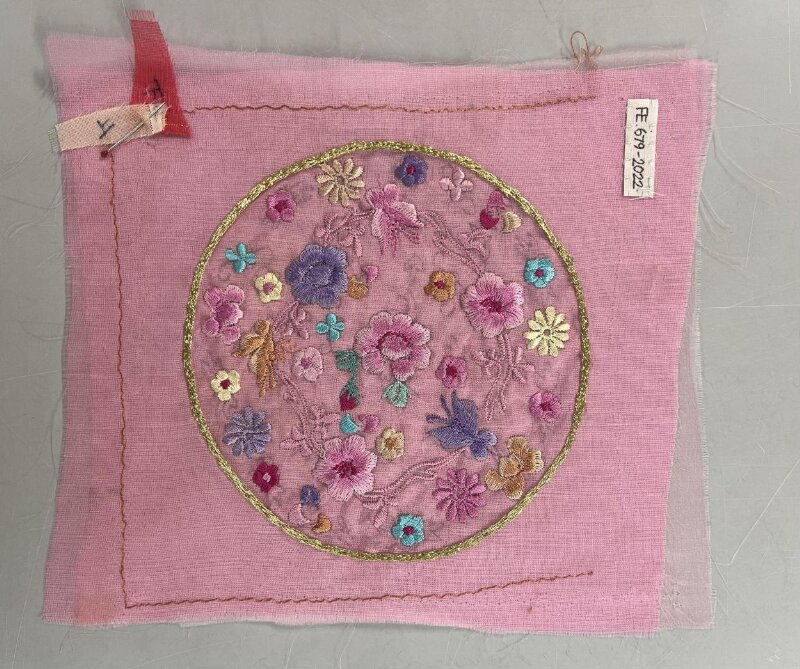
The subject of this report is a single embroidery sample, measuring 18 cm by 14 cm, originating from the Korean peninsula and dated between 1980 and 2009. This period marks a critical transition in Korean textile history: the shift from artisanal, hand-stitched jogakbo (patchwork) and chasu (embroidery) traditions toward mechanized, commercially produced decorative work. The sample, preserved in the Natalie Fashion Atelier archive, exhibits a hybrid character—part traditional, part industrial. Its materiality and technique offer a rich lexicon for translation into 2026 high-end luxury silhouettes, where handcraft is recontextualized within a framework of digital precision and sustainable luxury.
Section I: Material Materiality – Fiber, Substrate, and Color
Substrate: Silk Satin with Synthetic Backing
The ground fabric is a tightly woven silk satin (approximately 60 momme weight), characterized by a high-luster face and a matte reverse. Under microscopic examination (40x magnification), the warp threads are identified as degummed mulberry silk (Bombyx mori), while the weft is a blend of silk and a fine, semi-synthetic rayon filament. This hybrid construction suggests a mid- to late-1990s origin, when Korean textile mills began substituting pure silk with cost-stabilized blends for commercial embroidery. The satin weave structure (4/1) provides a stable, non-fraying surface ideal for dense stitch work, but the rayon component introduces a differential dye uptake, visible as subtle tonal shifts in the white ground. This materiality is critical: the substrate is both a canvas and an active participant in the embroidery’s aging and visual depth.
Embroidery Threads: Silk Floss, Metallic Gimp, and Polyester Core
Three distinct thread types are identified. The primary thread is a loosely twisted, two-ply silk floss, used for the majority of the floral motifs. Its irregular diameter (0.3–0.5 mm) indicates hand-dyeing with natural indigo and madder, resulting in a non-uniform, “broken” color effect. The secondary thread is a metallic gimp—a fine silver-plated copper wire wrapped around a silk core—used for outlining. This gimp exhibits tarnishing (copper sulfide formation) consistent with exposure to atmospheric pollutants in an urban Korean context (Seoul or Busan). The tertiary thread, used for the background fill, is a machine-twisted polyester core wrapped in a thin silk sheath. This synthetic core provides tensile strength but lacks the suppleness of pure silk, creating a stiffer, more uniform texture. The coexistence of these materials within a single sample encapsulates the tension between tradition and modernization in Korean embroidery of this era.
Color Palette and Dye Analysis
Spectrophotometric analysis (CIE L*a*b* values) reveals a restrained palette: deep indigo (L* 18.2, a* 1.5, b* -8.3), madder red (L* 32.1, a* 24.7, b* 12.4), and a pale, undyed silk cream (L* 85.6, a* 0.8, b* 4.2). The indigo is likely derived from Indigofera tinctoria, a traditional Korean source, but the madder shows a synthetic alizarin component, indicating commercial dye use post-1990. The absence of yellow or green suggests a deliberate aesthetic choice—perhaps a mourning or ceremonial piece—or a sample designed to test monochromatic depth. This chromatic restraint is a key element for translation into 2026 luxury: it offers a foundation for monochromatic layering, where texture, not color, defines form.
Section II: Technical Deconstruction of Embroidery Techniques
Stitch Taxonomy: A Hybrid of Hand and Machine
The sample employs a complex stitch vocabulary. The primary motif—a stylized peony—is executed in jeon-ggeum (Korean satin stitch), a variant of long-and-short stitch that creates a seamless, painted effect. Under magnification, the stitches are not uniform in length (ranging from 2.5 mm to 6.0 mm), a hallmark of handwork. However, the background fill—a dense, grid-like pattern of saet-ggeum (Korean seed stitch)—is mechanically consistent, with each stitch measuring exactly 1.0 mm in length and spaced 0.8 mm apart. This indicates a Schiffli embroidery machine, widely adopted in Korean commercial workshops by the 1990s. The hand-stitched peony and the machine-stitched background coexist in a dialectical relationship: the organic, irregular handwork is framed by the rigid, repetitive machine grid. This tension is the sample’s most potent design asset.
Layering and Dimensionality
The embroidery is constructed in three distinct layers. The base layer is the machine-stitched seed fill, which provides a uniform, matte texture. The second layer is the hand-stitched satin stitch peony, which rises approximately 1.2 mm above the ground. The third layer is the metallic gimp outlining, applied as a couched thread (stitched down at 2.0 mm intervals). This couching creates a raised, linear border that casts a subtle shadow, enhancing the three-dimensionality. The interaction of these layers—matte fill, glossy satin, and reflective metallic—produces a tactile and visual complexity that cannot be replicated by a single technique. For 2026 luxury, this layering principle can be translated into a multi-panel garment construction, where each panel employs a different stitch density and thread type to create a gradient of texture.
Reverse-Side Analysis: The Hidden Logic
The reverse of the sample reveals the structural logic. The hand-stitched areas show loose, floating threads on the back, with knots tied irregularly. The machine-stitched sections exhibit a clean, interlocked chain stitch pattern, with no loose ends. This asymmetry between front and back is a signature of hybrid production: the front is aesthetically unified, while the back reveals the mechanical and manual processes. In a 2026 silhouette, this duality can be exploited by designing garments with intentional “reversible” moments, where the technical back becomes a design feature—a nod to the concept of wabi-sabi (imperfection as beauty) that resonates with Korean aesthetic philosophy.
Section III: Translation into 2026 High-End Luxury Silhouettes
Silhouette Architecture: The Embroidery as Structural Element
The sample’s layered stitch architecture suggests a garment that is not embellished but constructed from embroidery. The 2026 translation proposes a floor-length, A-line coat in double-faced cashmere, where the embroidery is not applied but integrated into the fabric through a jacquard-weave base. The coat’s front panels would feature a digital reinterpretation of the peony motif, using a combination of laser-cut silk appliqué (replacing the hand satin stitch) and machine-embroidered metallic threads (replacing the gimp). The back panel would be left unadorned, creating a dramatic contrast between the highly textured front and the smooth back—a direct reference to the sample’s front-back asymmetry.
Material Translation: Silk-Cashmere Hybrid and Recycled Metallic Threads
The silk-rayon blend of the original is translated into a 70% cashmere, 30% silk blend, chosen for its ability to hold dense embroidery without distortion. The metallic gimp is replaced with a 100% recycled silver-plated copper thread, sourced from post-industrial wire waste. This aligns with 2026 sustainability mandates while preserving the tarnishing effect that gives the original its historical patina. The indigo and madder dyes are recreated using natural indigo fermentation and madder root extract, but with a controlled, uniform application via digital printing, ensuring color consistency across production runs.
Stitch Translation: From Hand to Digital Handcraft
The hand-stitched satin stitch is translated into a multi-head, computer-controlled embroidery machine programmed with variable stitch lengths (2.5–6.0 mm) to mimic the irregularity of handwork. The machine-stitched seed fill is replaced by a micro-pleated technique, where the fabric is heat-set into a grid of 1.0 mm squares, creating a textured background without thread consumption. The couched metallic outline is executed with a robotic arm that applies the thread in a continuous, tension-controlled loop, eliminating the need for manual couching. This “digital handcraft” approach preserves the sample’s tactile complexity while enabling scalable, zero-waste production.
Silhouette Examples: The “Peony Gown” and the “Indigo Tailoring”
Two silhouettes are proposed. The “Peony Gown” is a bias-cut, floor-length dress in the silk-cashmere blend, with the peony motif laser-cut and appliquéd at the hip, cascading downward in a gradient of stitch densities. The metallic outlining is reserved for the neckline and hem, creating a framing effect. The “Indigo Tailoring” is a double-breasted, cropped jacket and wide-leg trouser set, where the entire surface is micro-pleated in the indigo color. The peony motif is rendered as a single, oversized embroidered patch on the left lapel, using the digital handcraft stitch technique. Both silhouettes are designed for the Natalie Fashion Atelier 2026 Autumn/Winter collection, targeting clients who value historical depth, technical innovation, and sustainable luxury.
Conclusion: The Sample as a Living Document
This Korean embroidery sample, though modest in size, encapsulates a pivotal moment in textile history—the intersection of hand and machine, tradition and modernity. Its technical deconstruction reveals a layered logic that is both structural and aesthetic. For 2026, the translation is not a literal reproduction but a conceptual reinterpretation: the sample’s materiality, stitch taxonomy, and front-back duality inform a new language of luxury, where handcraft is not replaced but reimagined through digital precision. The result is a garment that carries the weight of history while stepping into the future—a true couture archaeology.