Silent Avian Authority: A Technical Deconstruction of the Mandarin Duck Rank Badge
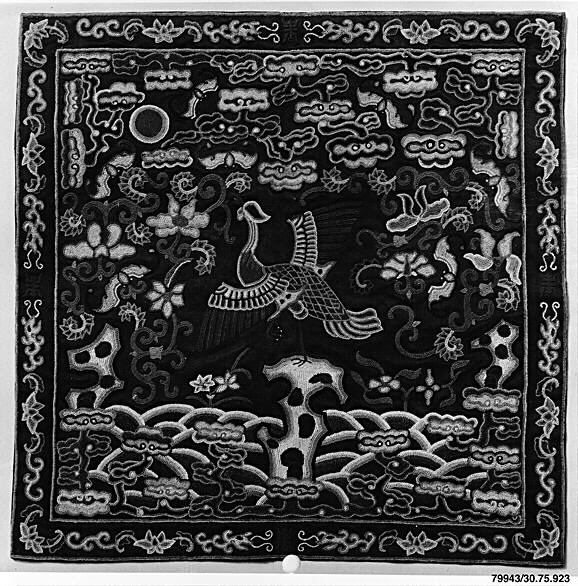
Within the isolated context of aesthetic archaeology, the Chinese rank badge, or buzi, emerges not merely as a heraldic emblem but as a profound treatise on structured elegance. This particular artifact, depicting the Mandarin Duck and rendered in silk on silk embroidery, belongs to the seventh rank for civil officials. Its isolation from its original ceremonial context allows us to appraise it purely as a masterclass in symbolic materiality and controlled composition. The foundation is a ground of densely woven silk, a substrate representing both literal and societal order. Upon this, the avian motif is built through a meticulous application of silk thread, employing techniques such as satin stitch for lustrous, unbroken planes of color and couching for raised, textured outlines. The Mandarin Duck itself is a paradox of fixed iconography and fluid form; its posture is prescribed by imperial decree, yet the rendering of every feather, the gradient of its plumage, and the serene complexity of the surrounding clouds and waves speak to an artisan’s interpretive grace. This creates a dialectic of rigidity and softness, flatness and dimension—a dialectic that is the very essence of haute couture’s relationship between structure and drape.
Structural Poetics: The Architecture of Restraint
The badge’s elegance is fundamentally classical, derived from its unwavering adherence to a bounded, circular form within a square or rectangular field. This is elegance as defined by perimeter and containment. The composition is radially balanced, with the central avian figure commanding attention not through scale, but through the intricate density of its execution. The technical takeaway is the power of a defined silhouette boundary acting as a canvas for extreme internal complexity. Every element—the duck’s elegantly curved neck, the sweep of its wing, the precise knots of the lotus blossoms—is subservient to the whole. There is no overflow, no deconstructive fraying; authority is communicated through completeness and impeccable finish. This mirrors the foundational principle of couture architecture: the creation of a clean, unmistakable silhouette that serves as the armature for exquisite, labor-intensive detail. The "silhouette-first" philosophy is paramount, where the outer line must be as deliberate and authoritative as the imperial square framing the duck.
Material Intelligence: Silk as Cognitive Medium
The material specification—silk on silk—is not a mere note on substance but a core tenet of the artifact’s intelligence. This monomaterial approach creates a unified sensory field where texture and luster become the primary languages of hierarchy and nuance. The ground silk provides a subtle, matte resistance, while the embroidered silk threads capture and refract light, creating a low-relief topography. This generates a tactile narrative discernible to both the eye and the hand. The luxury is in the homogenous yet stratified handling of a single, noble fiber. It speaks to a deep material literacy, where the potential of silk is exhaustively explored through technique rather than through the introduction of foreign elements. For the atelier, this advocates for a return to profound material mastery—the ability to manipulate one exceptional fabric in multiple states to create a complete, self-referential world of texture.
Informing the 2026 Silhouette: From Imperial Insignia to Parisian Architecture
The 2026 luxury silhouette, as informed by this archaeology, will pivot on the reconciliation of serene authority with intimate craftsmanship. The lessons of the rank badge move beyond literal translation into the realm of sartorial philosophy, shaping a future defined by quiet power and intelligent materiality.
The Contained Volume and the Defined Perimeter
The 2026 silhouette will embrace contained volume and the sharp definition of perimeter. This manifests in coats and dresses with clear, geometric outlines—broad, squared shoulders that echo the badge’s frame, or rounded, cocooning volumes that reference its central medallion. The key is that this volume is never slouchy or amorphous; it is engineered and precise, built from within through internal structure reminiscent of the badge’s padded couching. Think sculpted wool coats with a circular, mandala-like sweep from the shoulders, or column dresses with a subtle, radial flare at the hem, creating a sense of grounded elegance. The silhouette is a statement of composed self-assurance, a modern equivalent of the badge’s unimpeachable authority.
Monolithic Materiality and Tactile Hierarchy
Following the silk-on-silk principle, 2026 will see a rise in monolithic material narratives. A single, sumptuous fabric will be explored in all its dimensions. Imagine a gown entirely of double-faced cashmere, where the silhouette is carved through strategic seaming that alternates between the matte and lustrous sides, creating a play of light akin to the badge’s embroidery. Or, a tailored suit in a heavyweight silk faille, where structural seams are emphasized with a self-fabric corded piping, embedding the detail within the material’s own ecosystem. The luxury is in the depth of exploration, not the breadth of assortment. Embroidery, if present, will be of the same fiber—silk thread on silk georgette, wool crewel on wool bouclé—creating a cohesive, tactile hierarchy that must be closely examined to be fully understood.
The Centralized Motif and Asymmetric Equilibrium
The Mandarin Duck’s central, balanced placement evolves into a concept of focal point engineering. For 2026, this may not mean a literal appliqué, but a concentration of detail that anchors the garment. A single, intense cluster of hand-pleating at the torso, radiating like feathers, becomes the modern motif. A dress may feature a perfectly placed, intricate knot closure at the sternum, from which all drapery emanates. This creates a point of visual gravity, organizing the entire garment around a single, artful nexus. Conversely, the perfect radial balance may be deliberately disrupted to create asymmetric equilibrium—a heavy, embroidered panel descending from one shoulder, counterbalanced by the sheer volume of the opposite skirt, mirroring the way the duck’s dynamic form sits within its static circle.
In conclusion, the Mandarin Duck rank badge, through its isolated study, provides a pristine blueprint for the coming era. It instructs that true luxury resides in the mastery of boundary, the intelligent stratification of a single material, and the placement of consummate artistry within a framework of serene authority. For Natalie Fashion Atelier, this artifact is not a relic, but a rigorous technical manifesto. The 2026 silhouette it informs is one of deliberate shape, profound material literacy, and a quiet, powerful elegance that, like the badge itself, communicates stature not through proclamation, but through impeccable, self-contained perfection.