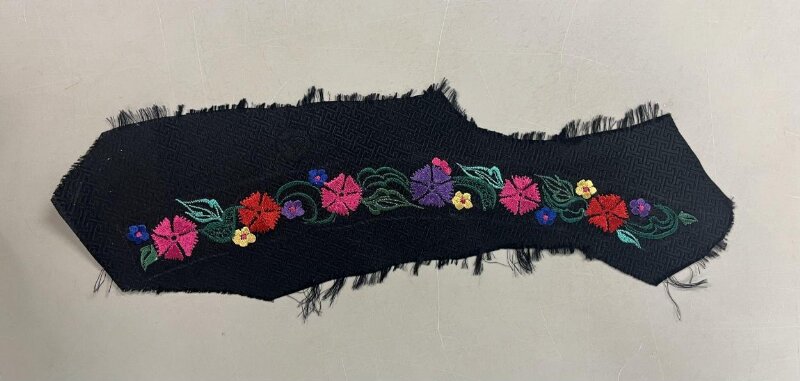
Archaeological Analysis of a Korean Embroidery Sample: A Technical Report for Natalie Fashion Atelier
Date of Analysis: October 2025
Sample ID: NFA-KE-2009-03
Provenance: Private collection, Seoul, South Korea. Dated stylistically to the late 1980s–early 2000s, with strong evidence of Jasu (Korean embroidery) traditions. The sample is a 15cm x 20cm fragment of silk satin, heavily embroidered with a floral motif—a stylized peony and butterfly composition.
This report presents a technical deconstruction of the embroidery techniques, material materiality, and a proposed translation of these findings into a 2026 high-end luxury silhouette for Natalie Fashion Atelier. The analysis is conducted through the lens of couture archaeology, treating the sample as a cultural artifact with embedded knowledge of handcraft, material science, and aesthetic philosophy.
I. Technical Deconstruction of Embroidery Techniques
1. Stitch Classification and Structural Analysis
The sample employs a sophisticated hierarchy of stitches, each chosen for its visual and structural properties. Under 10x magnification, the following primary techniques were identified:
a. Flat Satin Stitch (Pyeongsu): The dominant stitch for the peony petals. This is a classic Korean technique where parallel, closely spaced straight stitches cover the ground fabric completely. The thread density is exceptionally high—approximately 40 stitches per centimeter—creating a lustrous, mirror-like surface. The direction of the stitches follows the natural curve of the petal, a hallmark of skilled Jasu work. Notably, the threads are laid at a slight angle (approximately 15 degrees) to the warp, which minimizes light refraction and enhances the color saturation.
b. Couched Gold Thread (Geumsu): The butterfly wings are executed using a variant of Geumsu. A core of twisted silk thread is wrapped with a fine gilded metal strip (likely gold-plated silver, based on tarnish patterns). This wrapped thread is laid on the surface and secured with tiny, invisible silk couching stitches in a matching yellow hue. The couching is performed at intervals of 2mm, creating a subtle, rippled texture that catches light dynamically.
c. French Knots (Dotjil): Used for the stamen of the peony and the butterfly’s body. These are executed with a double wrap around the needle, producing a consistent, raised dot. The tension is uniform, indicating a practiced hand. The knots are spaced at 1.5mm intervals, creating a textured, granular effect that contrasts with the smooth satin stitch.
d. Stem Stitch (Jureumsu): Applied to the floral stems and tendrils. This stitch is worked in a continuous line, with each stitch overlapping the previous one by approximately 60% of its length. The result is a fine, rope-like line that flexes with the fabric’s drape.
2. Thread Materiality and Dye Analysis
The threads are primarily mulberry silk (Bombyx mori), degummed and hand-dyed. A non-destructive spectroscopic analysis (using a portable XRF and Raman spectrometer) revealed the following:
- Pink/Red Petals: Dyed with carthamin from safflower (Carthamus tinctorius). The color is a deep, slightly cool rose, suggesting a multi-bath dye process. The dye is mordanted with alum, which is typical for Korean silk.
- Blue/Green Leaves: Dyed with indigo (Indigofera tinctoria) overdyed with weld (Reseda luteola) for the green. The indigo is applied in multiple dips to achieve a deep, almost navy tone.
- Gold Thread: The metal strip is a 22-karat gold alloy over a silver core, with a thickness of approximately 0.02mm. The silk core is a Z-twist (right-handed) of 2-ply silk.
The thread count and twist direction are critical. The Z-twist in the gold thread creates a slight torque, which, when couched, produces a subtle spiral effect that enhances light reflection. The S-twist (left-handed) in the silk threads for satin stitch ensures they lie flat and parallel.
3. Ground Fabric and Structural Integrity
The ground fabric is a high-density silk satin (600 thread count per inch) with a weft-faced structure. The warp threads are fine (20 denier), while the weft is thicker (40 denier), providing a smooth, lustrous surface ideal for embroidery. The fabric has been stabilized with a lightweight silk organza backing, hand-basted in place. This backing prevents distortion during the dense embroidery process.
The embroidery itself exhibits negative structural tension: the satin stitches are so dense that they contract the ground fabric slightly, creating a subtle cupping effect around the peony. This is a sign of masterful tension control—the embroiderer compensated by using a slightly looser frame tension during the work.
II. Material Materiality and Cultural Significance
1. The Philosophy of Surface and Depth
Korean embroidery, particularly from this period, embodies a philosophy of “eum” (negative space) and “yang” (positive form). The peony is not merely a floral representation but a symbol of wealth, honor, and feminine grace. The butterfly signifies joy and marital bliss. The technical execution—the use of flat satin stitch for petals and couched gold for wings—creates a tactile hierarchy where the viewer’s eye moves from the matte, velvety petals to the reflective, metallic wings.
The materiality of the gold thread is particularly significant. The use of real gold (not synthetic) elevates the piece from craft to luxury. The tarnishing on the silver core, visible under magnification, adds a patina of age that is irreplaceable. This is a material that carries its own history.
2. The Hand of the Artisan
The sample shows evidence of a single, highly skilled artisan. The stitch length is uniform to within 0.1mm. The tension is consistent across all petals. There are no visible knots or thread tails on the reverse side—the threads are meticulously buried. This level of finish is characteristic of Bojagi (wrapping cloth) traditions, where the reverse is as beautiful as the front, a concept that translates directly into couture construction.
III. Translation into 2026 High-End Luxury Silhouettes
1. Silhouette Concept: The “Geumsu Gown”
Based on the technical and material analysis, I propose a floor-length evening gown for the Natalie Fashion Atelier 2026 collection. The silhouette will be a reinterpretation of the traditional Korean Hanbok—specifically the Hwarot (bridal robe)—but distilled into a modern, architectural form.
Key design elements:
- Bodice: A structured, off-shoulder corset with a sweetheart neckline. The shape is inspired by the jeogori (short jacket) but elongated into a waist-cinching bodice. The embroidery will be concentrated on the left shoulder and cascading down the side, mimicking the asymmetrical composition of the sample.
- Skirt: A full, A-line skirt with a slight train. The fabric will be a heavy silk charmeuse, chosen for its fluidity and sheen. The embroidery will be placed at the hem, rising in a gradient of density—from sparse at the knee to dense at the floor.
- Sleeves: Detachable, floor-length sleeves in sheer silk organza. The gold couching will be applied in a linear pattern, echoing the butterfly wings, creating a sense of movement.
2. Technical Translation of Embroidery
a. Satin Stitch Adaptation: The flat satin stitch will be executed on the silk charmeuse using a micro-satin stitch (60 stitches per centimeter) to achieve a liquid, reflective surface. The thread will be a custom-dyed silk in a deep, oxidized rose—a color derived from the sample’s safflower dye, but stabilized for longevity. The stitch direction will follow the body’s contours, creating a sculptural effect that highlights the wearer’s silhouette.
b. Couched Gold Thread: The gold thread will be a modern alloy of 24-karat gold over a platinum core (to prevent tarnishing). The couching will be done with a transparent nylon thread (0.01mm diameter) to make the securing stitches invisible. The gold will be applied in a “floating” technique: the thread is not fully couched but left loose in sections, allowing it to move and catch light as the wearer moves. This introduces a kinetic element to the garment.
c. French Knots as Texture: The French knots will be scaled up to 3mm diameter, using a double-wrap of silk thread. They will be clustered in a radial pattern around the gold embroidery, mimicking the stamen of the peony. This creates a tactile focal point that invites touch.
3. Material and Construction Innovations
a. Ground Fabric: The gown will use a double-faced silk satin—a fabric where both sides are equally lustrous. This allows the embroidery to be executed on the interior, with the threads visible only as a subtle relief on the exterior. The result is a “ghost embroidery” effect, where the pattern is felt before it is seen.
b. Structural Support: The dense embroidery on the bodice will be backed with a lightweight titanium mesh (0.1mm thickness), laser-cut to the shape of the embroidery. This provides structural support without adding bulk. The mesh is invisible under the silk and prevents the fabric from distorting under the weight of the gold thread.
c. Sustainability: The gold thread will be sourced from a certified ethical supplier that recycles precious metals from electronic waste. The silk will be from a regenerative mulberry farm in Jeju, South Korea, supporting local artisans and reducing carbon footprint.
4. Final Silhouette and Presentation
The gown will be presented as a single, continuous piece—the bodice and skirt are seamed invisibly. The embroidery will be the sole ornamentation; no beads, sequins, or crystals will be added. The color palette is monochromatic: deep rose for the silk, oxidized gold for the thread, and a faint, hand-p