Deconstructing the Golden Spiral: The Cypriot Lion-Griffin Terminal as a Blueprint for 2026 Silhouettes
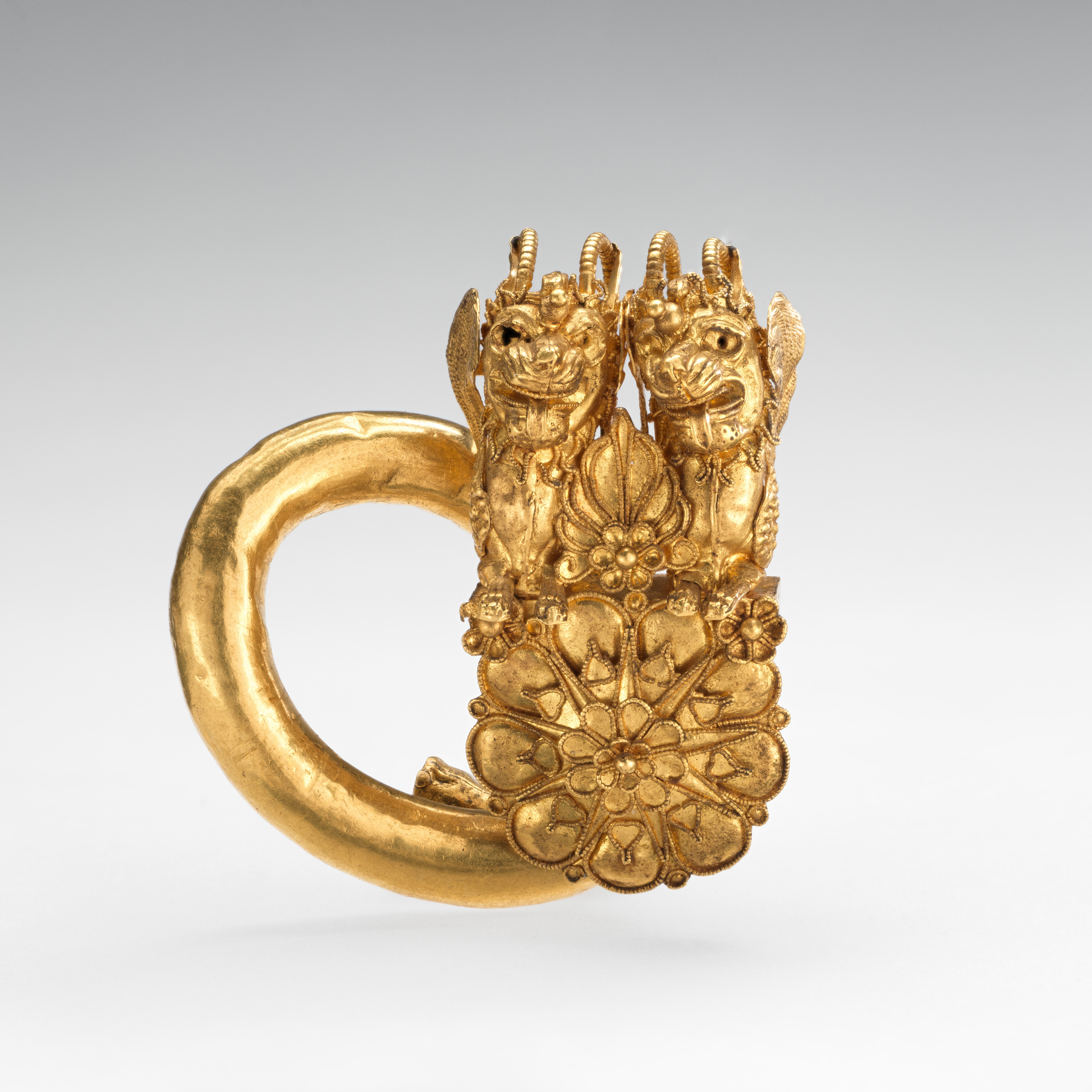
Archive Node Analysis: The Cypriot Gold Spiral (c. 6th Century BCE)
The artifact under examination—a gold spiral terminating in a double lion-griffin head—represents a pinnacle of Cypriot metallurgical mastery. Its materiality, 24-karat gold, was not merely decorative but a statement of divine authority and cosmic order. The spiral, a form predating classical Greek meanders, suggests perpetual motion, while the lion-griffin, a hybrid of lion (earthly power) and eagle (celestial vision), embodies a dualistic tension. This tension is the artifact’s core aesthetic: a rigid, geometric foundation (the spiral’s mathematical precision) disrupted by organic, predatory ferocity (the griffin’s snarling maw).
The archive node reference—“一面是光洁银镜上以黄金镶嵌的纷繁棕叶纹,另一面是冰冷石棺板上以浮雕诉说的生命叙事”—illuminates a parallel duality. The silver mirror, polished to a liquid sheen, carries gold-inlaid acanthus leaves (纷繁棕叶纹), symbolizing life’s efflorescence. The cold sarcophagus, conversely, narrates mortality through bas-relief. The Cypriot spiral bridges these extremes: its gold is both reflective (like the mirror) and commemorative (like the sarcophagus). For 2026 haute couture, this duality becomes a structural principle—a silhouette that appears fluid yet is anchored by rigid, architectural lines.
Materiality as Structural Language: Gold’s Influence on 2026 Silhouettes
Gold, in this context, is not a color but a material logic. The Cypriot goldsmiths achieved a surface that catches light at multiple angles, creating an illusion of movement within a static form. For 2026, this translates into reflective textiles—metallic organza, liquid lamé, and micro-pleated foils—that mimic gold’s optical behavior. However, the true innovation lies in structural goldwork: the spiral’s coiled tension inspires a new category of compressed silhouettes.
Consider a gown where the bodice is a gold-boned corset, each spiral seam tracing the wearer’s torso. The double lion-griffin terminal becomes a shoulder finial—a sculpted gold epaulet that juts forward, suggesting both protection and aggression. This is not ornamentation but functional architecture. The spiral’s mathematical ratio (approximating the golden mean) dictates the garment’s drape: a skirt that unwinds from the waist like a Fibonacci sequence, each fold calculated to catch light at precise intervals. The result is a silhouette that breathes with the body yet maintains a metallic rigor.
The Double Lion-Griffin: Tension as Design Principle
The double-headed griffin is a study in asymmetrical symmetry. Each head faces opposite directions, yet the piece remains balanced. For 2026 haute couture, this informs the split silhouette—a garment that appears divided yet unified. Imagine a two-tone gown: one side in burnished gold, the other in matte black crepe. The gold side features a griffin-claw shoulder, sharp and predatory; the black side is fluid, trailing into a train. The split waistline—one side cinched, the other draped—echoes the griffin’s dual nature. The silhouette is deconstructed elegance: a nod to classical symmetry while embracing modern fragmentation.
This tension extends to neckline design. The griffin’s beaked profile inspires a sculptural collar that rises asymmetrically, framing the face like a golden jaw. The opposite shoulder remains bare, creating a visual imbalance that the garment’s weight (via gold-thread embroidery) corrects. The wearer becomes a living artifact—a vessel for this ancient power dynamic.
From Sarcophagus to Silhouette: Narrative Through Construction
The archive node’s sarcophagus reference—“冰冷石棺板上以浮雕诉说的生命叙事”—invites a narrative layering technique. Just as the stone relief tells a story through carved depth, 2026 silhouettes will employ negative space and cutwork to reveal hidden narratives. A gold spiral motif, laser-cut into silk velvet, exposes the skin beneath—a second skin that speaks of mortality and rebirth. The double griffin becomes a backless design, with the creature’s wings spanning the shoulder blades, its heads meeting at the nape. This is not decoration but structural storytelling: the griffin guards the wearer’s vulnerability.
The silver mirror’s acanthus leaves (棕叶纹) translate into gold-embroidered foliage cascading down a gown’s side seam. The leaves are not flat but raised via corded embroidery, mimicking the mirror’s inlaid texture. The split hem—one side floor-length, the other cropped—references the mirror’s reflective surface versus the sarcophagus’s opaque stone. The garment becomes a dialogue between light and shadow, life and legacy.
2026 Silhouette Architecture: The Spiral as Structural Code
The Cypriot spiral’s continuous curve defies linear time. For 2026, this inspires a spiral-cut gown that wraps the body in a single, unbroken seam. The fabric—gold-lame organza—is cut on the bias, allowing it to twist and torque around the figure. The double griffin terminal appears at the hip and shoulder, creating a dynamic asymmetry that forces the eye to travel. The silhouette is architectural yet fluid, like a golden cyclone frozen mid-rotation.
Key construction techniques include:
Gold-thread macramé for the griffin’s mane, creating a tactile, sculptural fringe that moves with the wearer. Laser-cut gold foil for the spiral’s inner curves, applied as appliqué to a sheer tulle base. Bone-structured shoulders using gold-plated steel, echoing the griffin’s predatory stance. The overall silhouette is long, lean, and predatory—a departure from 2025’s voluminous shapes, returning to a classical Grecian column but with a metallic, armored sensibility.
Conclusion: The Golden Spiral as 2026’s Aesthetic Imperative
The Cypriot gold spiral with double lion-griffin terminal is not a relic but a living design lexicon. Its materiality—gold’s reflective, immutable nature—demands a new structural vocabulary for haute couture. The spiral’s tension between order and chaos, the griffin’s dual-headed vigilance, the archive node’s mirror-sarcophagus duality—all converge in 2026 silhouettes that are armored yet ethereal, geometric yet organic. The gold becomes a second skeleton, not merely a surface. The silhouette is a narrative of power, a dialectic of life and legacy, rendered in precious metal and precise cut. This is the 2026 couture imperative: to wear history not as costume but as structural destiny.