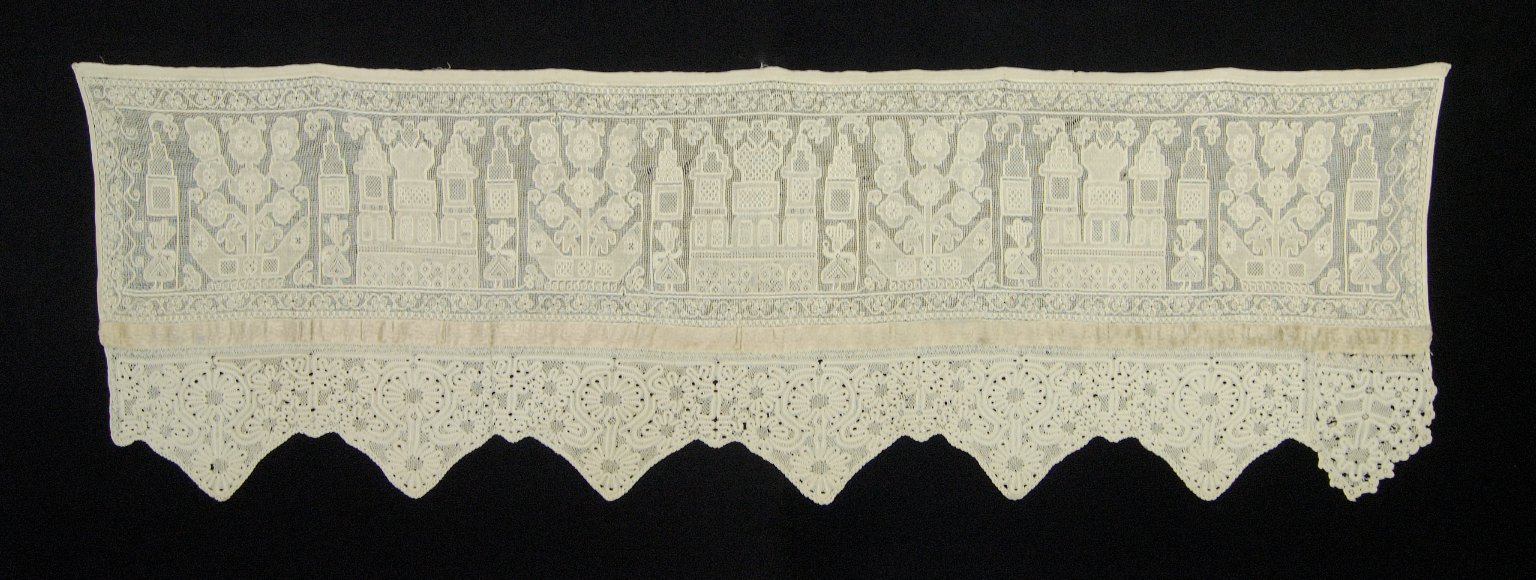
Deconstructing the Bed Curtain Border: An Aesthetic Archaeology for 2026 Haute Couture
The isolated artifact—a fragment of a bed curtain border, its provenance lost to the annals of global heritage—offers a profound lexicon for the 2026 luxury silhouette. This is not a study in reproduction, but in aesthetic archaeology: the extraction of structural principles, material dialogues, and spatial narratives from a domestic object to inform the most elevated forms of French Haute Couture. The border, a liminal zone between the private realm of the bed and the public space of the chamber, embodies a tension between concealment and revelation, weight and fluidity, that is immediately relevant to the contemporary atelier.
Materiality as Narrative: Linen and Silk in Dialogue
Linen: The Architecture of Drape
The linen component of the border is not merely a support; it is a structural protagonist. Its inherent crispness and linear memory—the tendency to hold a crease or a fold—create a foundational geometry. In the 2026 silhouette, this translates to architectural sleeves and sculptural bodices that retain their form without internal boning. The linen’s natural slubs and irregularities, far from being imperfections, become a textural narrative of handcraft. The border’s original function—to define the edge of a curtain—is reimagined as a structural seam that anchors volume, creating a visual weight that grounds the silhouette against the airy fluidity of silk. The linen provides the rigor of a frame, a quiet, unyielding presence that allows the silk to sing.
Silk: The Language of Light and Movement
The silk, likely a finely woven charmeuse or a lustrous taffeta, introduces a counterpoint of luminosity and dynamic flow. In the border, silk would have been used for embellishment, for the embroidered motifs, or as a contrasting facing. In the 2026 silhouette, this translates to liquid panels that cascade from a structured linen yoke, or asymmetrical drapes that mimic the way a curtain falls. The silk’s ability to catch and reflect light becomes a tool for optical illusion, creating zones of transparency and opacity that modulate the body’s form. The interplay between the matte, grounded linen and the glossy, ethereal silk generates a tactile tension that is the hallmark of Haute Couture. The border’s original role as a transitional element is reimagined as a gradient of materiality, where the silhouette moves from solid to sheer, from structure to surrender.
Silhouette Synthesis: From Domestic Edge to Couture Form
The Border as a Structural Seam: The Lisière Silhouette
The bed curtain border, by definition, is a liminal edge. It is neither the full curtain nor the wall; it is the negotiation between them. For 2026, this concept is distilled into the Lisière silhouette—a form defined by its boundaries. The key innovation is the inverted seam, where the structural linen is not hidden but exposed, acting as a visible, architectural border that contains and releases the silk. This is seen in a column dress where a rigid linen panel runs vertically from the shoulder to the hem, while a silk panel is gathered and released from its edge, creating a controlled, asymmetrical volume. The border is no longer a trim; it is the generative line from which the silhouette is born.
The Fold as Memory: The Plis de Rideau Technique
The border often retains the memory of its original folds—the deep, repeated pleats from being gathered on a rod. This is not a random crease but a systematic rhythm. We term this the Plis de Rideau (curtain pleats) technique for 2026. It involves controlled, machine-stitched pleating on the linen to create a rigid, fan-like structure at the shoulder or hip, while the silk is left unpleated, flowing freely. The result is a hybrid silhouette: a sharp, geometric volume that softens into a liquid cascade. This technique is particularly potent in a jacket silhouette, where the linen pleats form a structured, almost architectural epaulet, while the silk body of the jacket falls in a single, uninterrupted line. The border’s memory of gathering becomes a sculptural anchor for the entire form.
Negative Space and the Unseen: The Vide de Rideau Silhouette
The bed curtain border also defines the space behind it—the void of the window or the alcove. This concept of negative space is critical for the 2026 silhouette. We introduce the Vide de Rideau (curtain void) silhouette, where the garment is constructed to create a deliberate, framed emptiness. This is achieved by using the linen as a rigid frame around the torso, while the silk is cut away or left as a sheer, almost immaterial layer. The body becomes the “window” behind the curtain. A gown might feature a linen corset that frames the décolletage and shoulders, with a silk skirt that is entirely open at the front, revealing a sheer, second-skin layer of silk organza. The border is no longer a boundary; it is a portal that invites the gaze into the void.
Technical Execution: The Atelier’s Imperative
The realization of these silhouettes demands a recalibration of traditional couture techniques. The linen must be pre-shrunk and treated to maintain its crispness, while the silk requires a floating lining to prevent it from clinging to the linen’s structure. The Plis de Rideau pleats are not sewn flat; they are tacked at the base to allow for movement, mimicking the way a curtain’s pleats are anchored at the top but free at the bottom. The Lisière seam is executed with a double-stitched, visible seam that is pressed open and then topstitched, creating a deliberate, architectural line. The Vide de Rideau requires a micro-framework of horsehair braid or fine steel boning within the linen to maintain the frame’s integrity without visible support.
Conclusion: The Edge as Origin
The isolated bed curtain border, stripped of its original context, is not a relic but a blueprint for innovation. Its dialogue between linen and silk, its liminal position, and its memory of folds and voids offer a sophisticated vocabulary for the 2026 luxury silhouette. The atelier’s task is not to replicate the past, but to extract its structural intelligence. By treating the border as a generative principle rather than a decorative trim, we create silhouettes that are at once architectural and fluid, grounded and ethereal. The edge becomes the origin. The domestic becomes the divine. This is the essence of aesthetic archaeology for the modern couturier.