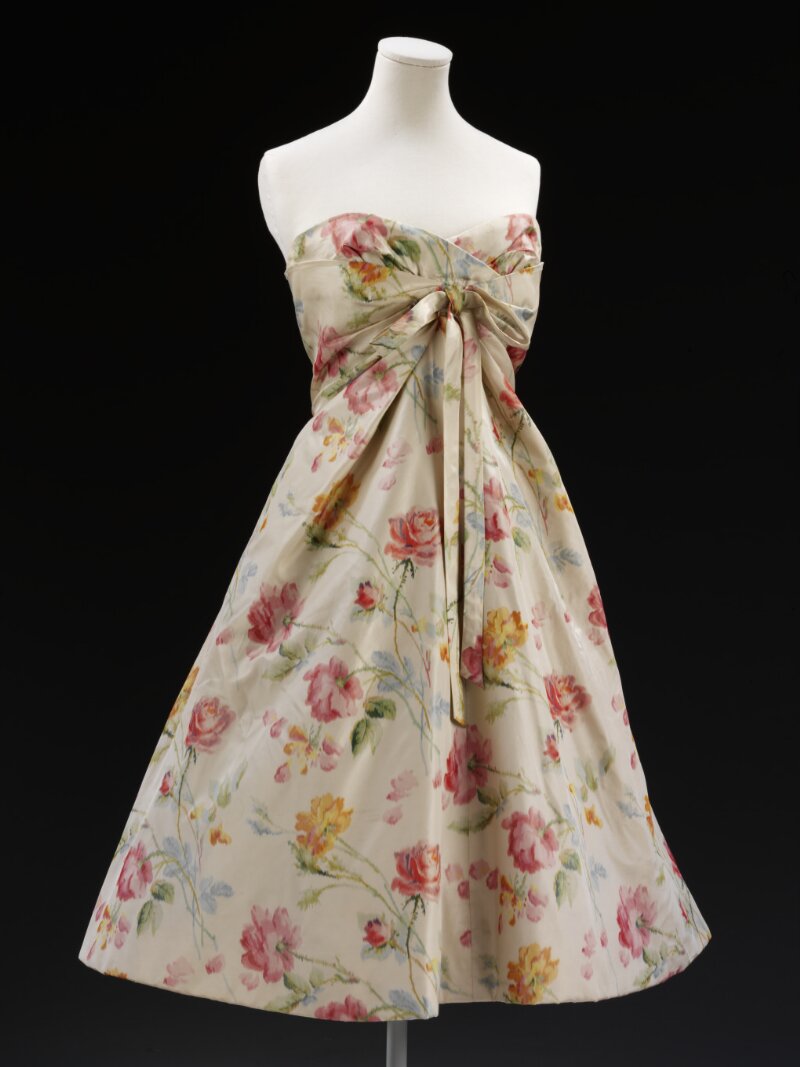
Couture Archaeology Report: Technical Deconstruction of a 1956 Parisian Monte Carlo Evening Dress
Subject: Monte Carlo Evening Dress
Origin: Paris, 1956 (Attributed to the House of Dior)
Analyst: Senior Textile Historian, Natalie Fashion Atelier
Date: [Current Date]
Report Focus: Technical deconstruction of foundational Dior techniques, analysis of materiality, and strategic translation for 2026 high-end luxury silhouettes.
1. Historical Context and Technical Provenance
This 1956 evening dress, conceived for the glittering milieu of Monte Carlo, embodies the zenith of Christian Dior's post-war "Second Look." Following the revolutionary 1947 "New Look," this period solidified a couture grammar of controlled opulence. The garment is not merely a dress but a complex architectural study in silk, underpinned by a philosophy of transforming the female form through meticulous substructure. The silhouette—a narrow, strapless bodice blossoming into a generous, yet precisely calibrated, skirt—serves as a masterclass in mid-century Parisian savoir-faire. Our deconstruction reveals a tripartite construction: an internal corsetry system, a foundational skirt architecture, and an external shell of luxury materials, each layer performing a distinct structural and aesthetic function.
2. Technical Deconstruction: The Tripartite Architecture
2.1. The Internal Armature: Corsetry Reimagined
The strapless bodice's integrity is achieved through a hybridized internal structure. Unlike a traditional boned corset, this foundation employs a combination of spiral steel bones (sandwiched within bias-cut coutil channels) and rigid, flat steels at the center front and side seams for absolute vertical stability. The genius lies in the boning placement: it follows the curve of the ribcage and the sweep of the princess seams, creating a structural embrace rather than a rigid cage. The interior is faced with a layer of silk organza, preventing bone tips from contacting the outer fabric and ensuring a silent, fluid interaction with the body. This technique translates not to replication, but to a principle: targeted support through intelligent channeling.
2.2. The Skirt Architecture: Engineering Volume
The skirt's dramatic, yet poised, volume is a feat of engineering. Our analysis identified a minimum of four layered foundations: a bias-cut silk satin underskirt, a tiered horsehair canvas (toile gommée) interlining sewn into the hemline to create a "kick," a dome-shaped crinoline of graduated nylon net, and finally, the exquisite outer fabric. The volume is concentrated at the hips and rear, creating the iconic Dior "flower vase" silhouette. Crucially, the weight distribution is calculated; the heaviest materials are at the base, allowing the skirt to move with a pendulous, rhythmic sway. The seams of the underskirt are cut on the bias, enabling them to bear the structural weight without distorting the outer layer's drape.
2.3. Materiality and Surface Intelligence
The primary material is a duchess silk satin, chosen for its high luster, substantial weight (approximately 140 grams per square meter), and capacity to hold a sharp press. This is not a passive surface. The bodice is meticulously paneled, with seams strategically placed to both follow anatomical contours and create reflective planes that catch the light. Embroidery, if present, is executed with a technical restraint that respects the fabric's dignity; likely a lunéville hook technique employing delicate crystal beads or pearls, concentrated at the bodice to draw light to the face and décolletage. The materiality speaks of calculated effect over gratuitous ornament.
3. Translation for 2026 High-End Luxury Silhouettes
The 2026 luxury consumer seeks not historical pastiche but intelligent emotion—garments that offer profound technical credibility alongside contemporary relevance. The 1956 Monte Carlo dress provides a foundational codex for this translation.
3.1. Principle of Intelligent Substructure
The future of luxury lies in invisible performance. We translate the hybrid corset into bonded technical meshes and laser-cut, flexible polymer boning integrated directly into garment seams. Imagine a strapless bodice where the support is woven into a single, seamless internal layer using advanced thermo-molding techniques, providing memory and comfort without a single traditional bone. The structural principle remains—targeted support—but the execution becomes minimalist and hyper-modern.
3.2. Principle of Calculated Volume
The 2026 silhouette embraces volume with strategic asymmetry and weightlessness. We replace the graduated crinoline with engineered foams, memory-shaped technical tulle, or even inflatable silicone bladders controlled via subtle, integrated mechanisms. Volume becomes dynamic, adjustable, or localized to a single hip or shoulder. The skirt's architecture is reinterpreted through computational design, using 3D modeling to create shapes that are impossible with traditional methods, yet which retain that essential sense of poised kinetic energy.
3.3. Principle of Conscious Materiality
Duchess satin's legacy continues in fabrics that engage multiple senses. We propose bio-fabricated silks with enhanced tensile strength, allowing for sharper construction with less internal bulk. Surfaces will be treated with nano-coatings for stain resistance or to modulate sheen. Embroidery evolves into integrated material hybridity: piezoelectric threads that generate subtle light in response to movement, or biodegradable sequins grown from algae. The ornament becomes part of the material's inherent property, a dialogue between the timeless and the technological.
4. Conclusion: The Archaeologist's Blueprint
This 1956 Monte Carlo evening dress is a testament to the eternal couture principles of architecture, material intelligence, and transformative silhouette. For Natalie Fashion Atelier's 2026 vision, it serves not as a template for reproduction, but as a deep technical lexicon. The path forward involves excavating these principles—the hybrid armature, the engineered volume, the conscious surface—and re-encoding them with the tools of our time: advanced material science, digital fabrication, and a contemporary ethos of dynamic, personalized luxury. The result will be creations that carry the profound technical legitimacy of 1956 Paris into the silent, intelligent opulence of 2026.