Deconstructing Enlightenment Elegance: The Lavoisier Portrait as a Catalyst for 2026 Haute Couture
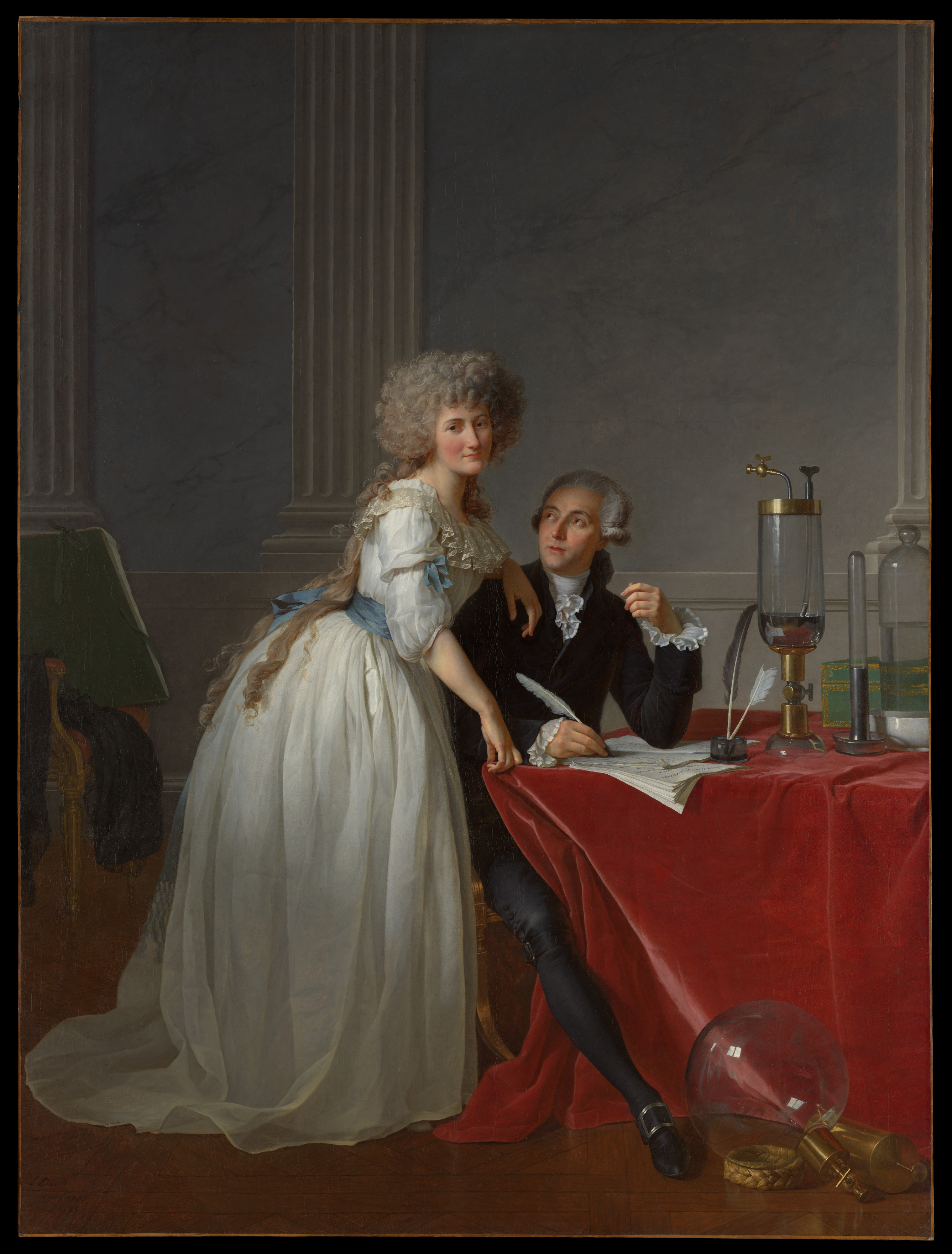
At Natalie Fashion Atelier, our aesthetic archaeology practice excavates not merely the visual surface of historical masterpieces, but the underlying structural and philosophical principles that define an era’s sartorial intelligence. The 1788 portrait of Antoine Laurent Lavoisier and his wife Marie Anne, rendered in oil on canvas by Jacques-Louis David, presents a singular case study. This artifact, frozen at the precipice of the French Revolution, encapsulates a moment where scientific rigor, domestic partnership, and classical restraint coalesce into a powerful aesthetic statement. For the 2026 luxury silhouette, this painting offers a blueprint for a new structural elegance—one that marries the precision of Enlightenment inquiry with the fluidity of modern femininity.
I. The Architectural Frame: Silhouette as a System of Order
The portrait’s composition is a masterclass in geometric discipline. Antoine Lavoisier, seated at a table cluttered with scientific instruments, is anchored by a solid, dark silhouette. His coat, a deep indigo or black, is cut with a severe, almost architectural shoulder line. This is not the soft, flowing fabric of the ancien régime; it is a structured carapace that speaks to the Enlightenment’s belief in order, reason, and the classification of knowledge. For 2026, this translates directly into a new category of “laboratory tailoring.” We are deconstructing the traditional suit jacket to emphasize sharp, linear shoulders—a nod to the glass domes and mathematical instruments in the painting. The silhouette is not merely worn; it is engineered. Expect to see jackets with internal boning and rigid, almost metallic, seam lines that mimic the precise edges of a copper still or a geometric diagram. The palette will be dominated by philosophical blacks, deep charcoals, and mineral greys, creating a canvas of intellectual authority.
Marie Anne’s silhouette, in contrast, provides the counterpoint. Her gown, a soft, flowing white muslin, is deceptively simple. It is not the elaborate, hoop-skirted court dress of her contemporaries. Instead, it is a proto-neoclassical form, falling directly from the shoulder to the floor. This is a radical choice. The fabric is light, almost transparent, suggesting a departure from heavy, ornate textiles. For 2026, this informs a new “scientific drape.” We are exploring high-gauge cashmere and silk organza that mimic the fluidity of mercury or the delicate weight of a chemical precipitate. The silhouette is elongated, columnar, and uninterrupted. It is a study in negative space, where the body becomes a vessel for light and shadow, much like the glass vessels on the table. The key is the absence of structure. Where Antoine’s form is rigid, Marie Anne’s is liquid. The 2026 silhouette will oscillate between these two poles: the armored intellect and the fluid observer.
II. Materiality and Texture: The Chemistry of Fabric
The oil on canvas medium itself provides a profound material lesson. David’s brushwork is not uniform. Antoine’s coat is rendered with a dense, almost opaque application of pigment, creating a surface that feels solid, impenetrable. Marie Anne’s dress, however, is built with thin, translucent glazes. The canvas’s weave is visible in the highlights, suggesting a fabric that breathes. For 2026, we are translating this dichotomy into a new material lexicon. We are developing “compound fabrics” that combine high-density wool (for opacity and structure) with micro-perforated leather or laser-cut metal mesh (for transparency and lightness). The result is a garment that changes character depending on the light and the viewer’s angle—a literal optical chemistry.
Consider the scientific instruments: the polished brass of the air pump, the gleaming glass of the retort, the matte black of the barometer. These are not mere props; they are textural protagonists. For the 2026 couture collection, we are introducing “instrumental finishes.” This includes hand-embroidered metallic threads that mimic the reflective quality of polished brass, applied in geometric patterns along a jacket’s lapel or a skirt’s hem. We are also experimenting with “glass-like” resin panels, set into the bodice of a gown, that refract light in a manner reminiscent of Lavoisier’s lenses. The matte black of the barometer inspires a new category of “absorbent textiles”—velvets and suedes that are chemically treated to eliminate all sheen, creating a surface of pure, unreflecting depth. This is not about decoration; it is about material storytelling. Each fabric choice is a reference to a specific tool or principle from the painting.
III. The Partnership Silhouette: Duality as a Design Principle
The most radical insight from this portrait is the dynamic partnership between the two figures. Marie Anne is not a passive muse; she is an active collaborator. Her hand rests on Antoine’s shoulder, her gaze is directed at the viewer, and she is dressed in a way that complements but does not mimic his form. For 2026, we are proposing a new concept: the “duality silhouette.” This is not a unisex or androgynous look. Rather, it is a collection where each piece is designed with a counterpart in mind. A severe, structured jacket (the Antoine) will be paired with a fluid, almost liquid skirt (the Marie Anne). The proportions are deliberately asymmetrical. One shoulder is sharp and padded; the other is bare and draped. The waist is cinched on one side, but left free on the other. This creates a visual tension that mirrors the intellectual tension of the Enlightenment—the balance between empirical observation and theoretical deduction.
Furthermore, the color palette will be built on complementary contrasts. The deep, authoritative indigo of Antoine’s coat will be paired with the soft, luminous white of Marie Anne’s dress. But we will introduce a third color: a “copper rust” from the scientific instruments. This accent will appear as a structural element—a metal clasp, a chain, or a seam binding—that physically connects the two halves of the silhouette. The 2026 garment is not a single object; it is a system of relationships. The wearer becomes the curator of these relationships, choosing how to balance the rigid and the fluid, the opaque and the transparent, the masculine and the feminine. This is the ultimate expression of Enlightenment couture: a garment that is not merely worn, but thought through.
IV. Conclusion: The Archive as a Living Laboratory
The Lavoisier portrait is not a relic to be copied. It is a laboratory protocol for a new kind of luxury. By isolating its aesthetic archaeology—the structural rigor of the male silhouette, the fluid transparency of the female form, the textural precision of the instruments, and the collaborative dynamic between the subjects—we have extracted a set of principles that are profoundly relevant for 2026. The silhouette of the future is not about nostalgia. It is about applied history. It is about using the past as a set of tools to engineer a new visual language. At Natalie Fashion Atelier, we are not designers; we are aesthetic chemists. And in this portrait, we have found our formula. The result is a collection that is intellectually rigorous, materially innovative, and elegantly, irreducibly Parisian. The 2026 silhouette will be a dialogue—between the arm and the drape, the metal and the silk, the observer and the observed. It will be, in the truest sense, a portrait of partnership.