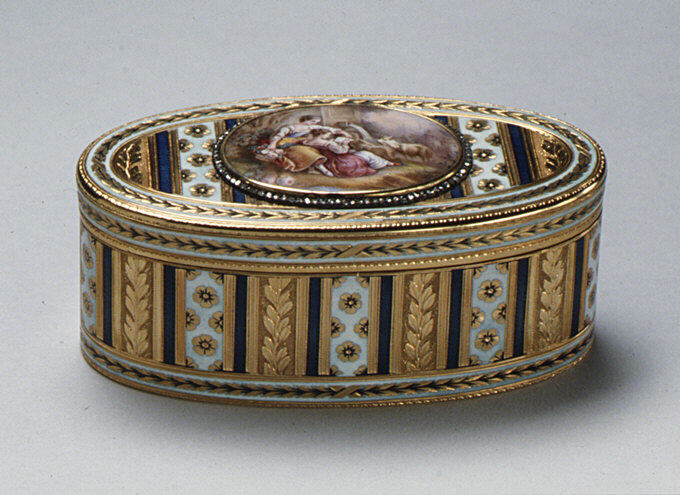
The Snuffbox as Silhouette: Aesthetic Archaeology for 2026
Within the isolated archives of Natalie Fashion Atelier, the snuffbox emerges not as a mere accessory of a bygone era, but as a condensed manifesto of classical elegance. This 18th-century objet de vertu, composed of gold, enamel, and diamonds, represents a pinnacle of micro-architecture—a study in containment, contrast, and precious restraint. For the 2026 haute couture season, we deconstruct this artifact to extract a lexicon of form, materiality, and structural logic that redefines the luxury silhouette.
Structural Syntax: The Geometry of Containment
The snuffbox’s defining characteristic is its precise volumetric enclosure. Typically a rectangular or oval form with a hinged lid, its silhouette is one of controlled tension—a hard, polished exterior concealing an intimate, often unadorned interior. This duality informs the 2026 silhouette through the concept of the “armored cocoon.” Jackets and bodices adopt the snuffbox’s sharp, clean lines: a structured shoulder that mimics the box’s gilded edge, a waistline that snaps shut with the finality of a clasp. The “hinge” becomes a dynamic architectural element, translated into a lateral seam that pivots the garment’s volume from front to back, allowing for a sculpted, almost architectural drape that retains a sense of contained movement.
Furthermore, the snuffbox’s proportional logic—often a ratio of 3:2 or 4:3—guides the segmentation of the 2026 ensemble. A high-waisted, boxy jacket over a column skirt replicates the object’s vertical hierarchy. The “lid” is interpreted as an asymmetrical, detachable shoulder piece or a rigid, off-shoulder collar that frames the décolletage like a precious frame. The “base” becomes a high-waisted, A-line skirt or a pair of structured, cigarette-cut trousers, both terminating in a clean, unadorned hem that echoes the box’s polished base.
Materiality as Narrative: Gold, Enamel, and Diamond
The snuffbox’s material triad—gold, enamel, and diamonds—provides a masterclass in tactile and visual hierarchy. Gold, as the primary structural element, is not merely a color but a weight and reflectivity. For 2026, this translates into metallic lamé woven with a dense, liquid-gold thread, used for the garment’s foundational structure—the lining of a tailored jacket or the internal corsetry that shapes the silhouette. The gold’s hardness is echoed in a new generation of structural organza treated with a metallic resin, creating a fabric that holds a crease like a metal sheet while remaining pliable for movement.
Enamel, with its vitreous, jewel-like finish, informs the color blocking and surface treatment. The snuffbox’s enamel panels—often in deep blues, rich greens, or opaque whites—are translated into lacquered silk gazar and patinated leather. The “cloisonné” technique, where thin gold wires separate color fields, inspires a new method of precision seam placement. Seams are not hidden but celebrated, acting as the “gold wires” that delineate zones of color on a gown or a cape. The “champlevé” technique, where enamel is carved into recessed areas, suggests a negative-space embroidery—a pattern of cutouts in a heavy satin or neoprene, backed with a contrasting, glowing silk, creating a light-and-shadow effect that mimics the depth of enamel.
Diamonds in the snuffbox are not scattered but strategically placed—as a clasp, a border, or a central motif. This informs the 2026 approach to embellishment: strategic, not decorative. Diamonds (or their high-lustre crystal equivalents) are used as structural closures—a single, large crystal cabochon that secures a jacket’s lapel, or a line of small diamonds that trace the edge of a sleeve’s cuff, echoing the box’s diamond-set border. The “rose-cut” diamond, with its flat base and faceted top, inspires a low-profile, high-impact beading technique where stones are set flush into the fabric, creating a smooth, tactile surface that catches light without adding bulk.
Silhouette Translation: From Object to Body
The 2026 silhouette, informed by the snuffbox, rejects the fluid, draped forms of recent seasons in favor of a rigid, architectural precision. The “snuffbox shoulder” is a key feature: a sharply defined, slightly extended shoulder that terminates in a clean, right-angle edge, often in a contrasting material (e.g., a gold lamé shoulder on a black wool jacket). The “enamel waist” is a defined, high-waistline, often cinched with a “diamond-set” belt or a strip of lacquered leather that acts as the box’s clasp.
For evening, the “snuffbox gown” is a column of structured fabric—a heavy silk duchesse satin or a stiffened crepe—that falls from a high, architectural neckline to the floor. The “hinge” is a lateral seam at the hip or the mid-thigh that allows the skirt to open slightly, revealing a contrasting panel of enamel-inspired color. The “lid” is a detachable, rigid cape or a bolero that covers the shoulders, echoing the box’s opening mechanism. The overall effect is one of controlled opulence—a silhouette that is both a tribute to the past and a radical proposition for the future of luxury.
Conclusion: The Art of Precious Restraint
The snuffbox, in its isolated aesthetic archaeology, teaches us that true elegance lies in restraint and precision. For 2026, Natalie Fashion Atelier translates this principle into a collection that values structural integrity over volume, material hierarchy over surface decoration, and strategic embellishment over abundance. The gold, enamel, and diamonds of the snuffbox are not replicated but reimagined as a new language of form and texture, creating silhouettes that are as intellectually rigorous as they are visually arresting. This is not nostalgia; it is an archaeological extraction of timeless principles, forged into the future of haute couture.