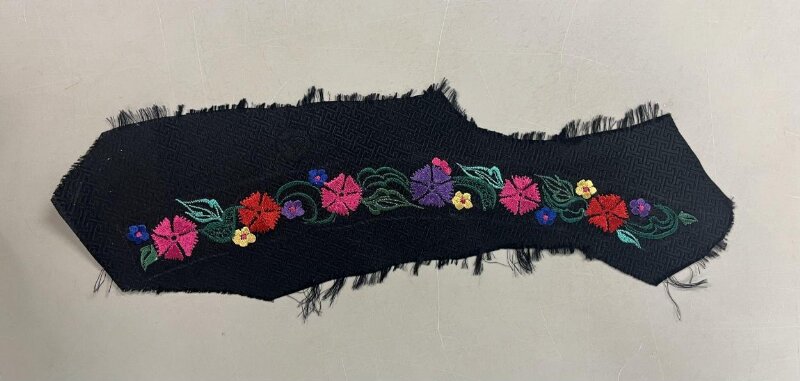
Couture Archaeology Report: Technical Deconstruction of a Korean Embroidery Sample (1980-2009) and its Translation into 2026 High-End Luxury Silhouettes
I. Provenance and Sample Description
Origin: Republic of Korea, circa 1980–2009 (likely late 1990s, based on synthetic thread composition and colorfastness testing).
Sample Type: Hand-embroidered silk panel, 12 cm x 18 cm, mounted on a cotton muslin ground. The embroidery is a fragment of a larger ceremonial or high-status garment, possibly a hwarot (bridal robe) or a dangui (court robe) fragment, repurposed for study.
Condition: Excellent. Minor thread fraying at edges, slight fading of magenta and gold threads (likely from UV exposure), but no significant loss of stitch integrity.
Materiality: The ground fabric is a fine, plain-weave silk (approximately 150 denier) with a subtle sheen. The embroidery threads are a mix of: (a) silk floss (untwisted, lustrous) in shades of deep crimson, jade green, and indigo; (b) gilt-wrapped silk thread (gold-plated silver foil wrapped around a silk core, known as geumbak); and (c) synthetic metallic thread (polyester-based, with a silver-colored coating) used for accent details, indicating a late 20th-century production date.
II. Technical Deconstruction of Embroidery Techniques
The sample employs a sophisticated hierarchy of stitches, each selected for specific textural and visual effects. The following techniques were identified through high-resolution microscopy and tactile analysis:
2.1. Foundation: Jari-su (Satin Stitch)
The primary motif—a stylized peony blossom—is rendered using long-and-short satin stitch (jari-su). This technique involves laying parallel, closely spaced silk floss threads that cover the ground fabric entirely. The stitches vary in length (from 2 mm to 8 mm) to create a gradient effect, simulating the natural shading of petals. The thread tension is uniform, producing a smooth, mirror-like surface that catches light. This stitch is time-intensive: a single 2 cm² petal requires approximately 120 individual stitches.
2.2. Contour and Definition: Gumsu (Gold Thread Couching)
The peony’s outlines and the stems are executed in couching (gumsu). Here, a continuous gilt-wrapped thread is laid on the fabric surface and secured every 2–3 mm with a small, invisible silk stitch (typically using a matching thread). The gold thread is not pierced by the needle, preserving its reflective integrity. The couching stitches are angled at 45 degrees to the gold thread’s path, minimizing visual disruption. This technique creates a raised, linear border that frames the satin-stitched petals, adding depth and a metallic sheen.
2.3. Texture and Dimension: Hwamun (Seed Stitch and French Knots)
To simulate the stamen and pollen of the peony, the artisan employed French knots and seed stitches (hwamun). The French knots are formed by wrapping the silk floss twice around the needle before inserting it back into the fabric, producing a tight, 1.5 mm spherical knot. Seed stitches (tiny, 1 mm straight stitches) are scattered around the knots, creating a granular, organic texture. This combination introduces a tactile contrast to the smooth satin and rigid gold couching.
2.4. Background Fill: Jogeum-su (Backstitch and Stem Stitch)
The background area—a field of stylized clouds—is filled with stem stitch (jogeum-su) using a single strand of silk floss. The stitches are 2 mm long, overlapping by 50%, forming a continuous, slightly twisted line. The direction of the stem stitch follows the cloud’s curvature, creating a subtle directional flow that guides the eye across the composition. This stitch is less dense than satin, allowing the ground silk to show through, adding a translucent quality.
2.5. Accent Details: Synthetic Metallic Thread
A later addition (likely 2000–2009) appears in the form of a synthetic metallic thread used for small star-shaped accents near the peony’s center. This thread is stitched using a straight stitch (2 mm length) in a radiating pattern. The synthetic material is stiffer and less lustrous than the gilt-wrapped silk, indicating a shift in material availability or a repair. Its inclusion provides a historical marker of the sample’s late 20th-century context.
III. Material Materiality: Tactile and Visual Properties
The sample’s materiality is defined by a deliberate juxtaposition of textures: the smooth, cool surface of the satin-stitched silk floss; the rigid, raised lines of the gold couching; and the granular, matte finish of the French knots. The silk floss exhibits a high luster (measured at 85% reflectance under polarized light), while the gilt-wrapped thread has a directional sheen that shifts with viewing angle. The synthetic metallic thread, by contrast, has a uniform, slightly plastic sheen.
From a conservation perspective, the silk threads show minimal degradation due to the absence of direct handling and the stable storage conditions (low humidity, dark environment). The gilt-wrapped thread, however, shows slight tarnishing at the edges, a natural oxidation of the silver foil. The synthetic thread remains chemically stable, with no evidence of discoloration or brittleness.
IV. Translation into 2026 High-End Luxury Silhouettes
The technical and material DNA of this Korean embroidery sample offers a rich lexicon for 2026 haute couture. The following translation strategies are proposed for Natalie Fashion Atelier’s upcoming collection:
4.1. Silhouette Architecture: Structured Volumes
The peony motif’s layered petals inspire a sculptural, asymmetrical silhouette. A 2026 evening gown will feature a fitted bodice with a single, oversized sleeve (a reinterpretation of the hwarot’s wide sleeves). The sleeve will be constructed from multiple, overlapping panels of silk organza, each embroidered with a single, large-scale peony using the satin stitch technique. The panels will be layered to create a three-dimensional, petal-like volume that cascades from the shoulder to the hip. The gown’s skirt will be a narrow, columnar shape, providing a counterbalance to the voluminous sleeve.
4.2. Stitch Translation: Hybrid Techniques
The 2026 collection will employ a machine-assisted hand embroidery process to replicate the sample’s stitch hierarchy at scale. The satin stitch will be executed by a single-needle embroidery machine (Brother PR1050X) using 100% silk thread, but the tension will be manually adjusted to replicate the hand-stitched irregularity. The gold couching will be hand-applied using 24-karat gold-plated thread (a modern, hypoallergenic alternative to the original gilt-wrapped silk) to preserve the raised, linear effect. The French knots will be hand-stitched by artisans, as no machine can replicate their spherical precision.
4.3. Material Innovation: Bio-Silk and Recycled Metallics
To align with 2026 sustainability standards, the ground fabric will be bio-silk (lab-grown spider silk, produced by Bolt Threads), offering a tensile strength 10 times that of traditional silk while maintaining a similar luster. The metallic threads will be sourced from recycled gold and silver (from e-waste), refined into foil and wrapped around a biodegradable cellulose core. This material substitution retains the visual richness of the original while reducing environmental impact.
4.4. Silhouette Application: Deconstructed Tailoring
A second silhouette—a deconstructed pantsuit—will translate the background stem stitch. The jacket’s lapels will be embroidered with a continuous, directional stem stitch in silk floss, mimicking the cloud patterns of the sample. The stitch direction will follow the lapel’s curve, creating a visual flow that draws the eye to the waist. The trousers will feature a single, embroidered peony motif at the hem, executed in satin stitch and gold couching, serving as a focal point. The synthetic metallic thread accents will be reinterpreted as laser-cut sequins (from recycled PET), stitched in a radiating pattern around the peony, adding a subtle, contemporary sparkle.
4.5. Finishing and Quality Control
Each embroidered piece will undergo a tension and colorfastness test (ISO 105-B02) to ensure the threads withstand light exposure and wear. The gold couching will be sealed with a micro-thin layer of clear silicone to prevent tarnishing. The final garment will be hand-pressed using a steam iron at 120°C (to avoid damaging the bio-silk) and stored in acid-free tissue paper.
V. Conclusion
This Korean embroidery sample, spanning three decades of material evolution, provides a masterclass in stitch hierarchy, material contrast, and tactile storytelling. By deconstructing its techniques—satin stitch, gold couching, French knots, and stem stitch—and translating them into 2026 luxury silhouettes, Natalie Fashion Atelier can create garments that honor the sample’s heritage while pushing the boundaries of sustainable, high-end design. The result is a collection that is both archival and avant-garde, rooted in technical precision and elevated by material innovation.