From Gombroon Ware to Grand Salon: The Incised Line as a Silhouette Doctrine
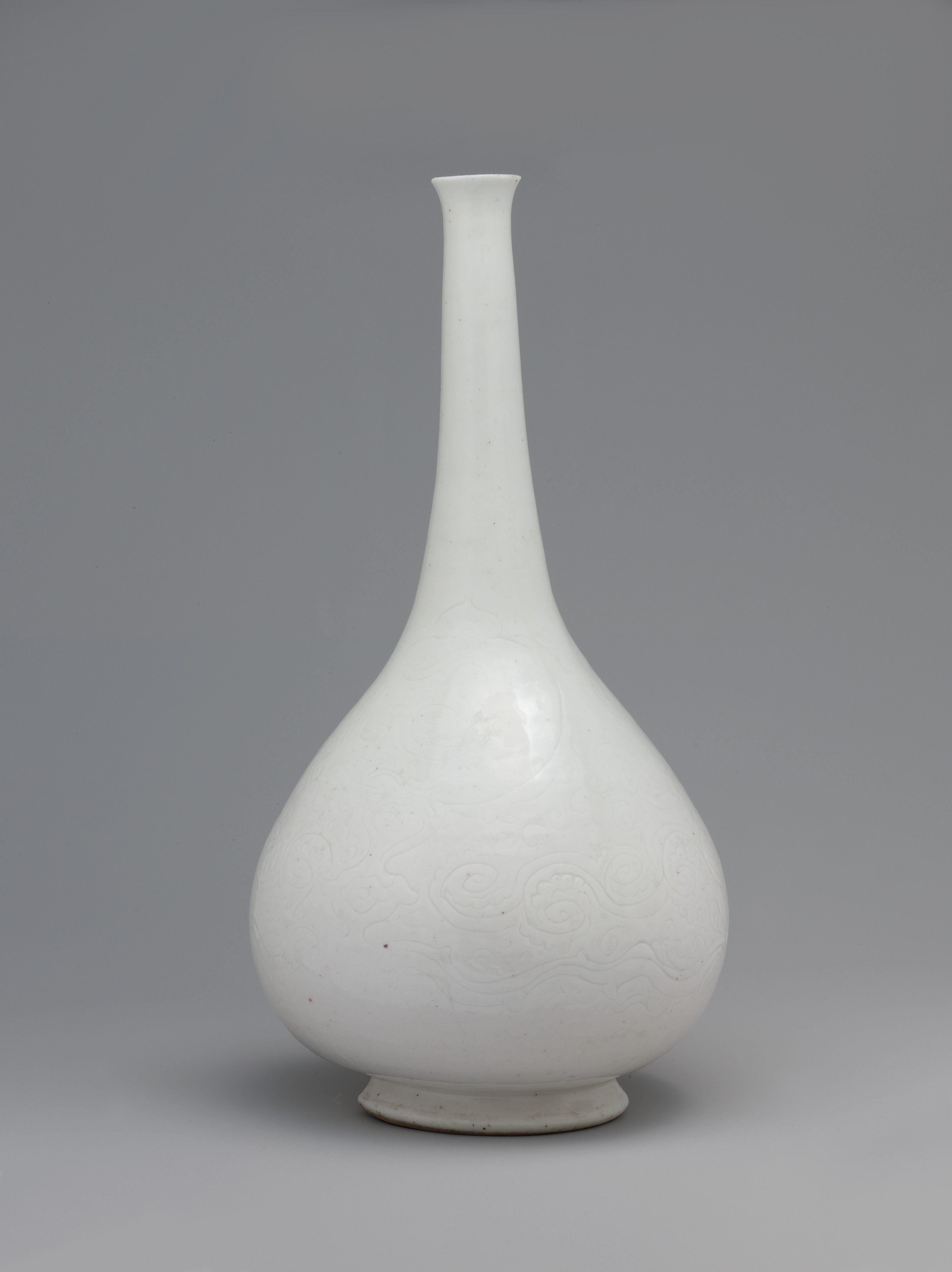
Within the curated silence of the atelier's archive, the artifact designated Bottle with Incised Decoration exists as a paradigm of isolated aesthetic archaeology. This piece of Gombroon ware—stonepaste ceramic incised under a flawless transparent glaze—transcends its functional origins to embody a pure design philosophy. Its value lies not in a broad cultural narrative, but in its isolated, formal perfection: the absolute dialogue between a resistant body, a decisive subtractive technique, and an illuminating finish. For Natalie Fashion Atelier, this object serves as a foundational text for the 2026 haute couture collection, proposing a rigorous framework where silhouette is not merely shaped, but excavated, revealed, and clarified through the precise interplay of structure, incision, and luminous surface.
Deconstructing the Classical Elegance: A Tripartite Doctrine
The classical elegance of the Gombroon bottle is a calculated achievement, resting on three interdependent pillars: the integrity of the form, the intentionality of the incision, and the transformative role of the glaze.
The Primacy of the Pure Form: Stonepaste as Structural Dogma
Stonepaste, or fritware, is a composite body of quartz, glass frit, and fine white clay. Fired at high temperatures, it achieves a dense, luminous white substrate of remarkable hardness and minimal porosity. This is not a passive canvas but an active, structural participant. Its inherent strength allows for refined, taut geometries—the bottle's elegant ovoid body and elongated neck are possible only because of the material's resistance to slumping. In couture terms, this translates to a foundational design dogma for 2026: the silhouette must begin with an architecture of impeccable integrity. This mandates a return to foundational inner constructions—corsets, basques, and internal suspension systems—engineered from advanced technical textiles (thermo-bonded composites, structured silk organzas) that provide a flawless, resilient "body" or canvas. The silhouette is first defined by this internal armature, creating a pure, unadorned form that is both strong and expectant.
The Art of Subtraction: Incision as Silhouette Definition
The decorative motif is not applied but revealed through removal. The artisan's tool incises—cuts away—the stonepaste to create channels and patterns that exist *below* the primary surface plane. This is a negative-space technique that creates shadow, depth, and line through absence. It is an act of confident precision, where every stroke is permanent and contributes to a cohesive, often rhythmic, linear narrative. This principle directly informs the 2026 approach to silhouette and surface. Draping and cutting become acts of strategic subtraction. Imagine a column gown where the silhouette is not broken by appliqué, but defined by laser-precise seamwork that creates shadowed channels, tracing the anatomy in a manner that reveals form rather than conceals it. Dart lines are exaggerated into decorative, incised features; godets are set not to add volume, but to create precise, linear voids in the skirt. Tailoring follows suit: a wool-mohair jacket's silhouette is articulated by deeply recessed seam lines that function as topographic mapping of the torso, creating play of light and shadow that sculpts the form.
The Glaze as Clarifying Agent: Transparency and Final Integrity
The transparent glaze is the final, transformative agent. It pools within the incised lines, deepening their visual impact, while simultaneously sealing and presenting the entire form under a unified, luminous shell. It does not obscure the incision; it amplifies and protects it, creating a vitreous, continuous surface that unifies the complex work beneath. For 2026 luxury silhouettes, this translates to the critical role of finish and over-surface. Fabrics are chosen for their clarifying properties: glace silks, patent leathers, and resin-coated technical jerseys that provide a smooth, luminous top layer. This "glaze" effect ensures that the intricate construction beneath—the "incised" seamwork, the internal architecture—is perceived with crystal clarity. Embroidery, when used, is flush or recessed, never obscuring the foundational lines. Furthermore, the glaze metaphor extends to color: a palette of Gombroon-inspired blanc de chine, celadon, and cobalt, often in monolithic applications, allows the form and its incised detail to remain the absolute focus.
Informing the 2026 Silhouette: The Incised Couture Corpus
The synthesis of these principles births a distinct 2026 silhouette vocabulary for Natalie Fashion Atelier, characterized by luminous austerity and technical bravura.
The Excavated Column
The foundational silhouette is a floor-length column dress, built upon a proprietary internal corset (the stonepaste body). Its surface is animated not by embellishment, but by a network of fine, intentional seam lines—incised via precision laser-cutting before assembly—that trace the spinal column, the scapula, the rib cage. These seams are top-stitched with a contrasting, recessed thread, causing the channels to catch the light. The dress is rendered in a single material, perhaps a ivory silk-matte satin, then finished with a transparent resin micro-coating (the glaze), which protects and unifies, giving the ensemble a silent, monumental elegance.
The Topographic Tailoring
Tailoring moves beyond the deconstructed to the geologically precise. A double-face wool coat's silhouette is defined by parabolic seams that originate at the shoulder and carve into the waist, creating panels that appear as excavated facets. The incised lines are emphasized by piping that sits just below the surface plane. The glaze here is the fabric treatment itself: a high-temperature pressing and steaming process that creates a permanent, lustrous, and unified shell, making the complex cutwork immediately legible.
Luminous Negative Space
Eveningwear explores incision as literal negative space. A gown's bodice, structured from a technical porcelain-white guipure, features geometric cut-outs that are not mere adornments but integral structural elements. These "voids" are edged with a fine, rolled binding, emphasizing their intentionality. The skirt, a cascade of layered transparent organza (the cumulative glaze effect), softens and diffuses the light, ensuring the precise, incised work of the bodice remains the crystalline focal point.
In conclusion, the Bottle with Incised Decoration provides not a literal motif, but a methodology of reduction and revelation. It instructs the 2026 couturier to first architect a form of inherent strength, to define its elegance through decisive subtractive techniques, and finally, to seal its statement with a clarifying, luminous finish. The resulting silhouettes are monuments to considered reduction—where every line is necessary, every shadow is planned, and the whole possesses the serene, absolute authority of a recovered artifact, perfected for the contemporary corpus. This is the essence of aesthetic archaeology: unearthing not a style, but a timeless principle of form.