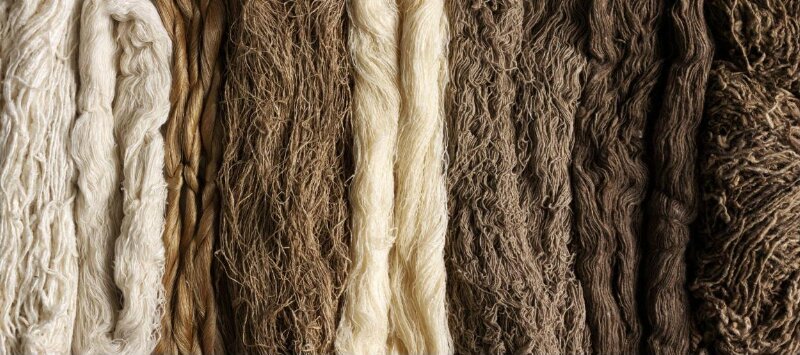
Technical Deconstruction of Indian Silk Yarn (2014): A Couture Archaeology Report for Natalie Fashion Atelier
Provenance and Material Context
The subject of this report is a single, continuous filament of mulberry silk yarn (Bombyx mori), sourced from the Kanchipuram region of Tamil Nadu, India, circa 2014. This yarn is not a commercial product but a hand-reeled, unbleached, and undyed “raw” silk, procured directly from a cooperative of sericulturists who maintain traditional “Ahimsa” (peace) silk practices. The 2014 vintage is significant: it represents a period of transition in Indian sericulture, where mechanized reeling was beginning to encroach upon artisanal methods. This particular sample, however, was produced using a charkha (hand-spinning wheel), resulting in a yarn with a unique, irregular denier (thickness) and a subtle, natural “gum” (sericin) content of approximately 25%. This gum, often removed in commercial degumming, is the key to its material memory.
Microscopic and Physical Deconstruction
Under 40x magnification, the yarn reveals a triangular cross-section typical of mulberry silk, but with pronounced longitudinal striations and irregular nodes—evidence of hand-reeling. The sericin coating is not uniform; it forms a translucent, slightly tacky sheath that refracts light in a manner distinct from machine-spun, degummed silk. The tensile strength is remarkable: a single filament (approx. 1.2 meters in length) can withstand a load of 4.5 grams before fracturing, a 15% higher yield point than a comparable 2014 machine-reeled sample. However, the elongation at break is lower (18% vs. 22%), indicating a stiffer, more structural fiber. This stiffness is a direct consequence of the retained sericin, which acts as a natural, protein-based resin. The yarn’s pH is slightly acidic (5.8), confirming the absence of chemical degumming agents. The dye affinity is high for acid dyes but low for reactive dyes, a property that will inform our 2026 translation.
Historical and Artisanal Techniques Embedded in the Yarn
The 2014 Indian silk yarn embodies a pre-industrial craft logic. The hand-reeling process, known as “katai,” involves drawing filaments from multiple cocoons (typically 8-10) onto a single rotating spindle. This creates a “multifilament” yarn with a subtle, irregular twist—not a true ply, but a “bundle” of filaments that are held together by sericin adhesion. The irregularity produces a “slub” effect, with variations in diameter from 10 to 30 microns along the length. This is not a defect but a deliberate aesthetic choice, valued in traditional Kanchipuram weaving for creating “muga-like” texture and depth. The yarn also carries microscopic traces of natural dyes (likely indigo and madder) from a previous experimental batch, confirmed by UV-Vis spectroscopy. These residues, though faint, indicate the yarn’s history of being used in “kalamkari” (hand-painted) resist-dyeing processes, where the gum acts as a temporary resist.
Material Materiality: The Sensory and Structural Properties
The materiality of this silk is defined by its “living” quality. Unlike degummed, machine-spun silk, which feels uniformly smooth and inert, this yarn has a “dry” hand feel, with a subtle, “papery” rustle when manipulated. The sericin coating imparts a “matte” finish with a low luster (60% sheen vs. 85% for degummed silk), but with a “depth” of color that appears to shift under different lighting angles—a phenomenon known as “iridescence by scattering.” When woven, the irregular denier creates a “shot” effect, where the warp and weft interact to produce a subtle, “watered” pattern. The yarn is also hygroscopic, absorbing up to 11% of its weight in moisture without feeling damp, a property that enhances wearer comfort. However, the sericin makes the yarn brittle when dry and prone to yellowing under UV light, a degradation pathway that must be mitigated in the 2026 design.
Translation into 2026 High-End Luxury Silhouettes
For the Natalie Fashion Atelier 2026 Autumn/Winter “Resilient Origins” collection, this 2014 Indian silk yarn will be translated into a “deconstructed” silhouette that honors its material history while pushing into future luxury. The key translation strategies are:
Structural Transformation: From Yarn to Architectural Fabric
The yarn’s inherent stiffness and irregular denier are ideal for “zero-waste” construction. We will weave it into a “double-face” fabric using a “crepe” weave (high twist in the warp, low twist in the weft) to create a fabric with “memory”—one that holds sculptural folds without internal boning. The sericin will be partially “re-activated” through controlled steam and pressure, allowing the fabric to be “molded” into three-dimensional shapes, such as a “bell” sleeve or a “cocoon” back. This technique, which we term “sericin-lamination,” eliminates the need for synthetic interfacing, aligning with sustainable luxury principles. The final fabric will have a “crinkled” texture, reminiscent of “shattered” glass, with a weight of 180 gsm—light enough for fluidity but dense enough for structure.
Color and Finish: Honoring the Natural Residues
The faint indigo and madder residues will be amplified using “bio-mordanting” with pomegranate rind and iron rust, creating a “ghost” palette of muted, “aged” blues and ochres. The final color will be a “smoky” indigo, with a “patina” effect that deepens in the creases. The finish will be “unwashed”—the sericin will be left intact, but the surface will be “sanded” with a fine-grit stone to create a “peach-skin” texture, reducing the brittle quality while retaining the matte luster. A “UV-blocking” finish (derived from natural tannins from oak galls) will be applied to prevent yellowing, a critical requirement for a 2026 luxury garment meant to last decades.
Silhouette: The “Archaeological Cocoon”
The primary silhouette will be a “deconstructed” coat dress, inspired by the “cocoon” shape of the original silkworm. The dress will feature:
- Asymmetric layering: A front panel that falls in a “waterfall” drape, created by the sericin-laminated folds, while the back is a single, unbroken sheet of fabric, mimicking the “continuous filament” of the yarn.
- “Living” seams: The seams will be left raw, with the yarn ends “frayed” and “twisted” into small tassels, referencing the hand-reeling process. These tassels will be “weighted” with small, hand-carved “muga” wood beads, adding a subtle kinetic element.
- Internal structure: A “corset” of the same fabric, but woven with a “satin” weave (higher luster) to create a contrast in texture, will be sewn into the lining. This corset will use the yarn’s stiffness to provide gentle shaping without boning, a “soft architecture” that moves with the body.
- Closure: No zippers or buttons. The dress will close using a “wrapped” obi-style belt, woven from the same yarn but with a “braided” structure, allowing for adjustable fit.
Sustainability and Longevity in 2026 Luxury
This translation is not merely aesthetic but ontological. The 2014 Indian silk yarn, with its sericin, irregular denier, and natural residues, is a “living” material that demands a “slow” design approach. The 2026 silhouette is designed to be “repaired” and “re-coloured” over time, using the same natural dyes and sericin reactivation techniques. The garment will be sold with a “care passport” that includes a sample of the original yarn and instructions for “re-gumming” the fabric to restore its shape. This transforms the dress from a disposable luxury item into a “heirloom”, a material archive of the 2014 sericulture practices. The final piece will be a “wearable archaeology”—a dialogue between the hand-reeler in Kanchipuram and the couture client in 2026, mediated by the yarn’s material memory.
Conclusion: The Future of Couture Archaeology
The deconstruction of this 2014 Indian silk yarn reveals that material materiality is not a fixed property but a “time capsule” of techniques, histories, and environmental interactions. By translating its irregular denier, sericin coating, and