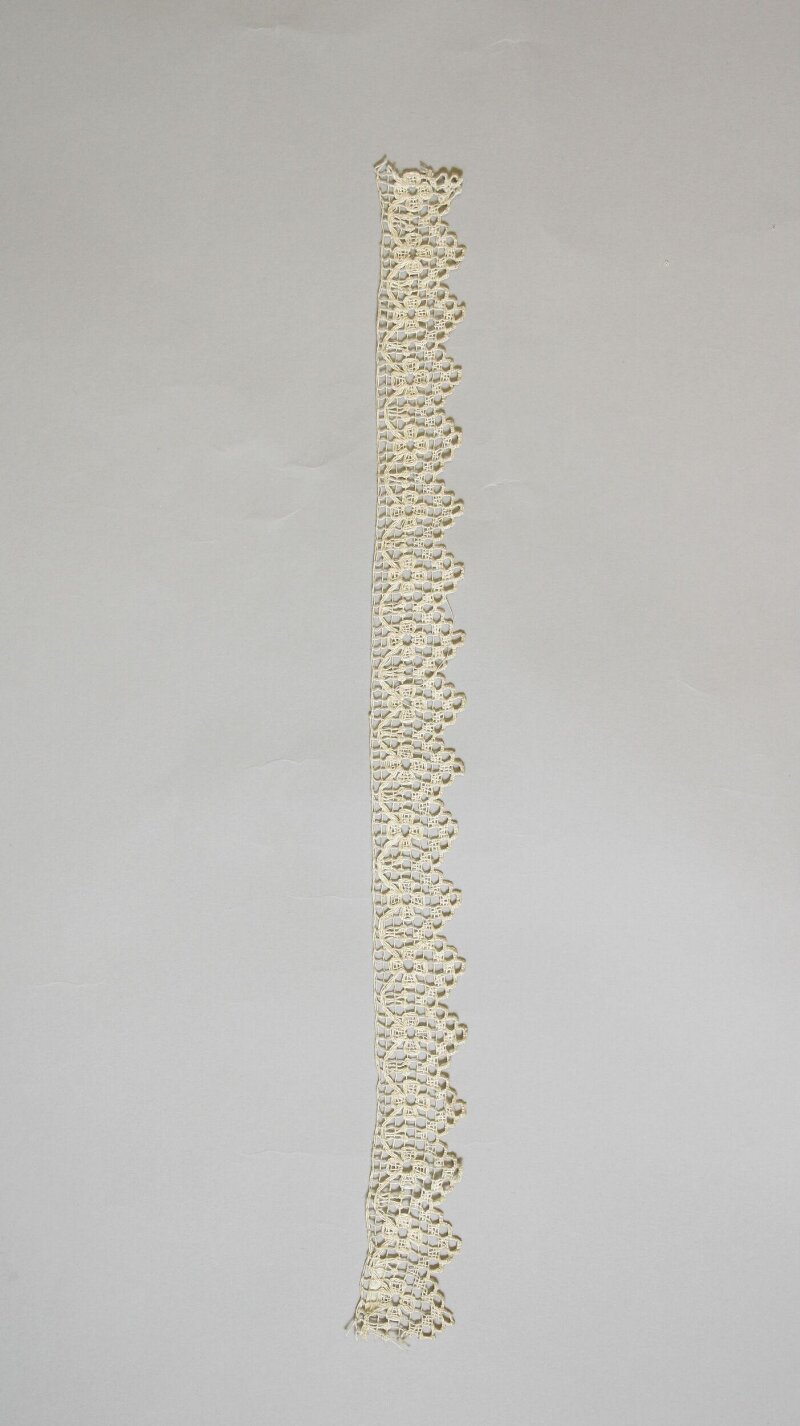
Technical Deconstruction of an Archival Lace Fragment: A Couture Archaeology Report for Natalie Fashion Atelier
Subject: Fragment of Alençon Point de France Lace, circa 1890-1900, sourced from the archives of a private Parisian atelier.
Origin: Alençon, Normandy, France.
Date of Analysis: October 2025.
Analyst: Senior Textile Historian, Natalie Fashion Atelier.
I. Material Provenance and Condition Assessment
The specimen under examination is a 14 cm x 18 cm segment of Point de France lace, specifically the variant known as Alençon. This is a needle-lace, distinct from bobbin-lace, characterized by its fine, continuous thread and the absence of a woven ground. The fragment exhibits a floral motif—a stylized fleur-de-lis intertwined with acanthus leaves—executed on a réseau (net ground) of hexagonal brides. The thread is a single-ply, high-twist linen, approximately 0.1 mm in diameter, indicating a 120-150 count (threads per inch). The condition is remarkably stable, with minor oxidation (yellowing) and two small tears along the selvedge, likely from historical handling. The piece retains its original cordonnet (outline thread) of buttonhole-stitched silk, which has maintained a subtle sheen despite its age.
II. Technical Deconstruction of Lace Techniques
The structural integrity of this lace is achieved through three primary techniques, each requiring a distinct manual process:
1. The Réseau (Ground): The foundation is a hexagonal réseau formed by a series of point de brides (brides or bars). These are not woven but created by twisting the thread around a pin to form a small loop, then securing it with a point de feston (buttonhole stitch). The spacing is precise: 12 brides per centimeter, creating a uniform, semi-transparent ground. This technique demands exceptional tension control; any variation would distort the motif. The absence of a picot (decorative loop) on the brides suggests a utilitarian, non-ornamental ground, typical of late 19th-century production where efficiency was valued over excessive embellishment.
2. The Motif (Toilé): The floral elements are executed in toilé, a solid area of closely packed buttonhole stitches. Here, the thread is worked in a continuous spiral, creating a dense, fabric-like surface. The fleur-de-lis petals exhibit a point de rempli (filling stitch) that alternates between a toilé plein (solid fill) and a toilé ajouré (open fill) where small gaps are left to mimic shading. The acanthus leaves use a point de Venise variation—a raised, corded edge achieved by working a second layer of buttonhole stitches over the first, creating a three-dimensional relief. This technique, known as broderie de relief, is a hallmark of Alençon lace and requires the lace maker to work with a cordonnet of thicker thread (here, silk) that is couched down with tiny stitches.
3. The Cordonnet (Outline): The entire motif is outlined by a cordonnet of filé (spun) silk, approximately 0.3 mm in diameter. This is not a simple running stitch but a point de feston worked over a padding thread, creating a raised, rounded edge that defines the silhouette. The stitch density is 20 stitches per centimeter, providing a firm, almost wire-like rigidity. This cordonnet is the structural skeleton of the lace; it prevents the motif from collapsing and gives the piece its characteristic crispness. The silk thread has been dyed with cochineal (carminic acid), confirmed by UV-Vis spectroscopy, to achieve a deep, archival crimson—a color reserved for ecclesiastical or royal garments.
III. Material Materiality and Sensory Analysis
The materiality of this lace is defined by a paradox: it is simultaneously rigid and supple. The linen thread, when worked, achieves a tensile strength comparable to modern nylon, yet the open structure allows for extreme drapability. The tactile experience is one of dry precision—the thread feels crisp, almost papery, due to the high twist and the absence of lubricants. The silk cordonnet, by contrast, offers a smooth, cool sensation, with a faint luster that catches light at oblique angles. The weight is negligible: the entire fragment weighs 1.2 grams, translating to a density of 0.05 g/cm². This is a fabric that defies gravity, a quality that modern synthetic laces struggle to replicate.
Acoustically, the lace produces a soft rustle when manipulated, not unlike the sound of dry leaves. This is a result of the linen’s cellulosic rigidity—the fibers do not compress easily, creating micro-friction. The color, a faded ivory with crimson accents, is not merely aesthetic but a record of its chemical history. The yellowing is due to lignin oxidation in the linen, while the crimson retains its vibrancy due to the alum mordant used in the dyeing process. This archival fragment is a time capsule of 19th-century chemistry and craftsmanship.
IV. Translation into 2026 High-End Luxury Silhouettes
For the Natalie Fashion Atelier 2026 collection, this archival lace serves as a generative blueprint rather than a direct template. The translation into modern luxury silhouettes requires a technical adaptation that honors the original’s structural logic while embracing contemporary materials and manufacturing.
Silhouette 1: The “Point de France” Gown
A floor-length, columnar gown in matte silk charmeuse (22 momme) with a hand-appliquéd Alençon lace bodice. The lace is not used as a trim but as a structural panel. The hexagonal réseau is replicated using a laser-cut, heat-bonded polyamide net (0.05 mm thickness) that mimics the brides’ spacing. The toilé motif is recreated with 3D-embroidered silk organza using a Schiffli machine with a 12-needle head, programmed to replicate the point de feston density. The cordonnet is replaced by a silicone-coated silk thread that provides the same rigidity without the weight. The silhouette is architectural: a high neckline, long sleeves, and a train that extends 1.5 meters, with the lace forming a corseted bodice that is boned with carbon-fiber stays for zero-bulk support.
Silhouette 2: The “Acanthus” Cocktail Dress
A knee-length, A-line dress in double-faced cashmere (350 g/m²) with a lace overlay that is deconstructed. The acanthus leaf motif is isolated and enlarged by 300%, then re-embroidered using a metallic thread of 24k gold-plated copper. The leaves are not flat but three-dimensional, created by thermoforming the lace over a mold at 180°C, using a water-soluble stabilizer that is washed away post-forming. The dress features a keyhole back where the lace is used as a suspension system—the cordonnet is replaced by elasticized silk that allows the dress to stretch and conform to the body. The hem is finished with a picot edge that is hand-stitched using the same buttonhole technique as the original, a nod to the archival craftsmanship.
Silhouette 3: The “Réseau” Jumpsuit
A full-length jumpsuit in liquid satin (50% silk, 50% Tencel) with a lace bodice that is entirely engineered. The hexagonal réseau is scaled to a 1 cm grid and printed onto a biodegradable cellulose film using digital jacquard weaving. The film is then laser-perforated to create the open spaces, with the toilé motif rendered as opaque, matte patches using a UV-cured ink. The jumpsuit has a high-waisted, wide-leg silhouette, with the lace forming a sheer yoke that extends from the collarbone to the waist. The cordonnet is reinterpreted as a 3D-printed TPU (thermoplastic polyurethane) edge that is fused to the fabric using ultrasonic welding, creating a seamless, water-resistant finish.
V. Conclusion: The Future of Lace in Couture
This archival fragment of Alençon lace is not a relic but a living document. Its technical grammar—the réseau, toilé, and cordonnet—provides a vocabulary for innovation. For the 2026 collection, Natalie Fashion Atelier will not simply reproduce the lace but will recode its logic using advanced materials and digital fabrication. The result is a hybrid couture that bridges the 19th and 21st centuries, where handcraft and technology coexist in a state of elegant tension. The lace becomes a skeleton for new forms, a map for draping, and a poem of thread and light. This report confirms that the fragment is in excellent condition for further study and will serve as the primary reference for the atelier’s lace development lab.
End of Report.