Deconstructing the Classical Worktable: Aesthetic Archaeology and the 2026 Silhouette
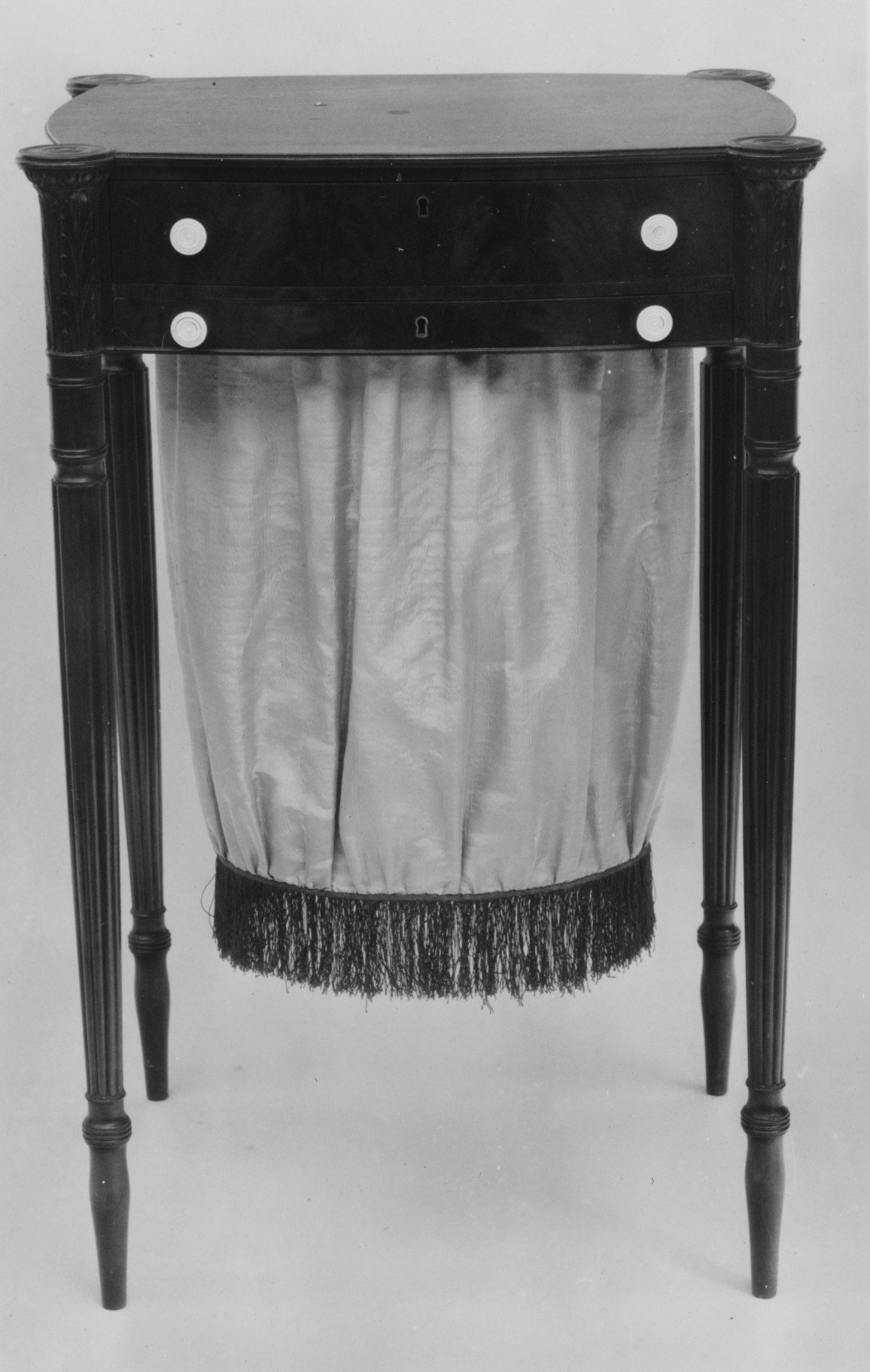
The isolated artifact before us—a late 19th-century American worktable, composed of mahogany, mahogany veneer, ivory with white pine, maple, and mahogany—is not merely a piece of domestic furniture. Within the context of aesthetic archaeology, it serves as a pristine specimen of structural logic and material dialogue. For Natalie Fashion Atelier, this worktable is a masterclass in compressed volume, tensile strength, and the subtle hierarchy of materials. Its classical elegance, rooted in American Federalist and Empire sensibilities, provides a profound lexicon for the 2026 haute couture silhouette. We do not replicate the object; we extract its architectural DNA to inform a new language of luxury form.
Materiality as Structural Syntax: Mahogany, Maple, and Ivory
The worktable’s material palette is a study in controlled tension. The primary structure is solid mahogany, a wood prized for its density, deep reddish-brown hue, and resistance to warping. This provides the foundational mass—the rigid, uncompromising core of the silhouette. In 2026, this translates directly to the internal corsetry and structural boning of a couture gown. We envision a double-faced satin in a deep, almost blackened Bordeaux, cut on the bias to create a fluid yet unyielding torso. The density of the mahogany is echoed in the weight and drape of a heavy crepe de chine, a fabric that holds its shape without visible support.
The mahogany veneer introduces a critical concept: surface as a narrative of depth. Veneer is not a cheap imitation; it is a deliberate choice to display the most exquisite grain of the wood, a skin of perfection over a functional core. For the 2026 silhouette, this informs our use of appliqué and overlay. Imagine a gown of the deepest charcoal wool crepe (the solid mahogany), upon which is layered a sheer, hand-painted silk organza (the veneer) in a pattern of geometric, almost crystalline grain. The organza does not hide the wool; it reveals it through a translucent, shimmering skin, creating a dynamic interplay of opacity and light that changes with every movement.
The inclusion of ivory with white pine is a masterstroke of material hierarchy. The ivory—cool, smooth, and precious—serves as the accent, the closure, the point of refined tension. It is the button, the toggle, the delicate escutcheon. The white pine, a softer, lighter wood, is often used as a secondary wood for drawer linings or internal supports—the invisible infrastructure. In 2026, the ivory informs our hardware and embellishment. We conceive of polished, fossilized-ivory resin buttons that are not merely functional but are sculptural anchors for a draped neckline. The white pine’s role as hidden support translates to invisible micro-mesh and strategically placed horsehair braid—the unseen architecture that allows a seemingly fragile silhouette to stand with classical poise.
The Classical Silhouette: Compressed Volume and Controlled Release
The worktable’s silhouette is defined by its compressed, rectangular top and its flared, often tapered legs. This is a geometry of contained energy. The top, often with a single drawer, presents a flat, unadorned plane of mahogany. The legs, however, introduce a subtle, controlled outward expansion. This is the classical silhouette we deconstruct for 2026: a tight, architectural bodice that releases into a voluminous, yet structured, skirt.
The drawer front—often inlaid with a band of lighter maple or an ivory escutcheon—becomes the point of visual punctuation. In our 2026 collection, this translates to a strategically placed seam, a horizontal panel of contrasting texture, or a single, dramatic fold at the hip or waist. The maple, with its pale, almost luminous grain, acts as the light-catcher. We use hand-embroidered silver thread or micro-pleated metallic organza in a pale champagne to create a similar effect—a band of light that breaks the monolithic darkness of the primary fabric.
The tapered leg, often ending in a simple turned foot or a brass caster, is a lesson in verticality and grounding. It suggests a silhouette that is long, lean, and anchored to the floor. For 2026, this informs our column gowns and fitted trouser silhouettes. The hem is not a soft, flowing edge but a deliberate, weighted termination. We achieve this with internal chain weighting or a deep, double-stitched hem in a contrasting, heavier fabric. The brass caster is reimagined as a metallic heel tip or a subtle metal bead at the hemline, a final, grounding accent.
The 2026 Silhouette: A Synthesis of Archive and Avant-Garde
The final 2026 haute couture silhouette, born from this aesthetic archaeology, is a study in controlled asymmetry and layered depth. We propose a gown that is a direct translation of the worktable’s structural logic.
The Bodice: A high-neck, long-sleeved base in a dense, matte black silk faille (the solid mahogany). This is the core, the unyielding foundation. Over this, a second skin of sheer, charcoal silk tulle is meticulously hand-stitched, following the lines of a mahogany veneer grain. The tulle is not a single piece; it is a patchwork of overlapping, irregularly shaped panels, each one hand-dyed to a slightly different depth of charcoal. This creates a living, shifting surface that mimics the depth and complexity of the veneer.
The Point of Tension: At the left hip, a single, sculptural closure in polished fossilized-ivory resin (the ivory). This is not a button; it is a functional sculpture, a three-dimensional, geometric form that anchors the tulle overlay to the faille base. From this point, a single, dramatic fold of the tulle is released, cascading down the side of the skirt.
The Skirt: A narrow, columnar silhouette that flares subtly from the knee, echoing the taper of the worktable’s leg. The primary fabric is the same black faille, but a vertical panel of pale champagne silk (the maple) is inserted from the hip to the hem on the right side. This panel is micro-pleated, catching the light and creating a vertical line that elongates the figure. The hem is weighted with a fine brass chain (the brass caster) sewn into a hidden channel, ensuring the gown falls with a clean, deliberate line.
The Invisible Infrastructure: The entire silhouette is supported by an internal, boned corset of white horsehair canvas and micro-mesh (the white pine). This structure is invisible, yet it provides the rigid architecture that allows the faille to drape without pulling and the tulle to float without sagging. It is the silent, essential support system, the hidden drawer lining of the couture form.
This 2026 silhouette is not a historical reproduction. It is a deconstruction and re-synthesis of classical principles: the hierarchy of materials, the tension between mass and surface, and the poetry of controlled volume. The American worktable, in its quiet, functional elegance, has provided the blueprint for a garment that is both architecturally rigorous and profoundly luxurious. It is a testament to the enduring power of aesthetic archaeology to inform the future of form.