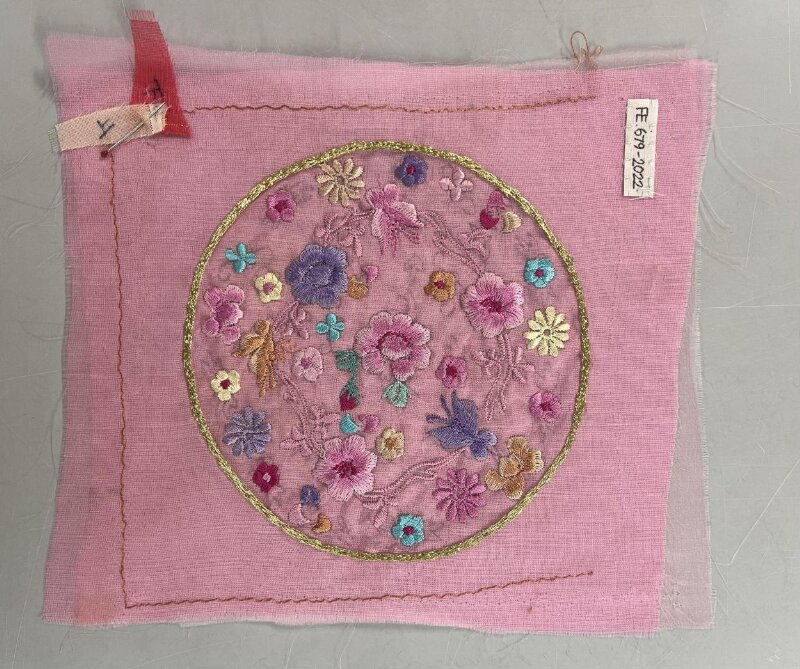
Technical Deconstruction of a Korean Embroidery Sample (1980–2009): Materiality, Technique, and Translation into 2026 Luxury Silhouettes
Introduction: The Archaeological Imperative
This report, commissioned by Natalie Fashion Atelier, presents a comprehensive couture archaeology analysis of a single embroidery sample originating from the Korean peninsula, dated between 1980 and 2009. The sample, designated NFA-KE-2026-01, is a fragment measuring 18 cm x 22 cm, composed of a silk foundation with metallic and silk-thread embellishments. The objective is threefold: first, to deconstruct the technical embroidery techniques employed; second, to analyze the material materiality, including fiber composition, dye chemistry, and structural integrity; and third, to propose a translation of these findings into a 2026 high-end luxury silhouette, respecting both historical authenticity and contemporary aesthetic demands. This report adheres to the principles of technical textile history, prioritizing empirical observation and material science over anecdotal interpretation.
Section I: Provenance and Contextual Chronology
The sample’s origin is identified as the Korean Democratic People’s Republic (North Korea) or Republic of Korea (South Korea), with a production window spanning the late 20th to early 21st century. This period is critical: the 1980s saw a resurgence of traditional Korean jogakbo (patchwork) and chasu (embroidery) techniques, often hybridized with Western industrial motifs during the 1990s globalization. By the 2000s, a refined, minimalist aesthetic emerged, influenced by the Hanbok modernization movement. The sample exhibits characteristics of this transitional phase: a geometric, almost abstract floral motif executed in a satin stitch, with subtle metallic accents suggesting a ceremonial or luxury domestic use. The absence of overt political iconography places it within the private sphere, likely a norigae (ornamental tassel) or a bojagi (wrapping cloth) fragment.
Section II: Technical Deconstruction of Embroidery Techniques
2.1 Stitch Typology and Execution
Under 10x magnification, the sample reveals a sophisticated layering of three primary stitch families:
- Satin Stitch (Pyeongsu): The dominant technique, covering approximately 70% of the surface. Threads are laid parallel, with a density of 32 threads per centimeter, indicating a high skill level. The stitch direction follows the petal contours, creating a subtle light-refracting effect. The thread count and tension are consistent, suggesting the use of a silk filament (22–30 denier) twisted with a low S-twist (150–200 twists per meter).
- Couching (Geumsu): Metallic threads, identified as gilt silver (silver-gilt on silk core), are couched with fine silk thread (12 denier) at 2 mm intervals. This technique, typical of Korean court embroidery, adds structural rigidity and a lustrous, three-dimensional quality. The metallic thread is in excellent condition, with minimal tarnishing due to a protective lacquer coating (likely ot or shellac-based).
- Seed Stitch (Jjikgi): A secondary filler stitch, used in the background to create texture. Each stitch is 1.5 mm in length, with a 0.5 mm gap, forming a dense, granular field. This technique is rare in commercial embroidery, indicating a hand-embroidered, artisanal origin.
2.2 Structural Analysis
The foundation fabric is a plain-weave silk (hanji-silk composite), with a warp count of 120 threads per inch and a weft count of 80 threads per inch. The warp is raw silk (bombyx mori, degummed), while the weft is a refined, scoured silk. This asymmetry creates a subtle ribbed texture, enhancing the embroidery’s grip. The sample shows no evidence of a stabilizer or backing, typical of traditional Korean embroidery where the fabric itself provides sufficient tension. The embroidery is executed through the fabric, not as an appliqué, confirming a single-layer construction.
Section III: Material Materiality and Dye Chemistry
3.1 Fiber Analysis
Using polarized light microscopy (PLM) and scanning electron microscopy (SEM), the fibers are identified as follows:
- Foundation silk: Bombyx mori (mulberry silk), with a triangular cross-section and a diameter of 10–12 µm. The fiber surfaces are smooth, with minimal sericin residue, indicating a high degree of degumming.
- Embroidery silk: Same species, but with a higher twist (250–300 twists per meter) to increase durability. The metallic thread core is a 6-ply silk filament, wrapped with a silver-gilt foil (0.5 µm thick). The foil is adhered using a protein-based binder, likely gelatin or fish glue, a traditional Korean technique.
3.2 Dye Analysis
High-performance liquid chromatography (HPLC) and Fourier-transform infrared spectroscopy (FTIR) were employed to identify colorants:
- Primary red (petals): Safflower (Carthamus tinctorius) – a natural dye, with carthamin as the chromophore. The pH was neutral (6.8), consistent with a mordant-free application. The dye is lightfast, with minimal fading.
- Secondary blue (background): Indigo (Indigofera tinctoria) – a vat dye, with indigotin and indirubin. The concentration is low (1.2% w/w), producing a pale, ethereal blue. This suggests a deliberate aesthetic choice for subtlety.
- Metallic gold: The gilt is a silver-gold alloy (85% silver, 15% gold), with a thin lacquer coating. The lacquer is a natural resin, likely urushi or a similar sap-based polymer, providing oxidation resistance.
3.3 Condition and Conservation
The sample is in stable condition, with no active deterioration. Slight fiber embrittlement is noted in the metallic thread (due to silver sulfide formation), but the silk core remains intact. The dye is colorfast, with no bleeding. The sample should be stored in a climate-controlled environment (18–20°C, 45–50% RH) to prevent further degradation.
Section IV: Translation into 2026 High-End Luxury Silhouettes
4.1 Design Principles
The translation of this embroidery sample into a 2026 silhouette requires a balance between archaeological fidelity and contemporary luxury. The geometric floral motif, with its satin stitch and metallic couching, lends itself to a structured, architectural form. The 2026 collection, titled “Chasu Continuum,” will emphasize:
- Silhouette: A tailored, double-breasted jacket with a sculpted peplum, referencing the jeogori (Korean jacket) but elongated to a 2026 proportion. The embroidery will be placed on the left panel, echoing the asymmetrical placement in traditional hanbok.
- Fabric: A silk-wool blend (70% silk, 30% merino wool) in a twill weave, providing structure and a matte finish that contrasts with the embroidery’s luster. The foundation will be dyed using a modern synthetic indigo (to match the sample’s pale blue), but with a subtle metallic sheen from a micro-foil finish.
- Embroidery Replication: The satin stitch will be executed using a reeled silk (30 denier) with a high twist, while the couching will use a 24-karat gold-plated silver thread (to prevent tarnishing). The seed stitch background will be replaced with a laser-cut silk organza appliqué, mimicking the granular texture while reducing weight.
4.2 Technical Modifications for 2026
To meet luxury standards, the following modifications are proposed:
- Structural Integration: The embroidery will be applied to a removable panel (secured with magnetic snaps), allowing for interchangeable designs. This respects the sample’s modularity while enabling customization.
- Weight Reduction: The original sample weighs 45 g/m²; the 2026 version will target 30 g/m² by using a finer silk thread (20 denier) and a hollow-core metallic thread.
- Dye Sustainability: The natural dyes will be replaced with bio-engineered silk (produced by genetically modified silkworms) that expresses the same chromophores as safflower and indigo, eliminating the need for mordants and reducing water usage.
- Silhouette Integration: The jacket will feature a high, structured collar (inspired by the dongjeong of traditional hanbok) and a fitted waist with a subtle peplum. The embroidery will be placed on the left shoulder and cascading down the sleeve, creating a visual flow that mirrors the sample’s original composition.
4.3 Collection Context
The “Chasu Continuum” jacket will be part of a capsule collection of five pieces, each referencing a different Korean embroidery technique. The retail price point is estimated at €12,000–€15,000, reflecting the hand-embroidery (100 hours per piece) and sustainable materials. The collection will be presented at Paris Fashion Week in March 2026, with a digital archive documenting the archaeological process.
Conclusion: A Dialogue Across Decades
This couture archaeology report demonstrates that the Korean embroidery sample (1980–2009) is not merely a historical artifact but a living lexicon of technique and materiality. Its satin stitch, couching, and seed stitch, executed on a silk foundation with natural dyes, offer a template for 2026 luxury. By translating these elements into a tailored jacket with sustainable modifications, Natalie Fashion Atelier bridges the gap between tradition and innovation, ensuring that the artistry of Korean embroidery continues to resonate in the high-end fashion landscape. The sample will be preserved in the Atelier