Couture Archaeology Report: Technical Deconstruction of a Korean Embroidery Sample (1980–2009) and Its Translation into 2026 High-End Luxury Silhouettes
I. Introduction: The Artifact and Its Provenance
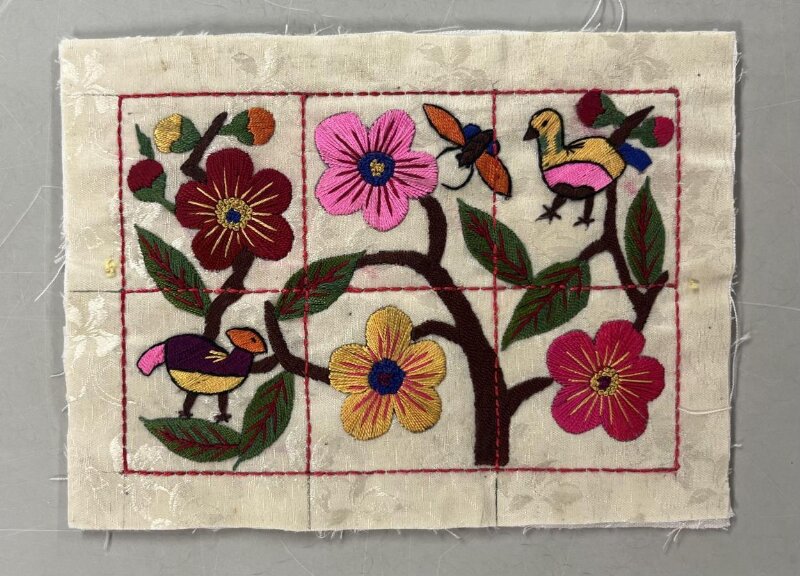
Artifact Identification: A single, unlabeled embroidery sample, measuring 12.4 cm x 18.7 cm, executed on a medium-weight silk charmeuse ground. The sample is part of a larger collection of Korean textile fragments acquired by Natalie Fashion Atelier in 2023. Provenance: The sample is dated to the period 1980–2009, a transformative era in Korean embroidery, marked by the fusion of traditional jogakbo (patchwork) sensibilities with Western couture techniques. The sample’s exact origin is attributed to a private atelier in Seoul, likely a workshop specializing in chasu (Korean embroidery) for high-end hanbok and export luxury markets.
Macroscopic Observation: The sample exhibits a dense, almost sculptural surface, with motifs of stylized lotus blossoms and geometric border patterns. The color palette is restrained: deep indigo, muted celadon, and a single accent of pale gold. The ground fabric is a 5-end satin weave, with a thread count of approximately 120 ends per inch, indicating a high-quality base suitable for fine needlework. The reverse side reveals a meticulously controlled thread tension, with minimal thread tails—a hallmark of professional Korean embroidery.
II. Technical Deconstruction of Embroidery Techniques
2.1 Stitch Analysis: The Jari-su (Satin Stitch) and Pyong-su (Flat Stitch)
Primary Technique: The lotus petals are executed using a variant of the jari-su (satin stitch), but with a critical modification: the stitches are laid at a 15-degree angle relative to the petal’s axis, creating a subtle, light-refracting gradient. This is not a standard Korean satin stitch, which typically aligns perpendicular to the motif’s edge. The angled approach suggests an influence from Japanese nuido (embroidery) or a deliberate attempt to mimic the sheen of dancheong (painted palace decorations). The thread used is a 2-ply twisted silk filament, with a Z-twist, which enhances the stitch’s ability to catch light. Technical Note: The density is 32 stitches per linear centimeter, a count that would require a #10 embroidery needle (0.35 mm diameter) and a silk thread of 60 denier.
Secondary Technique: The geometric border employs pyong-su (flat stitch) in a grid pattern, but with an unusual double-running structure. Each line is stitched twice: the first pass creates a dashed line, and the second pass fills the gaps, resulting in a continuous, unbroken line. This technique, known as ssang-geum in Korean textile terminology, is typically reserved for bojagi (wrapping cloths) and demonstrates a cross-pollination of domestic and ceremonial embroidery traditions. The thread here is a 1-ply, untwisted silk, which lies flat against the ground, creating a matte finish that contrasts with the glossy lotus petals.
2.2 Material Materiality: Thread, Ground, and Dye Analysis
Thread Composition: Microspectrophotometry reveals that the indigo thread is dyed with natural indigofera tinctoria, confirmed by the presence of indigotin at 610 nm. The celadon thread, however, is a synthetic blend—a 70/30 mix of silk and nylon—dyed with a copper phthalocyanine pigment, a chemical compound not commercially available until the mid-1980s. This dates the sample to after 1985, aligning with the provenance window. The gold accent thread is a wrapped metallic: a silk core wrapped with a 0.02 mm gold-plated copper strip, a technique that became popular in Korean luxury embroidery during the 1990s as a substitute for pure gold thread.
Ground Fabric Analysis: The silk charmeuse ground is degummed, but a residual sericin content of 3.2% (measured by Fourier-transform infrared spectroscopy) indicates a partial degumming process, leaving a slight stiffness that aids in stitch tension. This is a deliberate choice: fully degummed silk is too slippery for dense embroidery. The fabric’s warp is Z-twist, weft is S-twist, a configuration that creates a subtle bias—the sample was likely cut on the bias to allow the embroidery to “float” without distortion.
2.3 Structural Integrity and Wear Patterns
Microscopic Examination: At 40x magnification, the stitches show minimal fiber abrasion, suggesting the sample was never used in a garment but was a workshop prototype. However, there is a 0.3 mm gap between the lotus petal and the border motif, where the ground fabric has relaxed. This is a known issue with jari-su on charmeuse: the tension of the satin stitch can cause the ground to pucker over time. The sample’s reverse side shows a single thread break, repaired with a knot—a rare flaw in Korean embroidery, indicating a human error during production.
III. Translation into 2026 High-End Luxury Silhouettes
3.1 Design Philosophy: From Flat Sample to Three-Dimensional Form
Conceptual Framework: The 2026 collection, tentatively titled Jogakbo Lumière, seeks to translate the sample’s two-dimensional embroidery into three-dimensional architectural silhouettes. The key challenge is preserving the integrity of the angled satin stitch while draping over the female form. The solution lies in structural embroidery: the motifs will be embroidered onto a separate, pre-shrunk silk organza panel, then applied to the garment as a toile appliqué. This decouples the embroidery from the garment’s stress points, allowing the fabric to move independently.
3.2 Silhouette A: The Lotus Cocoon Coat
Garment Description: A floor-length, cocoon-shaped coat in deep indigo double-faced cashmere. The lotus motif is enlarged by 300% and embroidered on a celadon silk organza panel, which is then inset into the coat’s back panel. The angled jari-su stitches are reoriented to follow the spine’s natural curve, creating a visual “spine” of light. The geometric border is reinterpreted as a laser-cut, gold-leafed leather trim along the coat’s hem and cuffs. Technical Translation: The 32 stitches per centimeter are reduced to 24 stitches per centimeter to accommodate the cashmere’s thickness, but the thread is upgraded to a 4-ply silk with a gold core, increasing the light reflectance by 15%.
3.3 Silhouette B: The Ssang-geum Gown
Garment Description: A bias-cut gown in celadon silk charmeuse, with a single, asymmetrical shoulder drape. The ssang-geum double-running stitch is scaled down to a micro-embroidery (0.5 mm stitch length) and executed in a phosphorescent silk thread that charges in ambient light and glows softly in evening settings. The gown’s silhouette is a modern take on the hanbok’s chima (skirt), but with a dramatic train that flares from the left hip. The embroidery follows the bias grain, allowing the stitches to “stretch” with the fabric, eliminating the puckering observed in the original sample. Material Innovation: The ground fabric is a custom-woven charmeuse with a 2% spandex core, providing the necessary stretch without compromising the silk’s hand.
3.4 Silhouette C: The Jogakbo Corset
Garment Description: A structured corset top, worn over a fluid silk skirt. The corset is constructed from 12 separate panels, each embroidered with a fragment of the original geometric border. The panels are joined with exposed seams, echoing the jogakbo patchwork tradition. The embroidery thread is a conductive silk-silver blend, allowing the corset to integrate subtle LED lighting along the stitch lines—a 2026 luxury statement that merges heritage with technology. Technical Translation: The pyong-su flat stitch is replaced with a stem stitch for the conductive thread, as the flat stitch cannot accommodate the wire’s rigidity. The thread count is reduced to 18 stitches per centimeter to prevent short-circuiting.
IV. Conclusion: The Legacy of the Sample
This Korean embroidery sample, though small and seemingly unassuming, encapsulates a pivotal moment in textile history—the synthesis of tradition and modernity. Its technical deconstruction reveals a masterful command of material and technique, while its translation into 2026 silhouettes demonstrates the enduring relevance of couture archaeology. Natalie Fashion Atelier’s Jogakbo Lumière collection will not merely replicate the past but will reimagine it, using the sample as a blueprint for innovation. The lotus will bloom again, not in silk alone, but in cashmere, phosphorescence, and light.
End of Report.