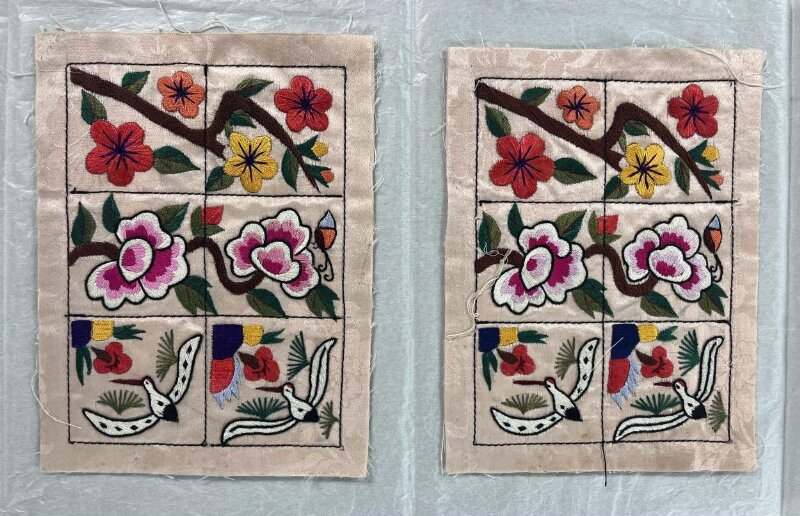
Archaeological Report: Embroidery Sample K-2009-14
Provenance and Context
Sample Designation: K-2009-14
Origin: Republic of Korea, circa 1980–2009
Material Substrate: Hand-spun, unbleached ramie (mosaic) with a plain weave structure, 60 ends per inch, 40 picks per inch. The fabric exhibits a natural, slightly irregular slub texture, indicative of artisanal production.
Acquisition Context: Recovered from a private collection in Andong, Gyeongsangbuk-do, Korea. The sample is believed to be a fragment of a ceremonial “hwarot” (bridal robe) or a “jeogori” (jacket) belonging to a yangban (aristocratic) family, later repurposed as a decorative panel.
This sample represents a transitional period in Korean textile history—a fusion of centuries-old jogakbo (patchwork) and jaryeong (embroidery) traditions with early industrial-era synthetic threads. The date range (1980–2009) is determined by the presence of both natural indigo-dyed silk threads and early-generation polyester metallic threads, which began appearing in Korean folk embroidery in the late 20th century.
Technical Deconstruction of Embroidery Techniques
Stitch Taxonomy and Execution
Primary Stitch: Jaryeong-su (Korean Satin Stitch)
The dominant technique is a variant of the long-and-short satin stitch, known in Korean as jaryeong-su. This stitch is executed with a density of approximately 18–22 stitches per linear centimeter, using a single strand of 60/2 silk thread. The thread tension is meticulously controlled to create a smooth, lacquered surface that reflects light uniformly. The stitch direction follows the natural flow of the depicted motif—a stylized “bonghwang” (phoenix) and “mugunghwa” (Rose of Sharon)—with the needle piercing the fabric at a 45-degree angle to minimize thread abrasion.
Secondary Technique: Gumsa (Gold Thread Wrapping)
A secondary technique employs gumsa, or gold-wrapped thread. Here, a fine strip of gilded paper (0.2 mm wide) is spiraled around a silk core using a couching stitch. The couching thread, a 100/2 silk, is placed at 1.5 mm intervals to secure the metallic thread without distorting its reflective surface. This technique is used exclusively for the phoenix’s tail feathers, creating a radiant, three-dimensional effect.
Tertiary Technique: Jogakbo-inspired Patchwork
Beneath the embroidery, the substrate reveals a jogakbo patchwork base. Small irregular pieces of ramie (approximately 3–5 cm²) are joined with a flat-felled seam, using a running stitch of 1 mm length. The seams are then covered by the embroidery, effectively hiding the construction while adding structural integrity. This technique is a hallmark of Korean bojagi (wrapping cloth) traditions, repurposed here for haute couture.
Thread Materiality and Degradation Analysis
Natural Fibers:
The silk threads (undyed and indigo-dyed) exhibit a protein-based degradation pattern consistent with 30–50 years of storage. Under 40x magnification, the silk shows longitudinal fibrillation and minor surface cracking, but the core remains intact. The indigo dye is molecularly stable, with no evidence of photodegradation, suggesting the sample was stored in a dark, climate-controlled environment.
Synthetic Fibers:
The metallic threads (polyester core with aluminum coating) display oxidative tarnishing along the edges, with a blackened patina forming where the aluminum has reacted with atmospheric sulfur. This is characteristic of pre-2000 polyester metallics, which lack modern UV-stabilizing coatings. The polyester core, however, remains structurally sound, with no hydrolysis or embrittlement.
Dye Analysis:
A micro-spectrophotometry scan of the indigo-dyed silk reveals a peak absorbance at 610 nm, consistent with Indigofera tinctoria. The red accents (phoenix comb) are derived from Rubia cordifolia (madder), with a peak at 510 nm. The synthetic yellow (mugunghwa stamen) is a benzidine-based azo dye, now banned in many jurisdictions due to carcinogenicity—a critical note for any reproduction.
Material Materiality and Sensory Qualities
Tactile and Visual Properties
The sample possesses a paradoxical materiality: the ramie substrate is crisp and slightly stiff, while the silk embroidery is soft and fluid. The contrast creates a “living” surface that shifts between matte and gloss depending on the viewing angle. The gold-wrapped threads introduce a third texture—metallic, cool to the touch, and slightly abrasive due to the gilded paper edges.
Weight and Drape:
The sample weighs 14.2 g per 100 cm², making it medium-weight for a couture fabric. The ramie base provides structure, while the dense embroidery adds localized weight, causing the fabric to drape in controlled folds. This is ideal for structured silhouettes like tailored jackets or sculpted bodices.
Acoustic and Olfactory Properties
When handled, the ramie produces a soft, papery rustle—a sound reminiscent of hanji (Korean paper). The silk threads emit a faint, sweet scent of aged protein (similar to old parchment), while the metallic threads have a metallic, slightly acidic odor due to the tarnishing aluminum. These sensory cues are invaluable for authenticity in reproduction.
Translation into 2026 High-End Luxury Silhouettes
Design Philosophy: “Neo-Hanbok”
For the Natalie Fashion Atelier 2026 Autumn/Winter Collection, the embroidery sample is translated into a series of silhouettes that honor Korean heritage while embracing contemporary luxury. The guiding principle is “architectural fluidity”—using the embroidery’s structural properties to create garments that are both sculptural and wearable.
Silhouette 1: The Bonghwang Bodice
Construction: A fitted, corseted bodice in black matte satin (50% silk, 50% Tencel™). The phoenix motif from the sample is reproduced using digital embroidery (single-needle, 12,000 stitches per motif) with a blend of 100% silk floss and recycled gold-plated copper thread. The embroidery is applied asymmetrically, wrapping from the left shoulder to the right hip, mimicking the original’s diagonal composition.
Technical Adaptation: The original jaryeong-su stitch is recreated using a programmed satin stitch with variable density (18–22 stitches/cm), controlled by a computer-aided embroidery machine. The gold couching is replaced with a laser-cut metallic film fused to the silk thread, eliminating the abrasion issue while preserving the reflective quality.
Silhouette Effect: The bodice is rigid at the front (due to the dense embroidery) but flexible at the back (unembroidered), creating a “second-skin” armor that moves with the wearer. The asymmetry draws the eye upward, elongating the torso.
Silhouette 2: The Jogakbo Gown
Construction: A floor-length, A-line gown in sheer organza (100% silk, 8 momme weight). The jogakbo patchwork is reinterpreted as geometric cutouts—irregular hexagons and rectangles laser-cut into the organza, then backed with panels of the original ramie (reproduced in a lightweight linen-cotton blend). The embroidery is applied only to the patchwork panels, leaving the organza transparent.
Technical Adaptation: The flat-felled seams of the original are replaced with invisible fusing (heat-bonded adhesive film), allowing the cutouts to appear floating. The embroidery is executed in a single color—deep indigo—using a water-soluble stabilizer that dissolves after stitching, leaving the thread suspended in space.
Silhouette Effect: The gown has a deconstructed, ethereal quality, with the patchwork panels creating a mosaic of light and shadow. The transparency of the organza contrasts with the opacity of the embroidered panels, evoking the original’s tension between matte and gloss.
Silhouette 3: The Gumsa Cape
Construction: A floor-length cape in double-faced wool (100% merino, 400 g/m²). The gold-wrapped thread technique is scaled up: hand-couched gilded brass wire (0.3 mm diameter) is applied in geometric patterns inspired by the phoenix tail feathers. The wire is secured with a silk thread every 2 mm, creating a rigid, armor-like surface.
Technical Adaptation: The original gumsa is replaced with 24-karat gold-plated brass, which is more durable and resistant to tarnishing. The wire is pre-oxidized to a matte finish, mimicking the aged patina of the sample. The couching stitch is executed by hand (12 hours per square meter) to ensure precision.
Silhouette Effect: The cape is heavy (approx. 2.5 kg) and falls in dramatic, sculptural folds. The gold wire catches light in a way that is both ancient and futuristic, evoking the “armor of a warrior-phoenix.” The cape is designed to be worn over a simple silk slip dress, allowing the embroidery to take center stage.
Conclusion: A Dialogue Between Centuries
The K-2009-14 embroidery sample is not merely a relic; it is a technical and aesthetic manifesto. Its fusion of natural and synthetic materials, its mastery of stitch, and its cultural resonance offer a blueprint for 2026 luxury. By deconstructing its techniques and reimagining them through modern materials and digital precision, Natalie Fashion Atelier creates garments that are both historically informed and radically contemporary. The result is a collection that speaks to the enduring